Home
>>
Antibody Platform
>>
Custom Antibody Platform
>>
Monoclonal Antibody Production
Download Center
Quick Inquiry & Consultation

Monoclonal Antibody ProductionIntroduction

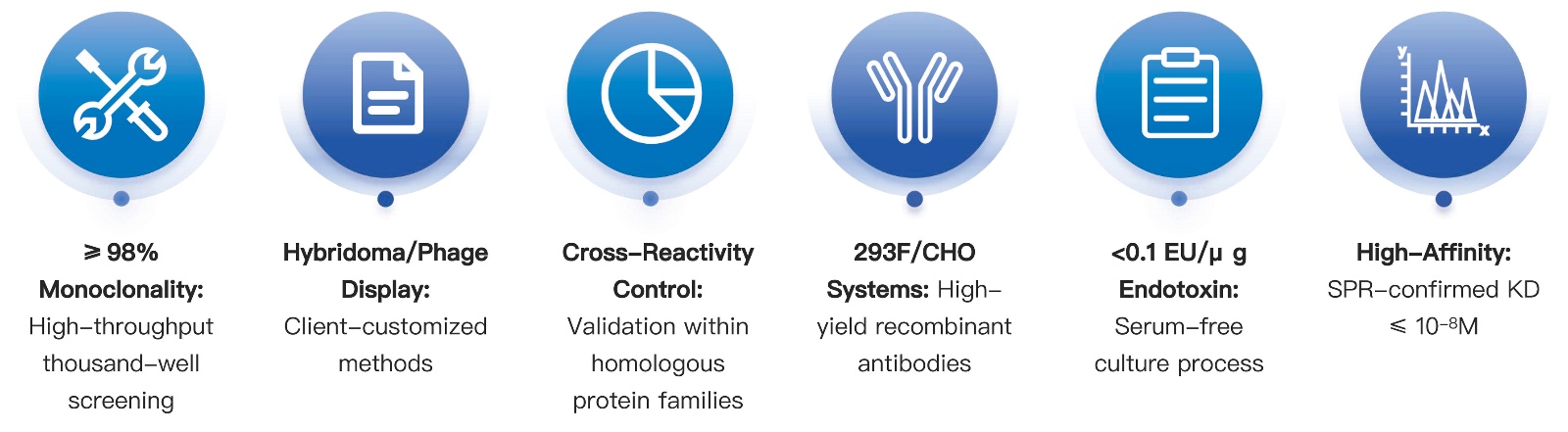
Monoclonal Antibodies (mAb) offer significant advantages including high specificity, minimal batch-to-batch variation, and virtually no cross-reactivity. KMD Bioscience provides premium Monoclonal Antibody Production services. Our experienced technical team, with years of expertise in Antibody Production, continuously optimizes the workflow to deliver high-quality antibodies rapidly, accumulating substantial experience in Monoclonal Antibody Production. The delivered antibodies are suitable for downstream applications such as IP, Co-IP, ELISA, and IHC.

To meet diverse client needs, KMD Bioscience offers two Monoclonal Antibody Production strategies. One utilizes traditional cell fusion technology, producing monoclonal antibodies via hybridoma generation from fusions including mouse-mouse, mouse-rat, or mouse-guinea pig cells, as well as fully human hybridomas. The alternative strategy employs species-independent Phage Display Antibody Library technology to construct hybridoma monoclonal antibodies. We provide comprehensive, one-stop services from gene synthesis through antibody production and characterization, and also offer high-quality Recombinant Antibody Production services.
Monoclonal Antibody Production via Traditional Hybridoma Technology

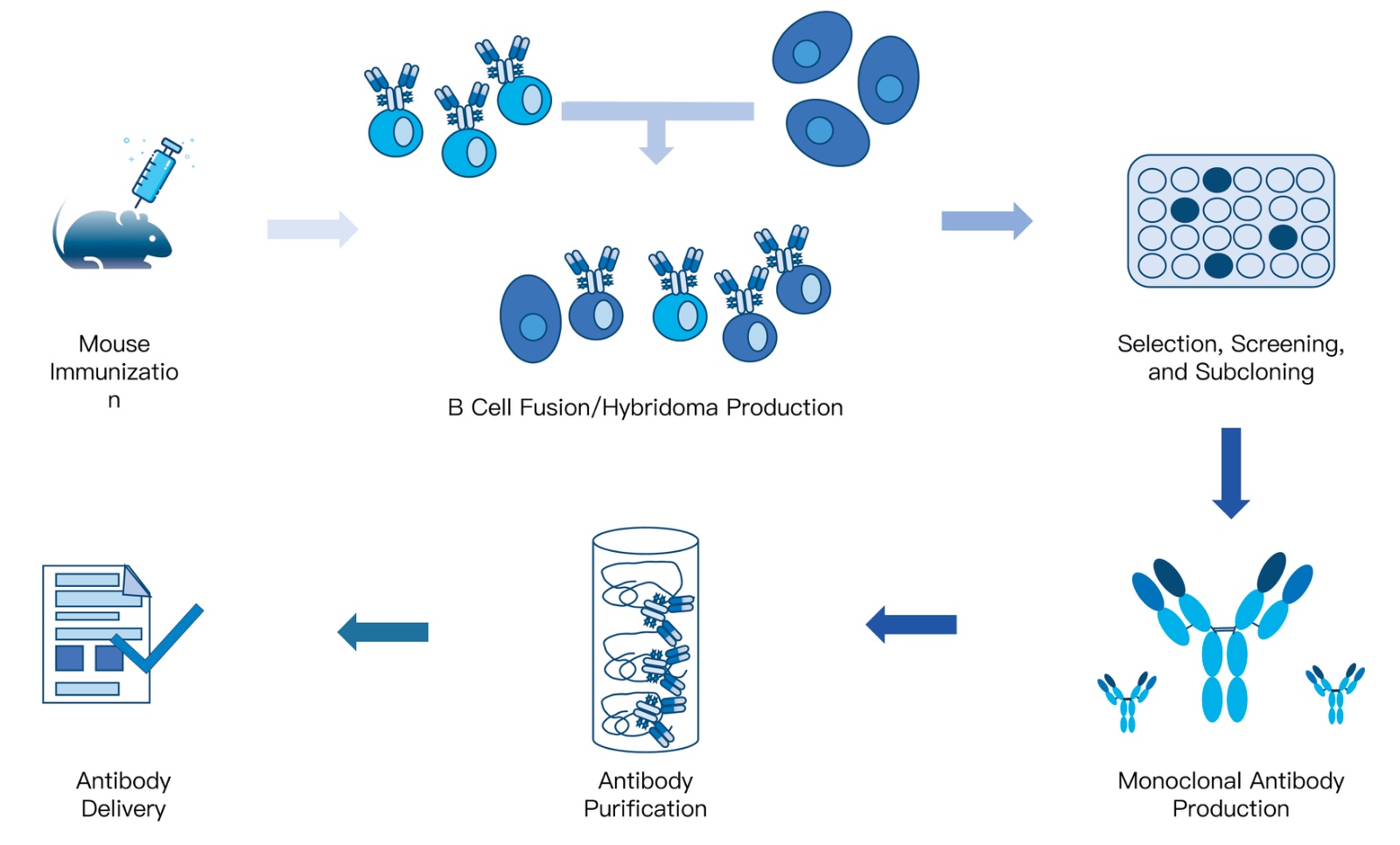
Traditional monoclonal antibody (mAb) technology refers specifically to the fusion of myeloma cells with antibody-secreting B lymphocytes (excluding fully human mAb preparation techniques), resulting in hybridoma cells that secrete monoclonal antibodies. Due to their action on only a single antigenic determinant (epitope) on an antigen complex, mAbs exhibit high specificity and high potency. Monoclonal antibodies have extremely wide-ranging applications in biological and medical research.

56-KMDBioscience-monoclonal-antibody-development-services.jpg

During the Animal Immunization Phase, clients can directly provide us with small molecules, peptides, modified peptides, proteins, fusion proteins, or modified proteins as antigens for Monoclonal Antibody Production. Leveraging this technology, KMD Bioscience can provide clients with the following Monoclonal Antibody Production services: Mouse Monoclonal Antibody Production Service, Small Molecule Antibody Production, and Rabbit Monoclonal Antibody Production.

Monoclonal Antibody Production Using Phage Display Antibody Library Technology

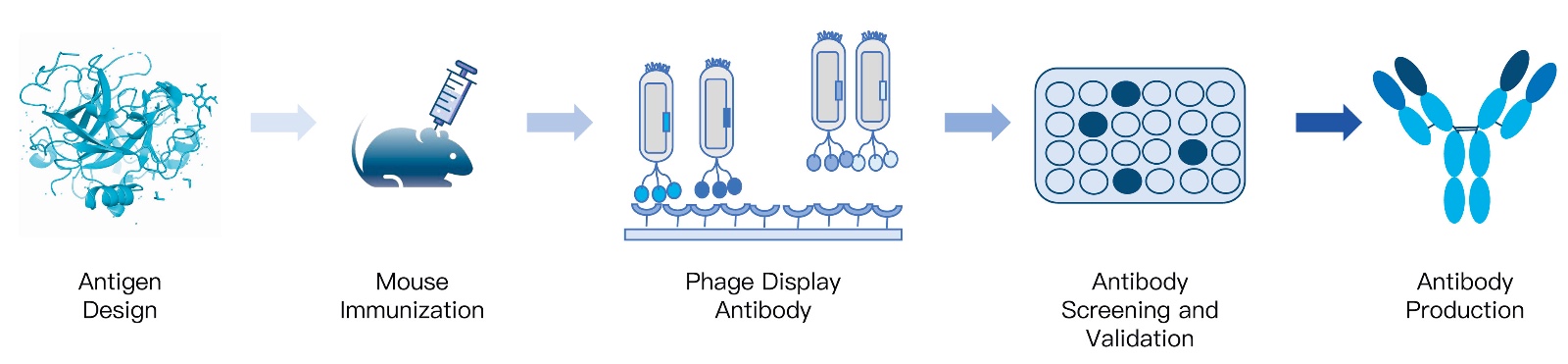
Phage display technology streamlines Antibody Library Construction by eliminating the cell fusion step, avoiding the tedious process of repeated subcloning due to hybridoma instability. Simultaneously, it significantly increases Library Capacity, elevating it from thousands of clones typical with hybridoma technology to 106. Additionally, phage display allows for the direct acquisition of antibody genes, facilitating the subsequent construction of diverse genetically engineered antibodies.

KMD Bioscience leverages Phage Antibody Library Technology to customize Monoclonal Antibodies derived from a wide range of species for clients, including human, mouse, rabbit, chicken, sheep, pig, cow, horse, donkey, camel, alpaca, and shark.

57-KMDBioscience-monoclonal-antibody-development-services.jpg

Furthermore, utilizing M13 filamentous phage coat proteins pIII and pVIII display technologies, we construct either Naive or Immunized Phage Antibody Display Libraries for different species, achieving library capacities of up to 1011. We have currently established and refined this technology platform, enabling us to provide Recombinant Monoclonal Antibody services for multiple species through Phage Antibody Display Technology.

Advantages of Monoclonal Antibody Production Services

58-KMDBioscience-monoclonal-antibody-development-services.jpg

Recommended Services

KMD Bioscience has established and refined its antibody development and preparation technology platform. We provide Monoclonal Antibody Production Services for a diverse range of species.

Login

Don’t have an account?Sign Up Now

Register

Already have an account?Log In Now