Home
>>
Technical Platform
>>
Plant Genetic Transformation Platform
>>
Cucurbitaceae Genetic Transformation
Download Center
Quick Inquiry & Consultation
Cucurbitaceae Genetic TransformationIntroduction

Cucurbitaceae plants include various species such as melon, watermelon, and cucumber. The fruits of these plants are typically fleshy and rich in water and various nutrients. Watermelon, as one of the Cucurbitaceae plants, can be classified into diploid, tetraploid, and triploid seedless watermelons. It offers numerous health benefits and economic value and is one of the most consumed fruits worldwide. Cucumber, a climbing or trailing herbaceous plant, is also an important component of the global vegetable market. Melon, belonging to the genus Cucumis in the family Cucurbitaceae, occurs in diploid and tetraploid forms and is one of the widely cultivated crops worldwide with significant economic value.

KMD Bioscience possesses a professional technical team in the field of Cucurbitaceae plant genetic transformation and has continuously optimized transformation conditions to improve transformation efficiency. For watermelon, Agrobacterium strain EHA105 is used to infect cotyledons, with kanamycin as the selection marker gene, achieving a relatively high transformation rate. Melon transformation generally faces challenges such as difficulties in delivering transformation vectors into cells, low shoot regeneration rates, and low overall transformation efficiency. The Melon Genetic Transformation System established by us provides customers with rapid, stable, and highly efficient genetic transformation services.
Content

Step

Content

Timeline

Step 1 Gene synthesis and vector construction

Standard vectors

1-2 weeks

Overexpression/RNAi/amiRNA vectors

Gene-editing vectors CRISPR/Cas9 vectors

Step 2 Transformation

Cucumber: Agrobacterium-mediated method (cotyledons).

1-2 months

Watermelon: Agrobacterium-mediated method (cotyledons).

Melon: Agrobacterium-mediated method (cotyledons).

Step 3 T0 generation plants

Differentiate and culture resistant shoots, transfer to rooting medium.

Consultation required

Step 4 PCR identification of T0 generation plants

Perform PCR identification of target genes in regenerated T0 plants and transfer positive plants to cultivation soil.

1 week

Step 5 Biological testing or phenotypic analysis of regenerated T0 plants (optional)

Perform physiological testing or functional analysis of T0 plants.

Consultation required

Deliverables: Positive T0 seedlings from standard transformation: ≥10 plants;  Positive T0 seedlings with successful mutations from gene-editing vector transformation: ≥5 plants; Experimental data and images; Standard genetic transformation experimental report.

Note: The plant organs listed in parentheses are commonly used explants for transformation. Customers may request other explants for transformation.

-- Available varieties: Watermelon (default: Jingxin), melon (default: Queen), cucumber (default: Green cucumber).

-- Customers may specify other varieties as needed or request T1 generation seeds. Please consult our technical staff for details.

-- Vectors: pBin series, pCAMBIA series.

-- Deliverables include positive plants, experimental data, images, and a standard genetic transformation report.

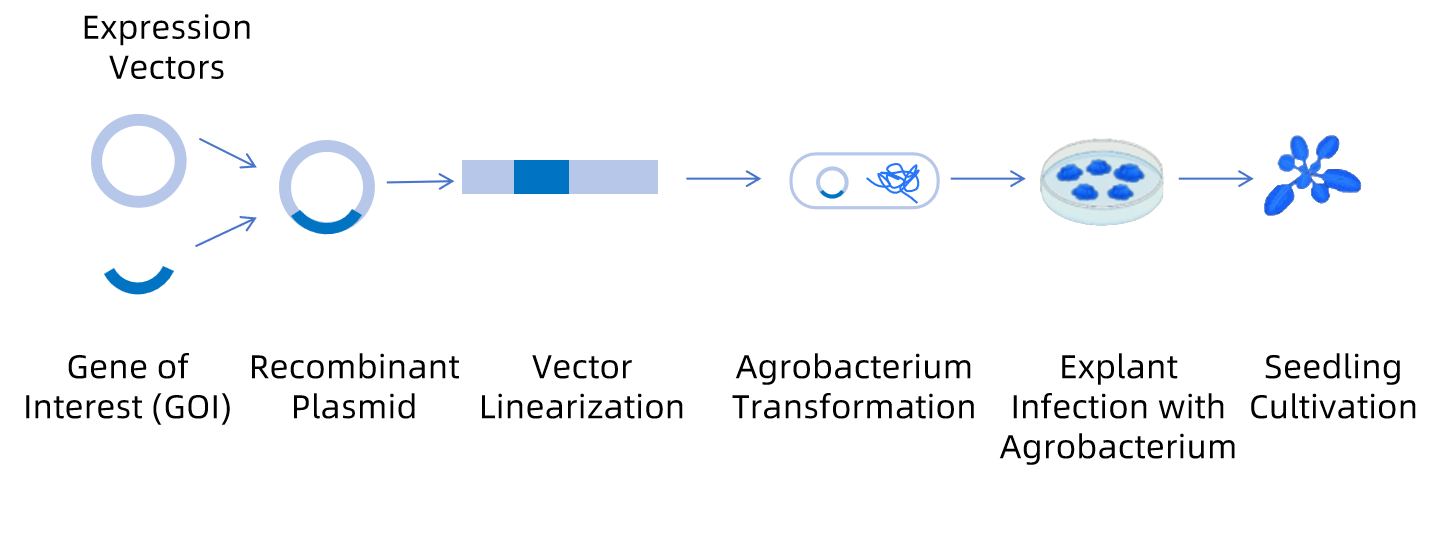
Process

图片49.png

Advantage

-- Efficient experimental workflow, unrestricted by plant material; aseptic seedlings of commonly used plants for genetic transformation are maintained year-round, enabling experiments to begin at any time.

-- Utilizes Agrobacterium-mediated transformation, which is rapid, efficient, stable, and primarily single-copy insertion. It supports various eukaryotic resistance markers such as hygromycin, G418, Basta, and kanamycin.

-- Seedling acclimatization services are available to support customers’ subsequent research.

-- Project traceability: Regular reporting ensures remote tracking of experimental progress and transparent project management.

Frequently Asked Questions

1.What are the key factors in optimizing the watermelon genetic transformation system?

Answer: Seed storage time: affects seed vigor and transformation efficiency. Genotype: different genotypes significantly impact transformation efficiency. Seedling age and explant type: influence callus induction and differentiation. Hormone combination and culture conditions: for example, the concentrations of 6-BA and IBA significantly affect the induction rate of adventitious shoots.


2.How to identify transgenic watermelon plants?

Answer: Kanamycin screening combined with DsRed fluorescence labeling can be used to rapidly identify positive transgenic watermelon plants.


3.How to identify transgenic melon plants?

Answer: Positive T0 transgenic melon seedlings can be identified by dual detection using glufosinate-ammonium reagent and PCR.

Login

Don’t have an account?Sign Up Now

Register

Already have an account?Log In Now