Home
>>
Antibody Platform
>>
Innovative Drug Discovery Platform
>>
Antibody Affinity Maturation Service

Antibody Affinity Maturation ServiceIntroduction

KMD Bioscience has been dedicated to antibody research for many years. Affinity is a critical parameter for antibody therapeutics, typically influencing both antibody function and efficacy. Affinity often decreases after antibody humanization. Therefore, restoring the affinity of humanized antibodies or elevating it to higher levels is a necessary step. In vitro affinity maturation technology is a commonly used technique to improve the affinity of antibodies for their antigens.

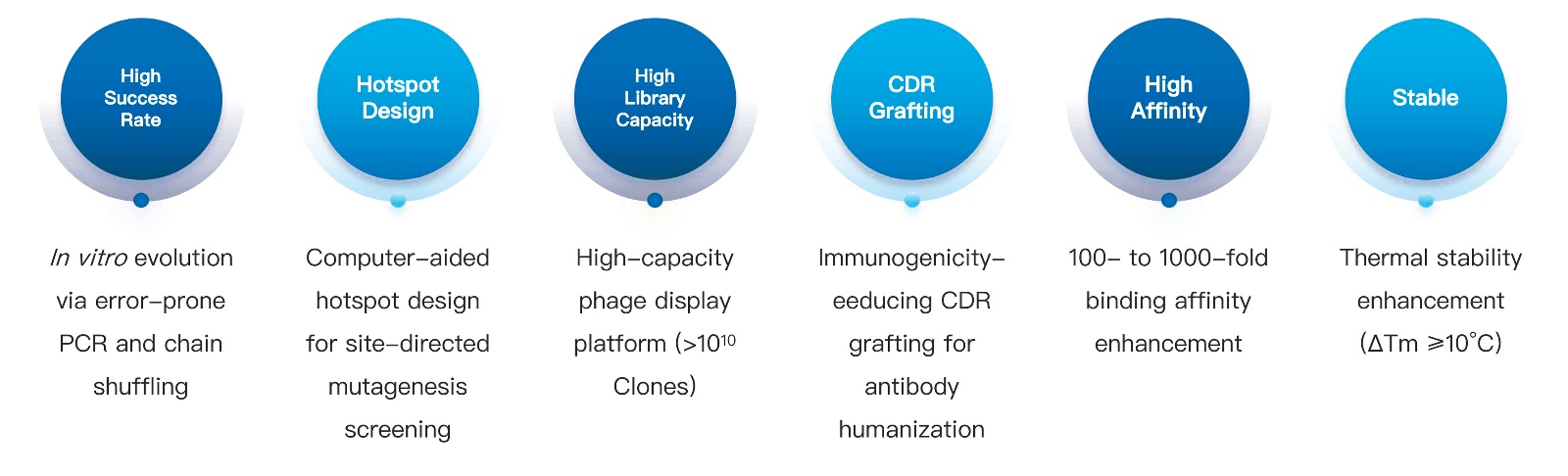
KMD Bioscience provides clients with multi-species Antibody Affinity Maturation Services based on our proprietary phage display antibody library technology. Staffed by a highly skilled antibody team with extensive experience in antibody affinity maturation, we can enhance the affinity of client-provided monoclonal antibodies by 2 to 3 orders of magnitude, achieving levels of up to 10-9 M.

Leveraging phage display technology, KMD Bioscience focuses on delivering comprehensice research services, including Phage Antibody Library Construction and Screening, Antibody Humanization, Human Fab Antibody Library Construction, Human scFv Antibody Library Construction, and Phosphorylation-specific Antibody Development. We can customize suitable experimental protocols for clients.
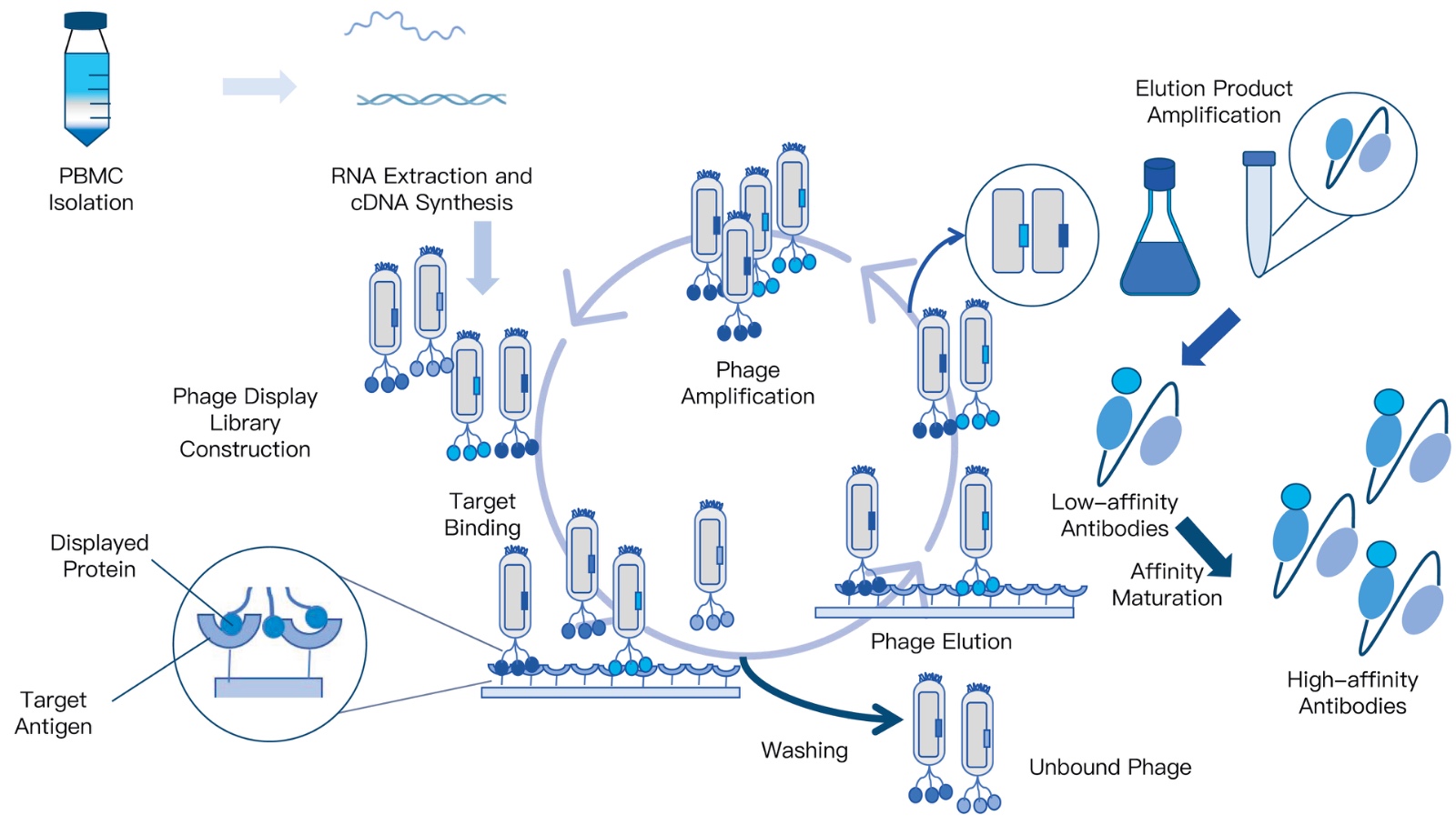
Phage Display Antibody Library Technology - Antibody Affinity Maturation Service

Affinity Maturation refers to the process where, upon encountering foreign antigens, B lymphocytes undergo antibody gene rearrangement accompanied by somatic hypermutation in the hypervariable CDR regions. This generates B lymphocytes secreting antibodies with varying affinities. Subsequently, B cells with low affinity undergo cell death, while those with high specificity and affinity survive and recognize the foreign antigens.

KMD Bioscience utilizes Phage Display Antibody Library Technology, combined with Error-prone PCR and Site-directed Mutagenesis, to mimic this somatic hypermutation process. KMD Bioscience's technical advantage lies in its capability for in vitro rapid mutation, enabling the construction of antibody phage display libraries exceeding 1010 independent clones. This facilitates the rapid identification of antibodies with high specificity and affinity for the target antigen.

Antibody Affinity Maturation Service Workflow

63-KMDBioscience-antibody-affinity-maturation-services.jpg

Common Antibody Affinity Maturation Techniques in Vitro

During in vitro Antibody Affinity Maturation, selecting the mutation region and the method for introducing mutations are critical issues. Current mutation strategies are primarily categorized into three classes: Random Mutagenesis, CDR Mutagenesis and Site-Directed Mutagenesis, and Error-prone PCR.

Type

Characteristics

Error-Prone PCR

* This is a commonly used antibody mutagenesis technique that can randomly introduce mutations throughout the entire antibody gene or within specific regions. During polymerase amplification of the target gene, mutations are randomly introduced at a certain frequency by employing low-fidelity polymerases or adjusting reaction conditions. Multiple rounds of PCR are performed to iteratively introduce random mutations, accumulating the mutational effects, ultimately yielding random mutants of the target protein.

Chain Shuffling

* Chain shuffling involves retaining either the heavy chain or light chain of a specific antibody, while pairing it with a randomized complementary chain. Higher-activity mutants are then selected through screening of the phage antiboyd library.

Site-directed Mutagenesis

* Somatic hypermutation occurs predominantly in the CDR regions, which directly contact the antigen. During in vitro antibody affinity maturation, the CDR regions are frequently chosen for site-directed mutagenesis. When performing site-directed mutagenesis on CDRs, multiple CDRs can be mutated in parallel or optimized sequentially.

DNA Shuffling

* DNA Shuffling Technology involves cleaving homologous antibody genes into fragments not exceeding 50 bp using DNase I. These fragments are then randomly reassembled and amplified by PCR into full-length antibody genes.

Delivery Result

Delivery Content

Affinity-Optimized Antibody Sequences

High-Affinity Purified Antibodies

Complete experimental reports and data: including results such as SDS-PAGE and affinity analysis.


Service Advantage

64-KMDBioscience-antibody-affinity-maturation-services.jpg

Login

Don’t have an account?Sign Up Now

Register

Already have an account?Log In Now