Home
>>
Technical Platform
>>
Plant Genetic Transformation Platform
>>
Legume Genetic Transformation
Download Center
Quick Inquiry & Consultation
Legume Genetic TransformationIntroduction

Leguminous plants are well known for their unique nodules and ability to perform biological nitrogen fixation, possessing significant economic and ecological value. Common leguminous plants include soybean, peanut, and alfalfa. Soybean, as a key economic crop, is rich in seed oil and protein, providing substantial nutritional and economic value. Alfalfa is a perennial Leguminous Plants characterized by high biomass yield, excellent nutritional quality, and broad adaptability.

KMD Bioscience has extensive experience in the genetic transformation of leguminous plants. For soybean transformation, both gene gun and Agrobacterium-mediated methods are available. In the gene gun method, shoot apical meristems or embryogenic suspension cells are used as explants and bombarded with the gene gun. In the Agrobacterium-mediated method, cotyledonary node axillary meristems are used as explants and infected with Agrobacterium carrying the target gene. Resistant buds are then obtained through antibiotic screening and further differentiated into transgenic lines.

Content

Steps

Content

Timeline

Step 1 Gene synthesis and vector construction

Standard vectors

1-2 weeks

Overexpression/RNAi/amiRNA vectors

Gene-editing vectors CRISPR/Cas9 vectors

Step 2 Transformation

Soybean: Agrobacterium-mediated (cotyledonary nodes), Gene gun (shoot apical meristem/embryogenic suspension cells); Alfalfa: Agrobacterium-mediated (leaves).

1-2 months

Alfalfa: Agrobacterium-mediated method (leaf).

Step 3 T0 Generation Plants

Differentiate and culture resistant shoots, transfer to rooting medium.

Consultation required

Step 4 PCR identification of T0 generation plants

Perform PCR identification of target genes in regenerated T0 plants and transfer positive plants to cultivation soil.

1 week

Step 5 Biological testing or phenotypic analysis of regenerated T0 plants (optional)

Perform physiological testing or functional analysis of T0 plants.

Consultation required

Deliverables: Positive T0 seedlings from standard transformation: ≥10 plants;  Positive T0 seedlings with successful mutations from gene-editing vector transformation: ≥5 plants; Experimental data and images; Standard genetic transformation experimental report.

Note: The plant organs listed in parentheses are commonly used explants for transformation. Customers may request other explants for transformation.

-- Transformable Varieties: Soybean: Default varieties include Jack and Williams82. Alfalfa: Transformable varieties include Spiny Alfalfa (R108), Zhongmu No. 1, Zhaodong Alfalfa, Nongjing No. 1, and Zhongmu No. 3.

-- Customers may specify other varieties as needed or request T1 generation seeds. Please consult our technical staff for details.

-- Vectors: pBI series and pCAMBIA series vectors.

-- Deliverables: Positive transformed plants, experimental data, images, and a standard genetic transformation experimental report.

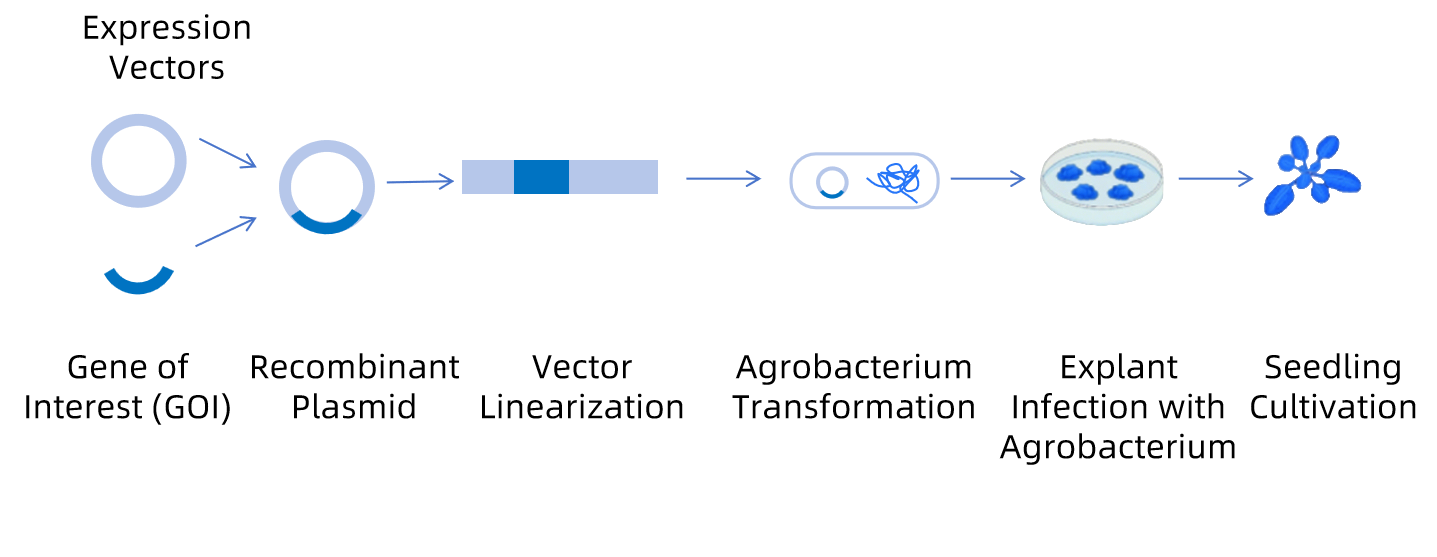
Process

图片49.png

Advantage

-- Efficient experimental workflow, unrestricted by plant material; aseptic seedlings of commonly used plants for genetic transformation are maintained year-round, enabling experiments to begin at any time.

-- Utilizes Agrobacterium-mediated transformation, which is rapid, efficient, stable, and primarily single-copy insertion. It supports various eukaryotic resistance markers such as hygromycin, G418, Basta, and kanamycin.

-- Seedling acclimatization services are available to support customers' subsequent research.

-- Project traceability: Regular reporting ensures remote tracking of experimental progress and transparent project management.

Frequently Asked Questions

1.How to improve the efficiency of plant genetic transformation?

Answer: Choose appropriate explants, such as young leaves, embryo leaves, etc. Optimize transformation conditions, including Agrobacterium concentration and co-cultivation time. Use tissues with strong regeneration ability, such as leaf tissue.


2.How to improve soybean genetic transformation efficiency?

Answer: Modify the Vir gene components. Optimize soybean phenotypic identification and screening methods. Add chemical inducers of Vir gene components in the culture medium to enhance the virulence of Agrobacterium. Methods such as ultrasound, bombardment, and vacuum filtration can increase tissue damage, improving transformation success.


3.Challenges in alfalfa genetic transformation?

Answer: Low transformation efficiency and success rate. Transformation frequency is unstable, and the regeneration period is long. Gene drift may cause closely related wild varieties to acquire the target gene, potentially resulting in “superweeds ”.

Login

Don’t have an account?Sign Up Now

Register

Already have an account?Log In Now