Home
>>
Protein Platform
>>
Protein Expression Services
>>
Recombinant Protein Prokaryotic Expression
Recombinant Protein Prokaryotic ExpressionIntroduction

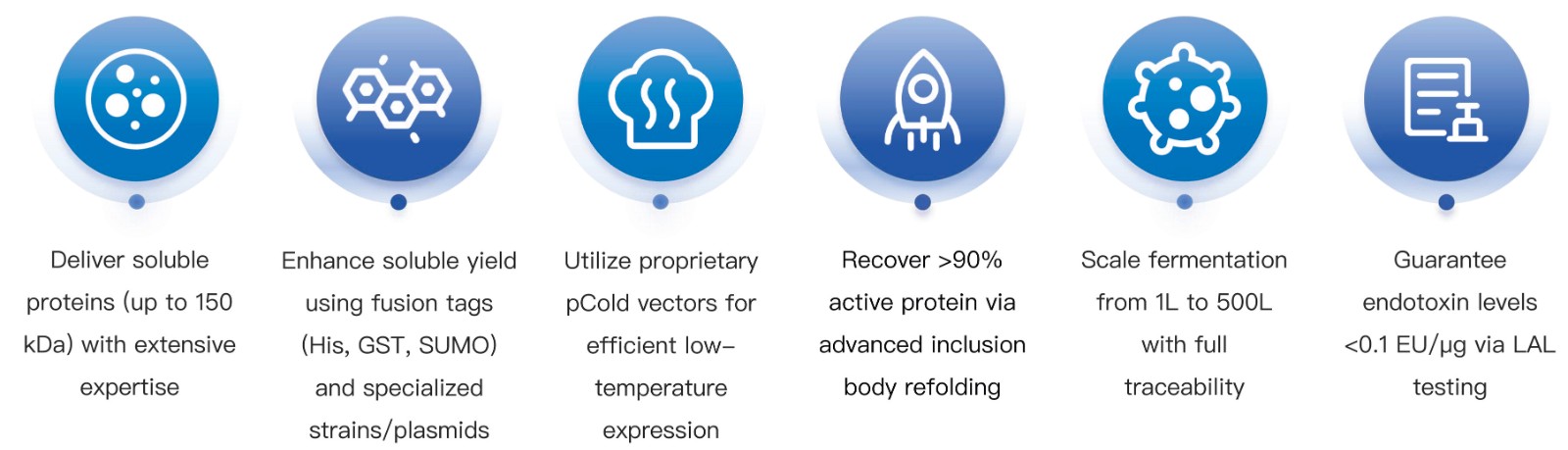
KMD Bioscience has been dedicated to the research and production of recombinant protein prokaryotic expression for many years. With extensive experience in prokaryotic protein expression as well as industrial-scale protein fermentation and purification, we have accumulated technical expertise from over 400 prokaryotic protein production projects annually. Based on this wealth of experience, KMD has designed an effective protein expression vector system, incorporating various fusion tags (His, GST, SUMO, FLAG, etc.), capable of expressing recombinant proteins with molecular weights exceeding 150kDa in soluble form. Additionally, we have established a collection of diverse expression strains, including low-temperature induced strains (for protein expression at 10-16°C), ensuring the high quality of every recombinant protein production. Clients need only provide us with a protein sequence, CDS, or protein name, and our experienced scientists can quickly develop a comprehensive Protein Expression and Purification Plan, providing clients with high-quality services in a short period of time.

Recombinant protein prokaryotic expression has become increasingly mature after years. However, to achieve high levels of soluble protein expression and high yields in the E. coli expression system, especially for large proteins and certain pharmaceutical proteins, a high-quality expression strategy is essential. Common small molecule (molecular weight < 10 kDa) protein-based drugs, such as Leptin, Liraglutide, and EGF, are typically expressed in the prokaryotic system in the form of affinity tags and fusion proteins, followed by fermentation and purification. The challenge with such proteins is that they are often expressed as inclusion bodies -fusion tags, requiring complicated renaturation processes after expression. KMD has developed mature technology and accumulated rich experience in the renaturation of inclusion bodies-fusion tags.
Host System Selection

There are two commonly used prokaryotic expression hosts: Escherichia coli and Bacillus subtilis. A comparison of the two is as follows:


Project

E. coli Expression Host

Bacillus subtilis Expression Host

Advantages

* Widely used, easy to operate, low cost for large-scale production.

* Low production cost, no endotoxin production, capable of secreting expressed proteins.

Disadvantages

* Poor secretion ability

* Relatively low yield

Commonly Used Hosts

* Rosetta (DE3),Rosetta(DE3)pLysS,Rosetta 2(DE3)pLysS,Origami 2(DE3),Rosetta-gami 2(DE3)pLysS.

* WB600,WB800N,Bacillus Subtilis 168.


The choice of plasmid expression system

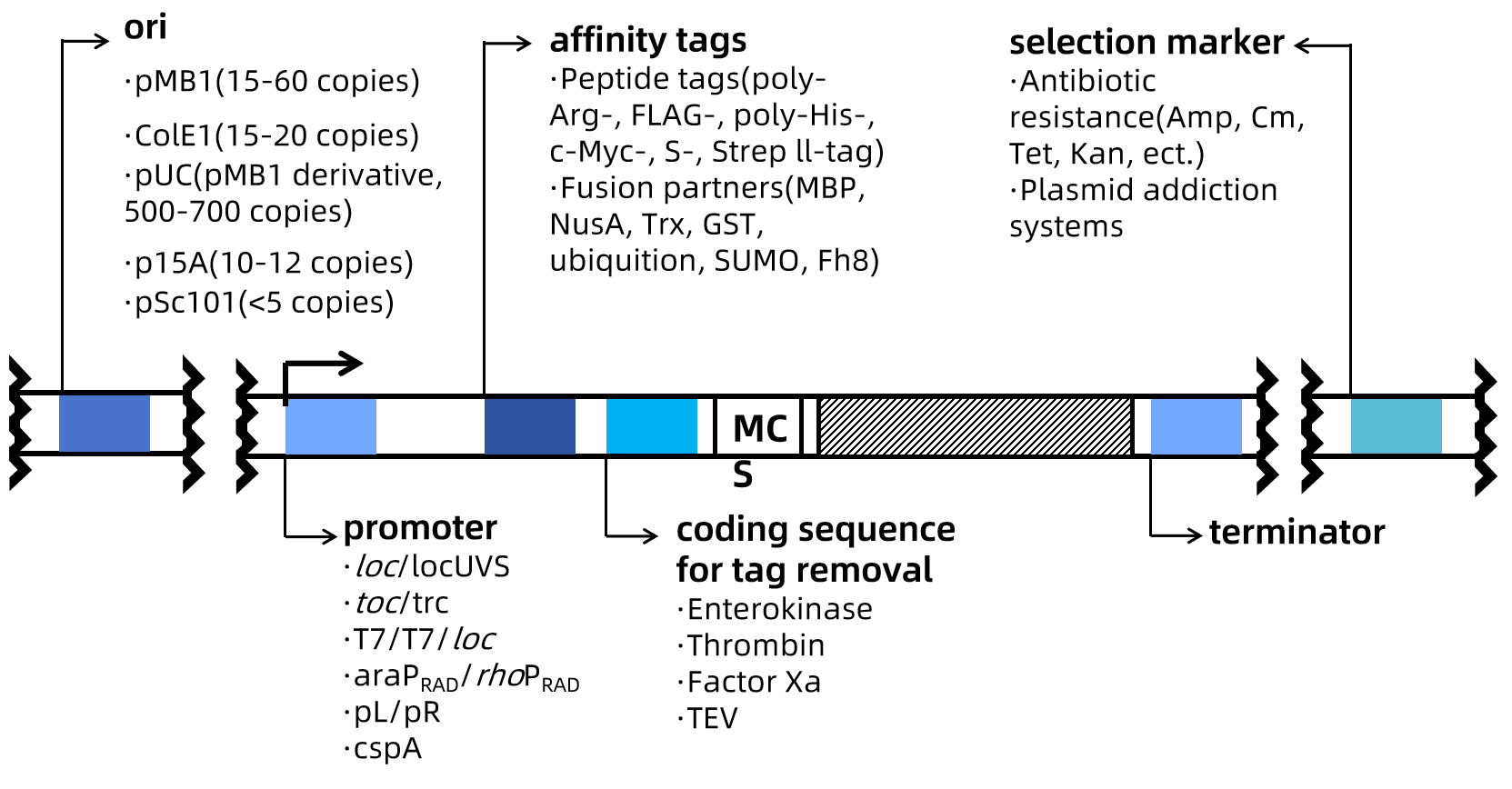
Currently, commonly used recombinant protein expression plasmids integrate various components, including replicons, promoters, selection markers, multiple cloning sites (MCS), and fusion protein removal strategies, as shown in Figure 1:

图片13.png

Figure 1: Prokaryotic Expression Vector Map

Scientists at KMD Bioscience have modified the pET vector to obtain a dual-expression plasmid (BiPlasmid vector), which contains dual MCS sites, dual T7 promoters, dual lac operons, and dual ribosome binding sites. Using this plasmid, we can perform a single transfection operation to achieve independent expression of two proteins. Additionally, we have developed the pCold series vectors, which contain low-temperature induction elements for protein expression. These vectors can express high molecular weight proteins, such as a 150kDa active protein in supernatant, under IPTG induction at 16°C.

Fusion Tag Selection

Affinity Tags: The use of affinity tag fusion in recombinant protein expression serves two main purposes. First, it makes the protein purification process easier. Second, it helps to solubilize certain insoluble proteins. Protein tags can be divided into two categories. One is short peptide tags, and the other is long peptide tags that co-express as fusion proteins (fused partners). The choice of protein tag should be analyzed based on specific cases. KMDhas summarized the properties of some commonly used protein tags, as shown in Table 1.


Table 1: Main Characteristics of Protein Tags

Peptide Tag

Residues/MW
(kDa)

Ligand/Substrate

Purification Conditions

Poly-Arg

~5/0.80

Cation exchange resin

NaCl linear elution (0–400 mM)

Poly-His

~6/0.84

Ni²⁺ agarose column

20–250 mM Imidazole/low pH

FLAG

8/1.01

FLAG antibody affinity agarose column

2–5 mM EDTA

Strep-tag II

8/1.06

Streptavidin

2–25 mM desthiobiotin

c-myc

11/1.20

myc antibody affinity agarose column

low pH

S-tag

15/1.75

S-protein affinity agarose column

3 M Isothiocyanate; 0.2 M potassium citrate, pH 2 or 3 M MgCl₂

Fusion Partner Proteins

Ca. (Calculated MW)


Fh8

69/8.0

Ca²⁺ dependent phenylpropyl agarose gel

10 mM EDTA

Trx

109/11.7

4-Amino-phenylarsine agarose gel column

5–1000 mM 2-mercaptoethanol

SUMO

ca. 100/12.0

Affinity Tag Purification(His)


BRT17 (β roll tag)

153/14.7


25–75 mM Ca²⁺ solution precipitation

GST

211/26.0

Glutathione agarose column

10–20 mM reduced glutathione

HaloTag7

ca. 300/34.0

Halogenated alkane ligand agarose column

Tagged protein cleavage by protease

MBP

396/ca. 42.5

Cross-linked amylose

10 mM Maltose

ELPs

550/ca.47.0


High concentration NaCl (>1.5 M) or temperature shift method

NusA

495/54.8

Affinity tag purification (His)


Recombinant Protein Expression Strategy Combinations

Recombinant protein expression is often not as smooth as the theory suggests. Various issues may arise during the actual expression process. When faced with difficulties in selecting an expression strategy, seemingly clumsy methods might turn out to be unexpectedsuccessful shortcuts.For example, when the project requires the expression of two recombinant proteins, constructing six different expression plasmids means there are 36 different expression condition combinations. Through high-throughput small-scale protein expression experiments, it is possible to obtain protein expression condition combinations all at once. The subsequent trial-and-error approach and cost control will become relatively easier.

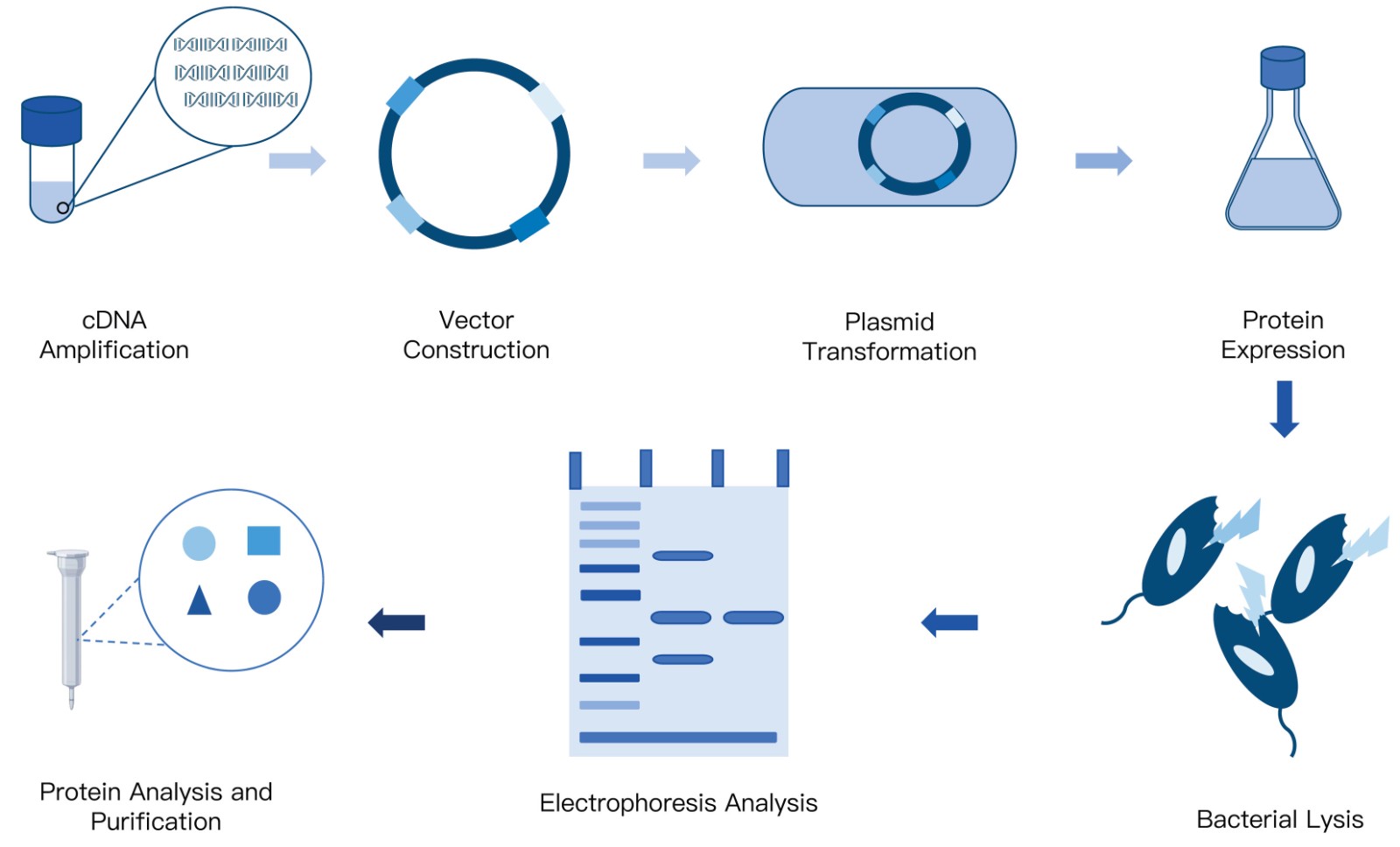
Process of Recombinant Protein Prokaryotic Expression Service

3-KMDBioscience-Recombinant-Protein-Prokaryotic-Expression-Service.jpg

Advantages of Recombinant Protein Prokaryotic Expression Services

4-KMDBioscience-Recombinant-Protein-Prokaryotic-Expression-Service.jpg

Login

Don’t have an account?Sign Up Now

Register

Already have an account?Log In Now