


KMD Bioscience has long been dedicated to the research and development of immunoassay products and technologies. With a comprehensive immunoassay technique and multiple cell-based experimental systems, we have established a complete Cell Culture Platform capable of providing customers with a variety of fundamental cell biology experiments and high-quality immunoassay services, including Dual-Luciferase Reporter Gene Assays. Our team consists of numerous experienced technical personnel who have accumulated extensive experimental expertise. Each experimental step is rigorously studied and carefully executed, enabling us to deliver stable and reliable results. We have developed an advanced Cell Biology Service Platform capable of offering a range of services, including Immunofluorescence, Apoptosis Detection, Fluorescence In Situ Hybridization (Fish), Wound Healing Assays, and Flow Cytometry. We can design customized experimental plan to meet the specific requirements of our customers, helping them save valuable research time.
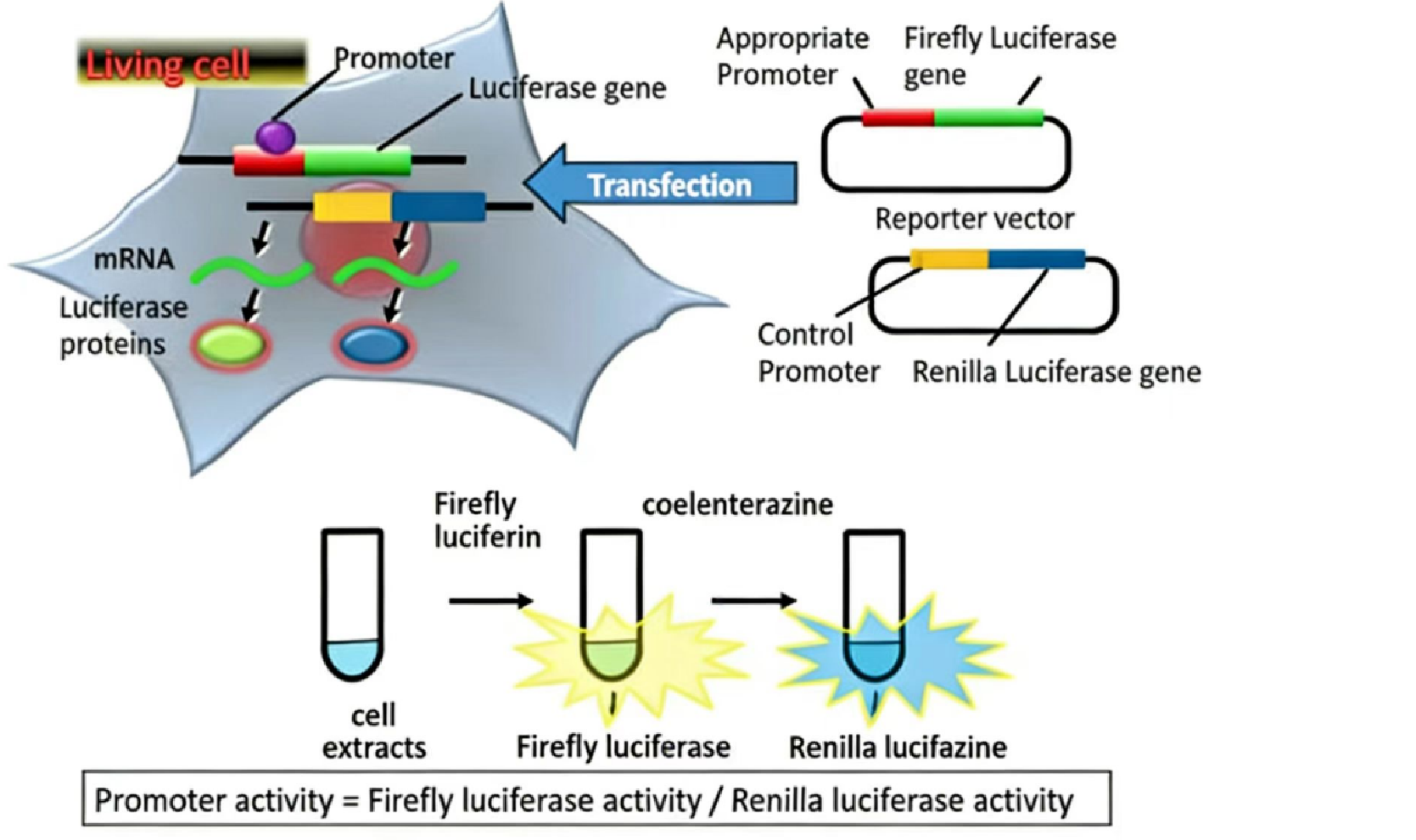
The Dual-Luciferase Reporter Gene Detection System provided by us is a gene reporter technology based on the in vivo expression and catalysis of Firefly luciferase (FLUC) and Renilla luciferase (RLUC). Luciferases are enzymes that catalyze the oxidation of luciferins or fatty aldehydes to produce bioluminescence, naturally found in luminescent organisms. Luciferases serve as ideal reporter genes because mammalian cells lack endogenous luciferase activity. Once transcription is completed, functional luciferase is produced immediately. Luciferases catalyze the oxidation of luciferins, emitting bioluminescence during the process, enabling the detection of luciferase reporter gene expression to assess the regulatory effect of miRNA on target genes. Dual luciferases typically refer to Firefly luciferase and Renilla luciferase. These two enzymes use different substrates, emit light of different colors, and have distinct absorption wavelengths, allowing independent detection without cross-interference. Moreover, the absence of endogenous expression in animal systems makes them widely used in dual-reporter experiments.
In single-reporter assays, experimental results are often affected by various experimental conditions. The advantage of the Dual-Luciferase Reporter Gene Assay provided by us is that the system simultaneously expresses two types of luciferases within the same cell. The co-transfected “control” (Renilla luciferase) serves as an internal reference, providing a baseline for normalization. This minimizes the influence of external factors, such as cell viability and transfection efficiency, reduces internal variability, and ensures the reliability of the experimental data.





 0
0
