Home
>>
Technical Platform
>>
Plant Genetic Transformation Platform
>>
Model Plant Genetic Transformation
Download Center
Quick Inquiry & Consultation
Model Plant Genetic TransformationIntroduction

Arabidopsis thaliana has a genome of approximately 125 million base pairs distributed across 5 pairs of chromosomes. This species is easy to cultivate, has a short life cycle, produces a large number of seeds, and is easy to hybridization and mutagenesis. Tobacco is characterized by ease of tissue culture and high transformation efficiency. Tomato can grow year-round in greenhouses and also has a short growth cycle. Due to these traits, short life cycle, small genome, and simple genetic manipulation, these species are commonly used as model plants in plant genetics and molecular biology research.

KMD Bioscience has successfully established a Genetic Transformation System for model plants and can provide Agrobacterium-mediated transformation, gene gun, and floral dip. We offer positively screened plants along with a series of downstream experimental services, including Gene Expression Analysis, Protein Function Studies, and Metabolite Analysis. In addition, our company is equipped with a comprehensive Protein Platform to provide one-stop research support, from genes to proteins.

Content

Steps

Content

Timeline

Step 1 Gene synthesis and vector construction

Standard vectors

1-2 weeks

Overexpression/RNAi/amiRNA vectors

Gene-editing vectors CRISPR/Cas9 vectors

Step 2 Transformation

Arabidopsis thaliana: floral dip

1-2 months

Tobacco: Agrobacterium-mediated method

Tomato: Agrobacterium-mediated method

Transient transformation: gene gun, PEG-mediated method

Step 3 T0 generation plants

Differentiate and culture resistant shoots, transfer to rooting medium

Consultation required

Step 4 PCR identification of T0 generation plants

Perform PCR identification of target genes in regenerated T0 plants and transfer positive plants to cultivation soil

1 week

Step 5 Biological testing or phenotypic analysis of regenerated T0 plants (optional)

Perform physiological testing or functional analysis of T0 plants

Consultation required

Deliverables: Positive T0 seedlings from standard transformation: ≥10 plants;  Positive T0 seedlings with successful mutations from gene-editing vector transformation: ≥5 plants; Experimental data and images; Standard genetic transformation experimental report.

-- Transformable varieties: By default, we use Nicotiana benthamiana for tobacco genetic transformation. Tomato varieties include MicroTom, Moneymaker, LA1781, and XinFan No. 2.

-- Customers may specify other varieties as needed or request T1 generation seeds. Please consult our technical staff for details.

-- Vectors: pCAMBIA series, pBin series, pGreen series.

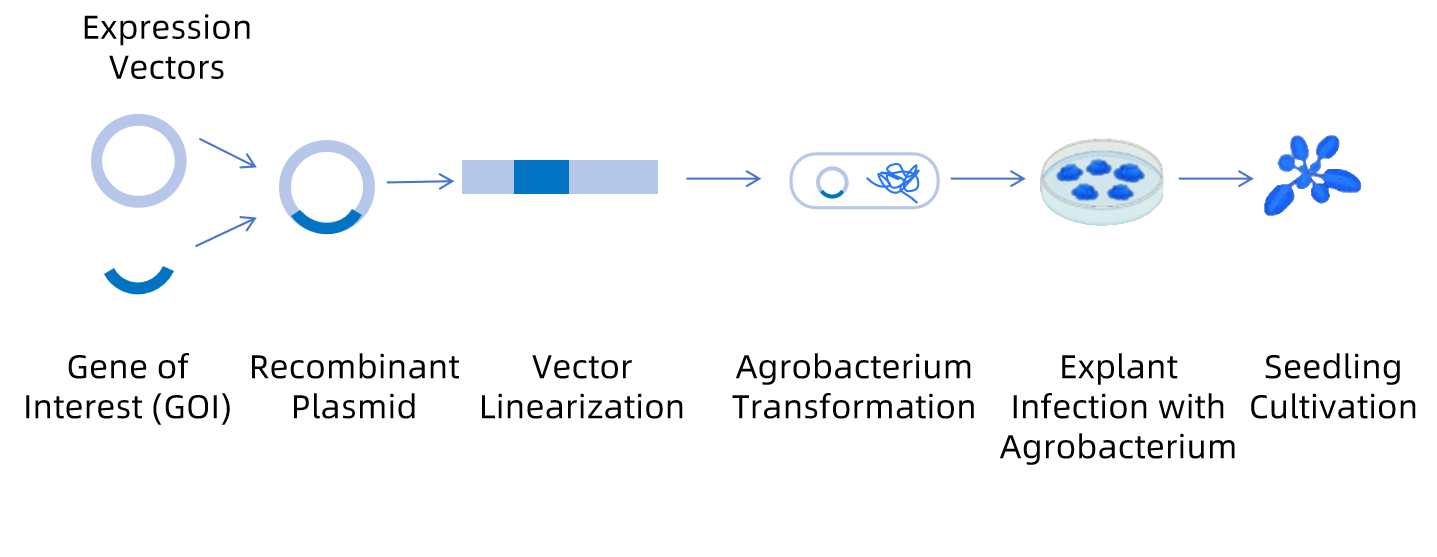
Process

图片49.png

Advantage

-- Efficient experimental workflow, not restricted by experimental materials; aseptic seedlings are produced year-round in the laboratory, allowing experiments to be conducted at any time.

-- Equipped with a Gene Editing Platform for siRNA and gRNA sequence design.

-- Multiple types of promoter options, including constitutive (p35s, pUbi), inducible (pCAB), and tissue-specific (PDX1, pAP3).

-- Utilizes Agrobacterium-mediated transformation, which is rapid, efficient, stable, and primarily single-copy insertion. It supports various eukaryotic resistance markers such as hygromycin, G418, Basta, and kanamycin.

-- Seedling acclimatization services are available to support customers' subsequent research.

– Project traceability: Regular reporting ensures remote tracking of experimental progress and transparent project management.

Frequently Asked Questions

1. What is the role of model plants in genetic transformation?

Answer: By cloning and analyzing the functions of genes in model plants, it is possible to understand how genes control physiological and developmental processes. Functional studies of model plant genes help reveal the molecular mechanisms underlying plant growth, development, and environmental responses. The research outcomes can be directly applied to crop improvement.


2. What is the principle of the Agrobacterium-mediated method?

Answer: The principle of Agrobacterium-mediated transformation is to utilize the transfer of the T-DNA region into the plant genome during Agrobacterium infection. The T-DNA on the Ti plasmid of Agrobacterium can stably integrate and express in plant cells.


3. What are the advantages and disadvantages of the gene gun?

Answer: Advantages: Suitable for a wide range of plants, including monocots and dicots; relatively simple operation; allows for rapid transformation results.

Disadvantages: May cause damage to the genome; transformation efficiency may be relatively low; requires specialized equipment.

Login

Don’t have an account?Sign Up Now

Register

Already have an account?Log In Now