Home
>>
Antibody Platform
>>
Single B Cell Screening Platform
>>
Service for the preparation of monoclonal antibodies against bovine B cells
Download Center
Quick Inquiry & Consultation

Service for the preparation of monoclonal antibodies against bovine B cellsIntroduction

    KMD Bioscience has been dedicated to antibody preparation research for many years. The company boasts a team of specialized antibody preparation technicians with extensive experience in this field. We are committed to providing high-quality antibody preparation services and have established a comprehensive antibody preparation platform capable of offering customized monoclonal antibody solutions for various species. Leveraging years of expertise in phage display technology projects, we have successfully developed and produced bovine monoclonal antibodies, particularly those with ultra-long CDR3 (complementary decision region 3) sequences.

    In antibody research, cattle can produce antibodies with an exceptionally long CDR3 loop and a limited number of variable regions. Under natural conditions, approximately 10% of bovine antibodies contain this extended CDR3 domain, which forms a knot-like structure that primarily mediates antibody-antigen affinity, enhancing antigen-binding capacity. To overcome the conformational entropy loss associated with the elongated loop, cattle utilize disulfide bonds to stabilize the extended CDR3 domain.

    The bovine monoclonal antibodies produced by Camed Technology exhibit high immunological affinity. We provide comprehensive testing services and ensure delivery volumes meet your experimental requirements. Camed Technology possesses a mature antibody production platform, offering end-to-end antibody services including antibody humanization, antibody sequencing, antibody purification, antibody labeling, and other antibody-related services.
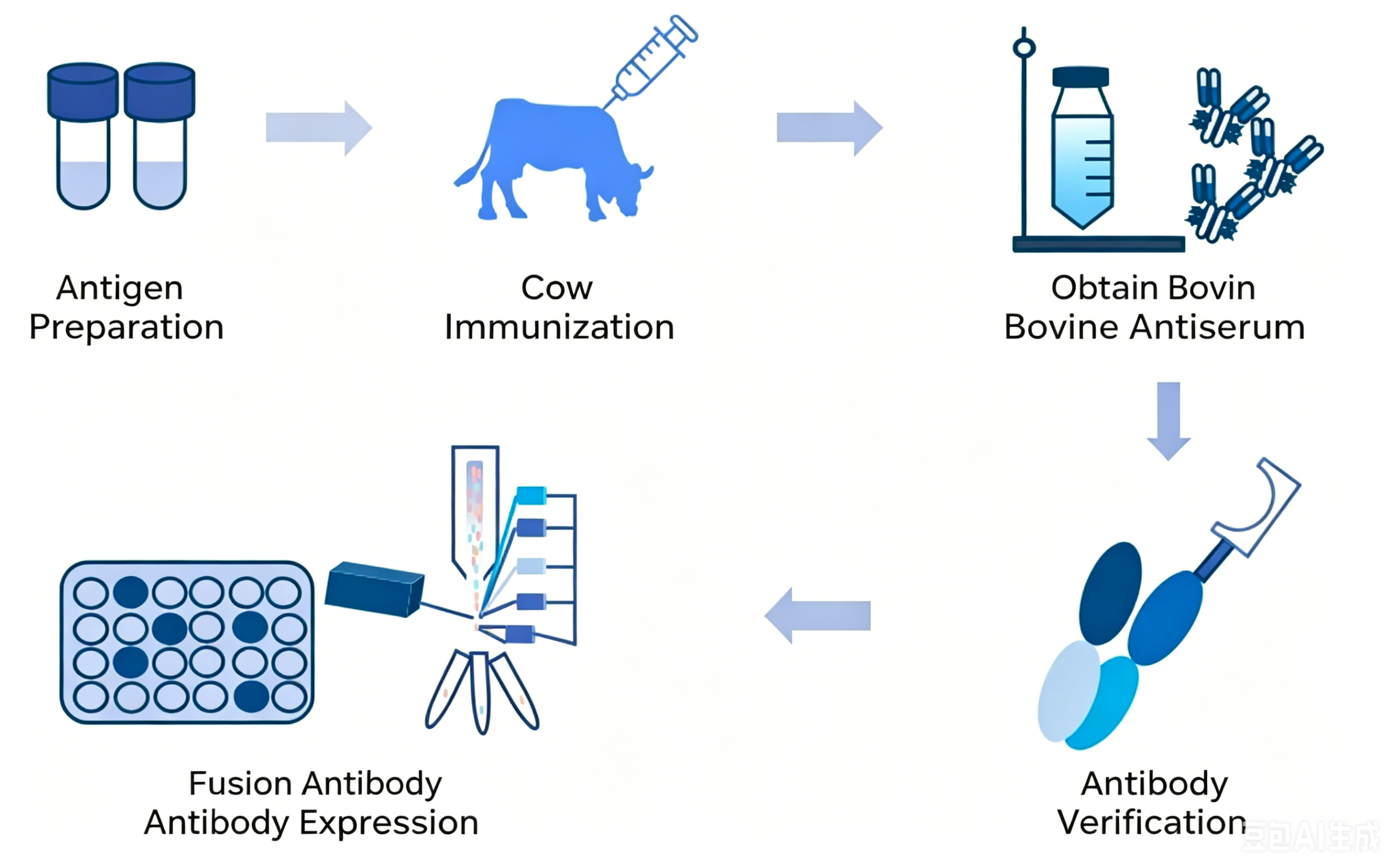


Principle of monoclonal antibody service technology for bovine monocytes

   Bovine monoclonal antibodies possess unique advantages in studying antigen structures. The ultra-long CDR3 loop of bovine antibodies is the longest among all species (comprising 50–61 amino acids), facilitating recognition of deeply buried epitopes. Structural and deep sequencing analyses have demonstrated that this ultra-long CDR3 loop contains an even number of cysteines, forming a distinctive structure where these cysteines contribute to a diverse disulfide bond "knob" domain supported by β-chain "hands." This elongated CDR3 loop enables bovine antibodies to more effectively target various bacteria and viruses or bind molecular targets, particularly antigens that are undetectable by conventional antibodies such as G protein-coupled receptors (GPCRs). Our independently designed experimental protocol allows for the production of bovine monoclonal antibodies with high purity and strong specificity.

    KMD Bioscience provides services for the preparation of bovine monoclonal antibodies based on phage display technology. We can also develop customized experimental protocols tailored to your specific needs, including the design of peptide antigens and the preparation of protein antigens.


Service Process for the Preparation of Cattle-specific B-cell monoclonal antibodies

牛单B细胞单抗制备服务流程.png

Service Content for the Preparation of Cattle-specific B-cell monoclonal antibodies

step

concrete content

period

Antigen Preparation and Animals

Administer the antigen via injection, with 5–7 immunization doses required.

Collect serum samples and determine the serum titer using ELISA assay.

Provide a detailed immunization report

10–14weeks 

cell separation

Collect post-immunized bovine blood for cell isolation

* Sort antigen-specific immune cells

* Construction of cDNA library

1–2 weeks

gene amplification

* Purpose of PCR amplification of the target gene

* sequencing

4–5 weeks

fused antibody expression

* vector construction

* Expression of fusion antibodies

Positive clone screening

6–7 weeks

functional verification

* SPR/BLI Validation

1 week


Delivery

--Complete information and raw data for all monoclonal antibodies' ultra-long CDR3H sequences

B cells derived from blood, lymphocytes, and spleen cells (>5×10^6 per sample); cDNA libraries, 3–4 vials per sample

--The constructed expression vector

High-purity fusion antibody (>90%)

– Experimental reports and raw data: including results from SDS-PAGE, ELISA assays, etc., with antibody validation results (e.g., Western blot, SPR) provided upon client request.


Advantages of the B-cell monoclonal antibody preparation service for cattle

--pM-level affinity and high specificity

--Sequence Diversity

—Selection for validation of multiple antibody expressions

High cell fusion survival rate: Ensures experimental success.

--A stringent QC system and standardized operational procedures ensure reliable antibody quality delivery.

--Diverse antibody purification techniques and protocols: Meeting various purity and scale requirements.

– Diversified antigen immunization: Administering proteins, peptides, and various small-molecule antigens, providing end-to-end services ranging from antigen preparation to antibody production.

—Diverse antibody detection methods: Provides antibody quality assessment techniques such as ELISA, WB, SPR/BLI, enabling comprehensive evaluation of antibody quality.

--Comprehensive platform: Equipped with a mature antibody and protein production platform, offering multiple expression systems and various immunization routes, enabling simultaneous experiments to ensure high-quality monoclonal antibody production.

--Complete result analysis: Provide a comprehensive report detailing the experimental procedures.

Custom Services: Provide personalized customization to meet customers' actual needs.


Login

Don’t have an account?Sign Up Now

Register

Already have an account?Log In Now