Home
>>
Technical Platform
>>
Gene Editing Platform
>>
Microbial Gene Knock-In Service
Download Center
Quick Inquiry & Consultation
Microbial Gene Knock-In ServiceIntroduction

Bacterial genomes are relatively simple and amenable to genetic manipulation, allowing gene transfer through transformation, transduction, and conjugation. Bacteria are often used as vectors for gene editing. Leveraging technologies such as CRISPR-Cas, their immune systems can be utilized to precisely delete, replace, or insert exogenous DNA sequences within their genomes.

Saccharomyces cerevisiae features a relatively compact genome with short intergenic regions, limited introns, ease of cultivation, a short growth cycle, and rapid reproduction. These characteristics facilitate screening and identification while retaining essential eukaryotic cell features, making it an ideal model organism for studying gene function and gene editing technologies in eukaryotes.

KMD Bioscience, leveraging years of expertise in genetic engineering, has established a Gene Editing Platform based on both the CRISPR/Cas9 system and the Red recombination system. We provide comprehensive experimental services, including sgRNA Design and Synthesis, sgRNA-Cas9 Vector Construction, Homologous Arm Construction, Plasmid Co-transfection, Screening, and Validation. In addition, we offer a full suite of downstream services, such as stable cell line development, protein expression, protein purification, and protein modification.

Microorganisms

Common strains

Bacteria

Escherichia coli, Klebsiella pneumoniae, Salmonella, Acinetobacter baumannii, Burkholderia, Bacillus species, Pseudomonas aeruginosa, Staphylococcus aureus, Corynebacterium glutamicum, Lactic acid bacteria species, Streptococcus mutans, Enterococcus faecalis, Streptococcus pneumoniae, Streptococcus suis, Erythrobacter, and other bacterial species.

Fungi

Escherichia coli, Klebsiella pneumoniae, Salmonella, Acinetobacter baumannii, Burkholderia, Bacillus species, Pseudomonas aeruginosa, Staphylococcus aureus, Corynebacterium glutamicum, Lactic acid bacteria species, Streptococcus mutans, Enterococcus faecalis, Streptococcus pneumoniae, Streptococcus suis, Erythrobacter, and other bacterial species.

Note: If you have genetic editing requirements for other strains, please contact us for one-on-one customized services.


Content

Site-specific knock-in refers to the technique of inserting exogenous functional genes into a cell's genome through homologous recombination with the homologous sequences in the genome. This process typically uses the CRISPR/Cas9 system, requiring the design of specific sgRNA and donor DNA.

Site-specific integration refers to the process of constructing an integration vector containing DNA fragments with homologous sequences. Through transformation, the exogenous DNA sequence undergoes homologous recombination with the target sequence, resulting in the targeted disruption of the target DNA sequence. A series of screening methods are then applied to obtain strains with the inserted gene.

Step

Content

Timeline

Step 1 Sequence Analysis and Primer Design

(1) Customer provides gene sequence;

1 week

(2) Bioinformatics analysis, formulation of the knock-in strategy;

(3) Primer design;

(4) Strain resistance verification.

Step 2 Integration Vector Construction (Site-directed Integration)

(1) Amplification of homologous arm fragments;

2-3 months

(2) Ligating homologous arms to intermediate vector;

(3) Construction of the target gene-homologous arm intermediate vector;

(4) Amplification of the target fragment;

(5) Ligating the target gene to the intermediate vector with homologous arms;

(6) Ligation of the target gene with the integration vector;

(7) Colony PCR verification.

Step 3  Knock-in Strain Screening

(1) Production of competent cells;

Consultation required

(2) Electroporation: Transformation of competent cells with the integration vector containing the target gene fragment;

(3) Double exchange screening: Selection of positive clones successfully integrating the exogenous fragment.

Step 4 Strain Validation

(1) Colony PCR verification.

Consultation required

Note: We also provide site-directed knock-in services based on the CRISPR/Cas9 system. Please contact us for knock-in strategy.


Process

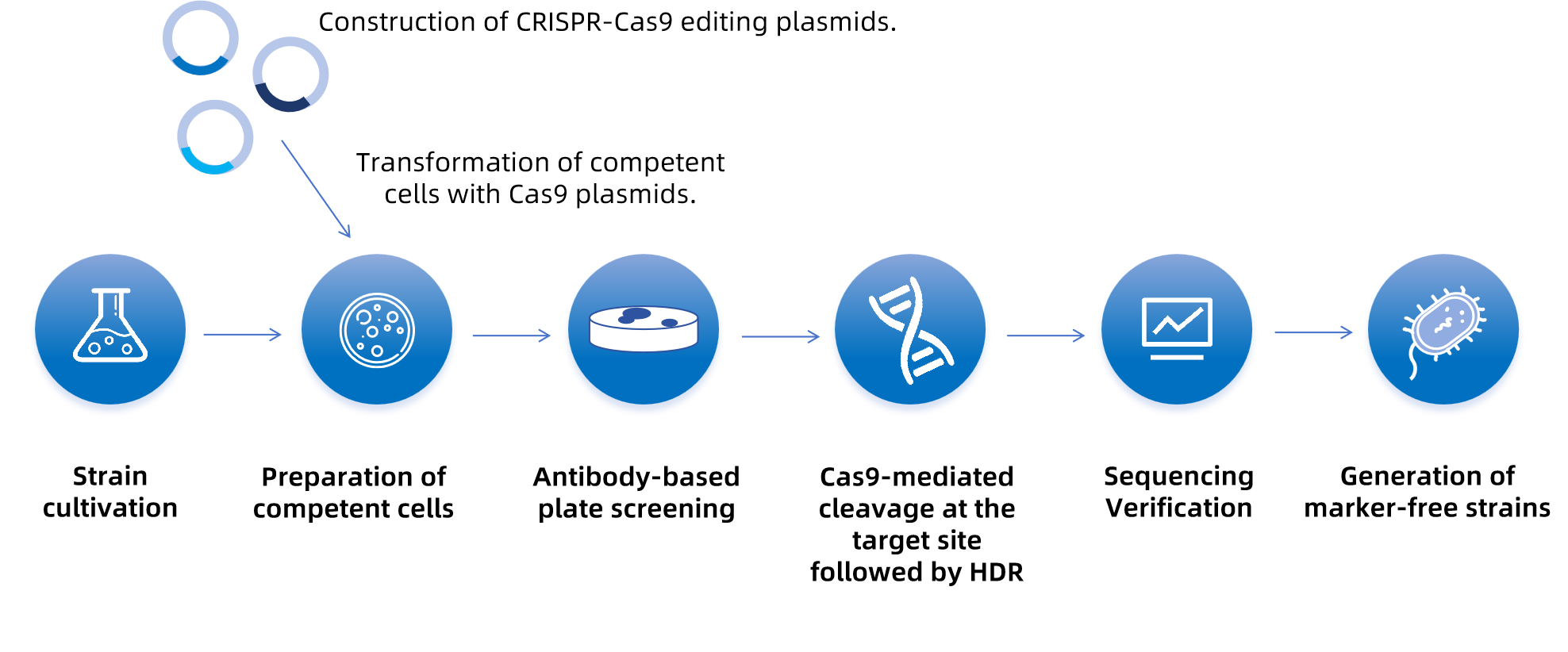
图片41.png

Advantage

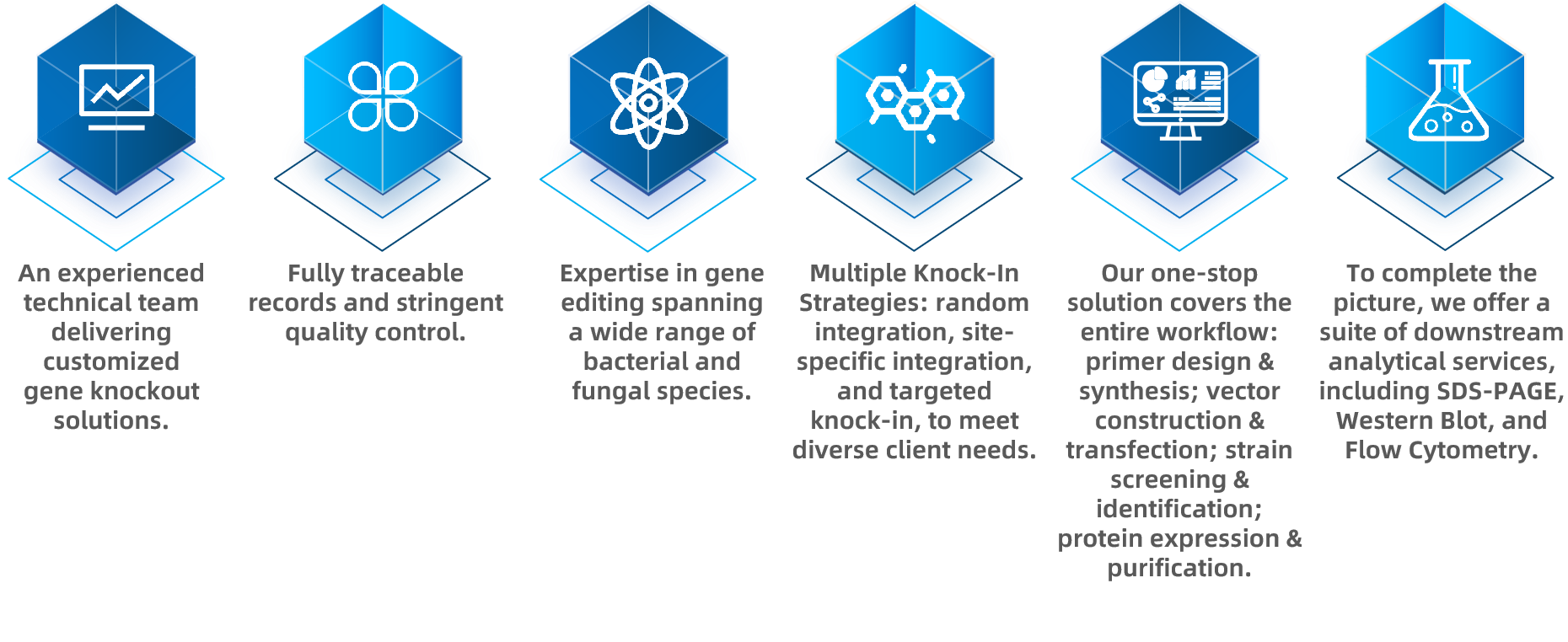
图片42.png

Frequently Asked Questions

1.What types of microbial gene knock-in are there?

Answer: There are two main types: in situ knock-in and site-specific knock-in. In situ knock-in refers to inserting a new gene at the site of the original gene knockout, which is the reverse process of gene knockout. In site-specific knock-in, regardless of the target gene's location, the gene is transferred to a precise insertion site using a transfer vector controlled by a specific promoter, ensuring accuracy in the insertion site.


2.What are the considerations for designing sgRNA?

Answer: The design of sgRNA affects the efficiency of gene knock-in. Key factors to consider include the sequence of the candidate editing site, its position, the orientation (positive or negative strand), GC content, and potential off-target sites.


3.How can the efficiency of microbial gene knock-in be improved?

Answer: To improve the efficiency and accuracy of gene knock-in, high-activity Cas9 protein variants and efficient gRNA designs should be selected. Additionally, optimizing the design of homologous arms and culture conditions can further enhance the success rate.

Login

Don’t have an account?Sign Up Now

Register

Already have an account?Log In Now