Home
>>
Technical Platform
>>
Plant Genetic Transformation Platform
>>
Poaceae Genetic Transformation
Download Center
Quick Inquiry & Consultation
Poaceae Genetic TransformationIntroduction

Grass plants are generally herbaceous, with a few woody species, and include wheat, rice, maize, and sorghum. Rice is a major source of carbohydrates and plays a vital role in human production and daily life. Rice husks and straw are also widely utilized. Maize is rich in carbohydrates, proteins, fats, and various vitamins, and serves as both a food source and an important material for feed and industry. Wheat contains abundant protein, dietary fiber, and a variety of vitamins and minerals, offering rich nutritional value and diverse benefits.

KMD Bioscience possesses a professional technical team with years of experience in plant genetic transformation, comprehensive pre-sales and after-sales technical support, and advanced molecular biology laboratory facilities. Our scientists can customize one-on-one personalized strategies according to customer needs and provide Genetic Transformation Services for a variety of grass species.

Content

Step

Content

Timeline

Step 1 Gene synthesis and vector construction

Standard vectors

1-2 weeks

Overexpression/RNAi/amiRNA vectors

Gene-editing vectors CRISPR/Cas9 vectorsa

Step 2 Transformation

Rice: Agrobacterium-mediated transformation (immature embryo/panicle/callus/shoot apical meristem); in-planta pollination method.

1-2 months

Wheat: Agrobacterium-mediated transformation (immature embryo); biolistic method (embryogenic callus).

Maize: Agrobacterium-mediated transformation (immature embryo).

Step 3 T0 generation plants

Differentiate and culture resistant shoots, transfer to rooting medium.

Consultation required

Step 4 PCR identification of T0 generation plants

Perform PCR identification of target genes in regenerated T0 plants and transfer positive plants to cultivation soil.

1 week

Step 5 Biological testing or phenotypic analysis of regenerated T0 plants (optional)

Perform physiological testing or functional analysis of T0 plants.

Consultation required

Deliverables: Positive T0 seedlings from standard transformation: ≥10 plants;  Positive T0 seedlings with successful mutations from gene-editing vector transformation: ≥5 plants; Experimental data and images; Standard genetic transformation experimental report.

Note: The plant organs listed in parentheses are commonly used explants for transformation. Customers may request other explants for transformation.

-- Available VarietiesMaize: default B104; Rice: default Nipponbare; Wheat: default Longchun23 and Westonia.

-- Customers may specify other varieties as needed or request T1 generation seeds. Please consult our technical staff for details.

– Vectors: pBin series, pCAMBIA series, pZP series.

-- Optional Agrobacterium strains: GV3101, AGL-1, EHA105, LBA4404.

-- Deliverables include positive plants, experimental data, images, and a standard genetic transformation report.

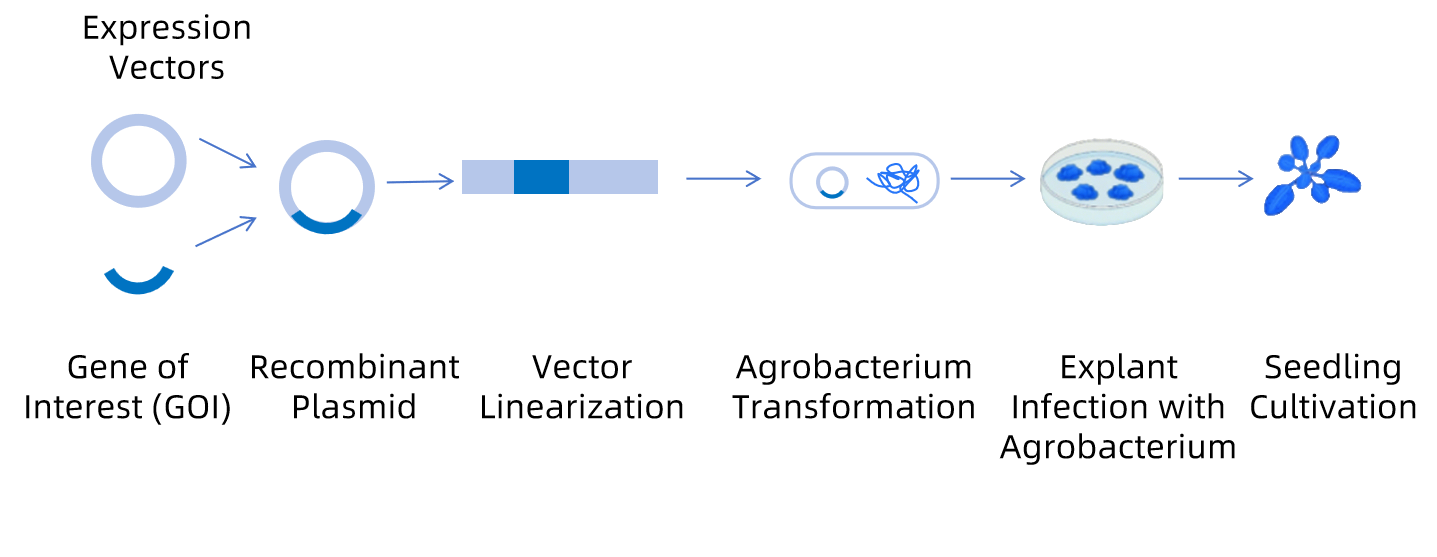
Process

图片49.png


Advantage

-- Efficient experimental workflow, unrestricted by plant material; aseptic seedlings of commonly used plants for genetic transformation are maintained year-round, enabling experiments to begin at any time.

-- Equipped with a gene-editing platform providing CRISPR-Cas9 technology services for precise editing at specific sites in the genome.

-- Utilizes Agrobacterium-mediated transformation, which is rapid, efficient, stable, and primarily single-copy insertion. It supports various eukaryotic resistance markers such as hygromycin, G418, Basta, and kanamycin.

-- Seedling acclimatization services are available to support customers’ subsequent research.

-- Project traceability: Regular reporting ensures remote tracking of experimental progress and transparent project management.

Frequently Asked Questions

1.What are the advantages of Agrobacterium-mediated transformation?

Answer: It can transfer relatively large DNA fragments, and the integration sites of exogenous genes are stable with low copy numbers. The resulting transformants exhibit good genetic stability. In addition, the method is convenient to operate and cost-effective.


2.What is wheat genetic transformation?

Answer: Wheat genetic transformation refers to altering the genetic traits of wheat through genetic engineering to achieve goals such as improving quality, increasing yield or enhancing stress resistance.


3.How can the efficiency of rice genetic transformation be improved?

Answer: By selecting suitable transformation materials and optimizing the vectors used in mediated transformation. Combining transformation systems with DNA-free methods and haploid induction techniques can further enhance efficiency and safety, while shortening the transformation and regeneration cycle.

Login

Don’t have an account?Sign Up Now

Register

Already have an account?Log In Now