Home
>>
Protein Platform
>>
Protein Expression Services
>>
Recombinant Protein Yeast Expression
Recombinant Protein Yeast ExpressionIntroduction

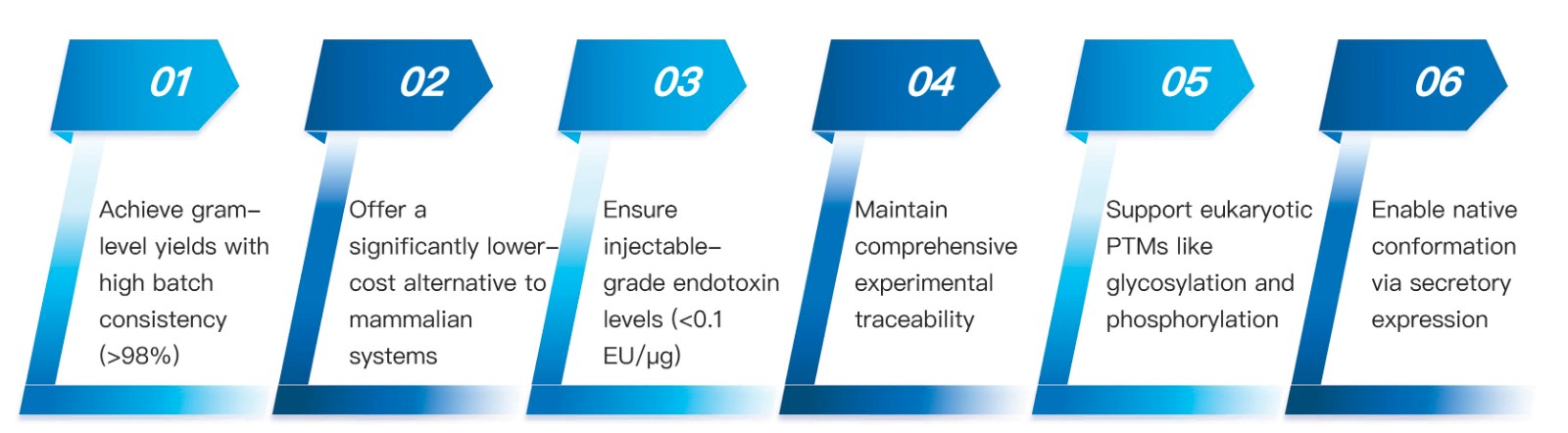
Yeast expression combines the simplicity, high efficiency, and low cost of prokaryotic expression with the advantages of eukaryotic expression systems, such as proper protein folding and post-translational modifications. Recombinant proteins can be expressed in yeast either in a secreted or non-secreted form, with high expression levels reaching up to 5 g/L. Exogenous genes can be stably integrated into the yeast genome, replicating with the chromosome without loss. As a eukaryote, yeast possesses subcellular structures and is capable of post-translational modifications such as glycosylation, acylation, and phosphorylation, making it suitable for the expression of active proteins and enabling ultra-high-density fermentation.

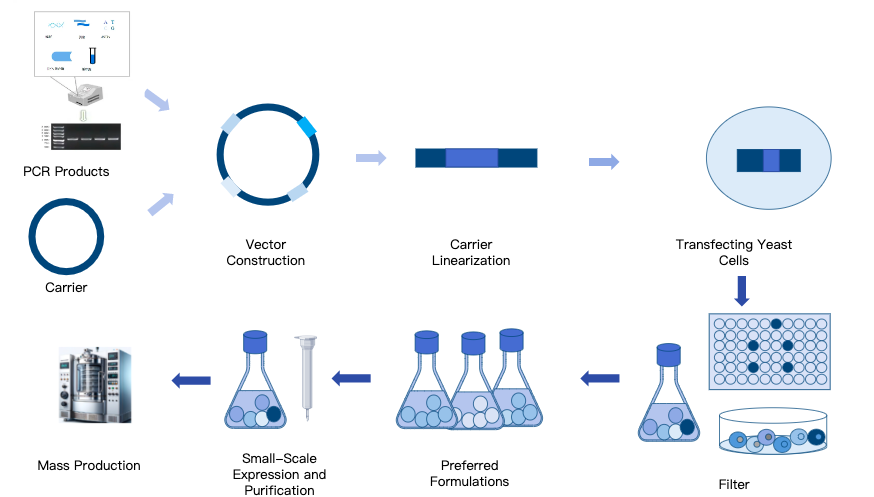
KMD Bioscience has extensive experience in Recombinant Protein Yeast Expression Services, providing various scales of Protein Fermentation. Combined with our comprehensive Protein Purification Platform, we can deliver high-quality recombinant proteins in a short time. Our team offers a complete and mature yeast expression system, delivering one-stop services from gene synthesis to yeast protein expression and purification. We provide multiple expression vectors such as pPICZaA, pGAPZaA, and pPIC9K, as well as strains like X33, GS115, and Saccharomyces cerevisiae. Equipped with various Protein Expression and Purification Methods, we can meet diverse protein production needs and offer Customized Expression and Purification Plans for our clients.
Selection of Yeast Expression Vectors

Yeast expression vectors are typically selected based on the intended purpose of gene expression. These vectors can be categorized into intracellular and extracellular yeast expression vectors. Intracellular expression vectors include the pGAP series and pPIC3.5K, which allow the target protein to be expressed within the cell. This helps avoid excessive glycosylation by yeast and is suitable for expressing cytoplasmic or non-glycosylated proteins without disulfide bonds. Intracellular expression vectors generally enable high expression levels, but the subsequent purification process is relatively complex. A commonly used extracellular expression vector is pPIC9K, which enables extracellular secretion of the target protein, making purification relatively easier. In addition to offering a variety of Pichia pastoris vectors, we also provide Saccharomyces cerevisiae vectors. Combined with large-scale fermentation, we can meet industrial-level production needs.

Applications of Yeast Expression Systems

The yeast expression system is one of the most economical and efficient eukaryotic protein expression systems, capable of achieving both intracellular and secretory expression. Its culture media are relatively inexpensive, the cultivation conditions are not stringent, and it is suitable for industrial-scale production. Similar to mammalian cell expression systems, the yeast expression system can perform modifications such as glycosylation, acylation, lipid modification, and phosphorylation, which help maintain the native conformation of the protein. This makes it suitable for the production of high-value protein materials that closely resemble their native forms. Using yeast expression systems, people have successfully expressed a wide range of proteins from various organisms, including bacteria, fungi, viruses, protozoa, plants, vertebrates, and humans. These proteins include enzymes, proteasomes, proteasome inhibitors, receptors, single-chain antibodies, antigens, regulatory proteins and other types of proteins. In the medical field, yeast expression systems have been successfully applied in the production of genetic engineering vaccines, genetic engineering drug production (such as antibody drugs and therapeutic proteins), protein function studies and others.

Steps and Timeline for Protein Secretory Expression in Yeast

Step

Service content

Timeline

Yeast Expression Vector Construction

* Codon optimization, gene synthesis (or gene template amplification).

1-2 weeks

* Subcloning target gene into suitable vector.

* Sequence verification by sequencing.

* Delivery: correctly constructed recombinant expression plasmid, strain, and original sequencing report.

Strain Transformation

* Transforming suitable yeast strains.

2 weeks

* Culturing 6–10 positive clones for recombinant protein induction expression.

* SDS-PAGE analysis.

* Delivery: positive clone strains and expression screening report.

Yeast Expression Strain Screening

* Detetction of recombinant protein expression (applicable to multi-copy and high-expression strains).

2 weeks

* Delivery: positive clone strains and expression screening report.

Strain Expression Optimization

* Optimize culture conditions (medium, optical density (OD) of the culture, methanol concentration, induction temperature and time, etc.) to increase target protein yield.

2 weeks

Small-Scale Protein Expression and Purification

* Purify recombinant protein from 1L fermentation broth and perform SDS-PAGE analysis.

2-3 weeks

* Delivery: 0.02–3 mg recombinant protein and purification report, purity >85%.

Large-Scale Protein Expression And Purification

Available fermenter sizes: 80L, 130L, 250L, and 500L.


Value-added Services

* Detailed target protein quality analysis by HPLC, mass spectrometry, etc.

1-2 weeks

* Protein N-terminal sequencing: PPSQ-31 (Edman degradation sequencer).

Yeast Expression Experimental Workflow

截屏2026-08-11 13.47.33.png

Advantages of Recombinant Protein Yeast Expression Services

7-KMDBioscience-Recombinant-Protein-Yeast-Expression-Service.jpg

Login

Don’t have an account?Sign Up Now

Register

Already have an account?Log In Now