Home
>>
Antibody Platform
>>
Peptide Library Platform
>>
Oligo Pool Custom Service
Download Center
Quick Inquiry & Consultation

Oligo Pool Custom ServiceIntroduction

Based on Trimer Condon chip technology, KMD Bioscience provides high-throughput, high-coverage Oligo Pool (oligonucleotide pool) custom synthesis services. With a mature process system and extensive project experience, we are capable of precisely synthesizing single-stranded oligonucleotide libraries with diverse sequences and excellent homogeneity, offering stable and reliable upstream sequence solutions for antibody engineering and peptide screening research. 

We not only provide high-quality Oligo Pool synthesis products but also leverage our comprehensive antibody discovery and engineering platform to undertake end-to-end project services, including library design, synthesis, amplification, vector construction, downstream display screening, positive clone identification, and functional validation. KMD Bioscience supports your innovation and breakthroughs in antibody drug development and peptide discovery through rigorous quality control, rapid delivery cycles, and professional scientific research support.

Oligo Pool Introduction

   An oligo pool, also known as a primer pool, is, as the name suggests, composed of diverse single-stranded oligonucleotides. The preparation of an oligo pool is based on the Trimer Condon technology, which utilizes chips as carriers for high-throughput synthesis of short fragments. Trimer primers are triphosphoramide derivatives formed by linking three nucleotides in a predetermined type and sequence, with each triphosphoramide corresponding to a specific amino acid. By synthesizing multiple Trimer primers as a single unit and incorporating them into the target sequence at predetermined positions, a primer pool that matches the desired sequence can be obtained.


The advantages of Oligo Pool

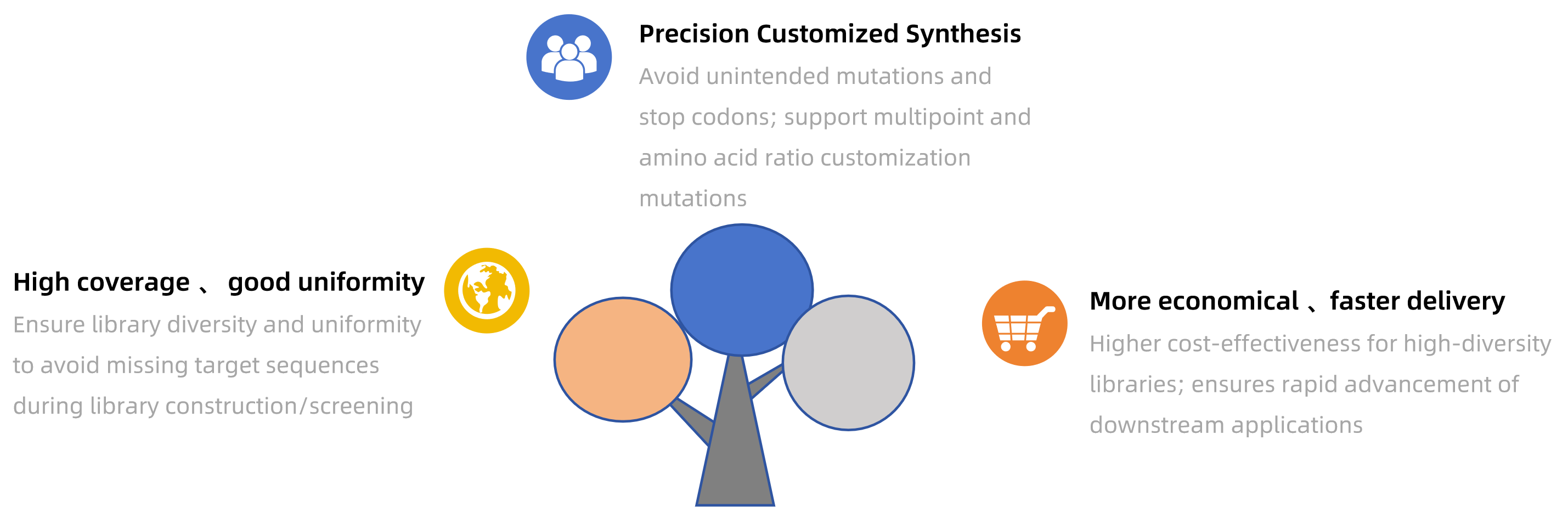
Advantage 1: Precise customized synthesis meets diverse clients' requirements for sequence customization.
Advantage 2: High coverage and excellent uniformity, which complement the immune library to enhance its diversity and homogeneity.
Advantage 3: More economical and faster delivery. Compared to the synthesis of double-stranded genes, single-stranded oligonucleotides are less costly. For clients with limited project timelines and tight budgets who require a high diversity of gene libraries, synthesizing an oligo pool followed by double-stranded amplification and vector ligation is a preferable option.

图片2.png

Figure 1: Synthetic Advantages of Oligo Pool


Oligo Pool Specifications

The synthesis of oligo pools becomes more challenging with increasing length, consequently raising production costs. During design, homology arm length must be considered, with 20nt carrier homology arms recommended at both N/C ends. Below is the total length gradient of the primer pool, with specific synthesis lengths determined by experimental protocols.

Table 1. Specifications of Oligo Pool

Chip 

model

Bearing 

Capacity

Size

GenTitan

HiFi-92K

92K(91944)

10-79nt

80-109nt

110-130nt

131-150nt

151-170nt


Prior to designing an oligo pool, clear sequence information is required. Camed Bio will conduct sequence analysis and customize protocols based on the client's experimental needs, laying the foundation for subsequent primer pool synthesis and library construction.


Application of Oligo Pool

    KMD Bioscience utilizes Trimer Condon technology for primer pool synthesis, which is widely applied in peptide library customization and antibody mutation library preparation.


I.custom peptide library


    KMD Bioscience offers peptide library customization services, including random peptide libraries and protein truncation peptide libraries. The primary objective is to obtain peptide sequences that bind to targets through subsequent library screening. Additionally, protein truncation peptide libraries can be utilized to validate the interaction sites between proteins and ligands via library screening, serving as a novel method for validating antigen-binding epitopes in antibody development.


II.Preparation of antibody mutation library


The application scenarios of antibody mutation libraries involve the addition, deletion, or substitution of specific structural sequences to investigate the effects of antibody modification. Certain positions may influence the nature of interactions, and altering partial sequences could lead to altered antigen binding or changes in epitope binding patterns. Downstream library screening can yield more diverse antibody sequences, thereby providing additional possibilities in subsequent antibody development processes.


III.Experimental Procedure

图片1.png

Figure 2: Experimental Procedure


IV.Case Study-Customized Peptide Library


kappframework-XJxyuF(1)(1).png

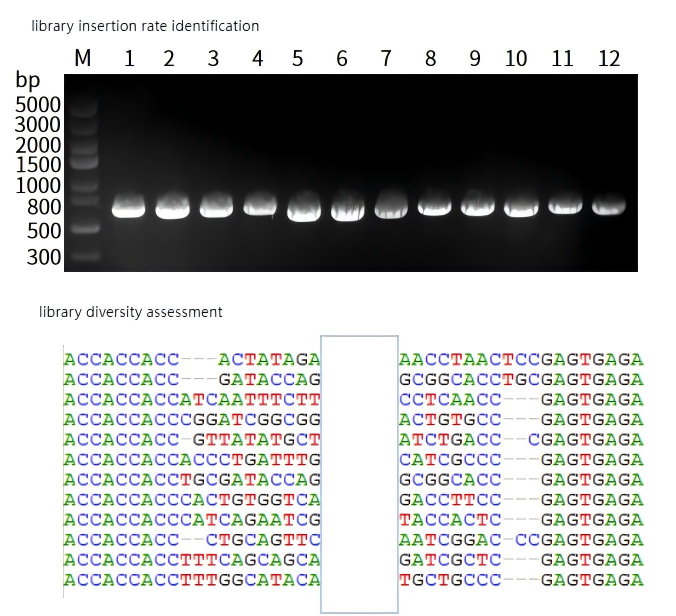
Figure 3: Library identification results


Login

Don’t have an account?Sign Up Now

Register

Already have an account?Log In Now