Home
>>
Protein Platform
>>
Protein Interaction Services
>>
Pull-Down Assay Service
Pull-Down Assay ServiceIntroduction

KMD Bioscience has been dedicated to protein-protein interaction research for many years. Protein-protein interactions reveal the interaction patterns between molecules, playing a crucial role in the study of protein structure and function. With rich experience in recombinant tag protein expression, we can express recombinant proteins with GST, Myc-tag, Flag-tag, HA-tag, and other tags in both prokaryotic and eukaryotic expression systems. Additionally, we have advanced detection equipment and mature technologies, with its immunoprecipitation and Pull-Down techniques originating from the IPS laboratory at Kyoto University, Japan, ensuring the accuracy of experiments. We are committed to providing high-quality services and offers one-stop technical services, from Recombinant Protein Production to Pull-Down Protein-Protein Interaction Detection, to meet various customer needs.

The Pull-Down assay is a method used to detect molecular interactions under in vitro conditions. This technique can be used to verify protein-protein interactions or to screen for target proteins. Similar to immunoprecipitation, Pull-Down assays utilize protein-protein and protein-other biomolecule interactions to capture and study target molecules. The principle is that a tagged bait protein is specifically captured by a solid-phase affinity ligand that binds to the tag, with secondary "affinity supports" used to purify other proteins that interact with the bait protein. By performing SDS-PAGE electrophoresis analysis, or combining with Western Blot verification and LC-MS/MS, the purified eluted protein complexes can be further identified, revealing the proteins that interact with the bait protein.
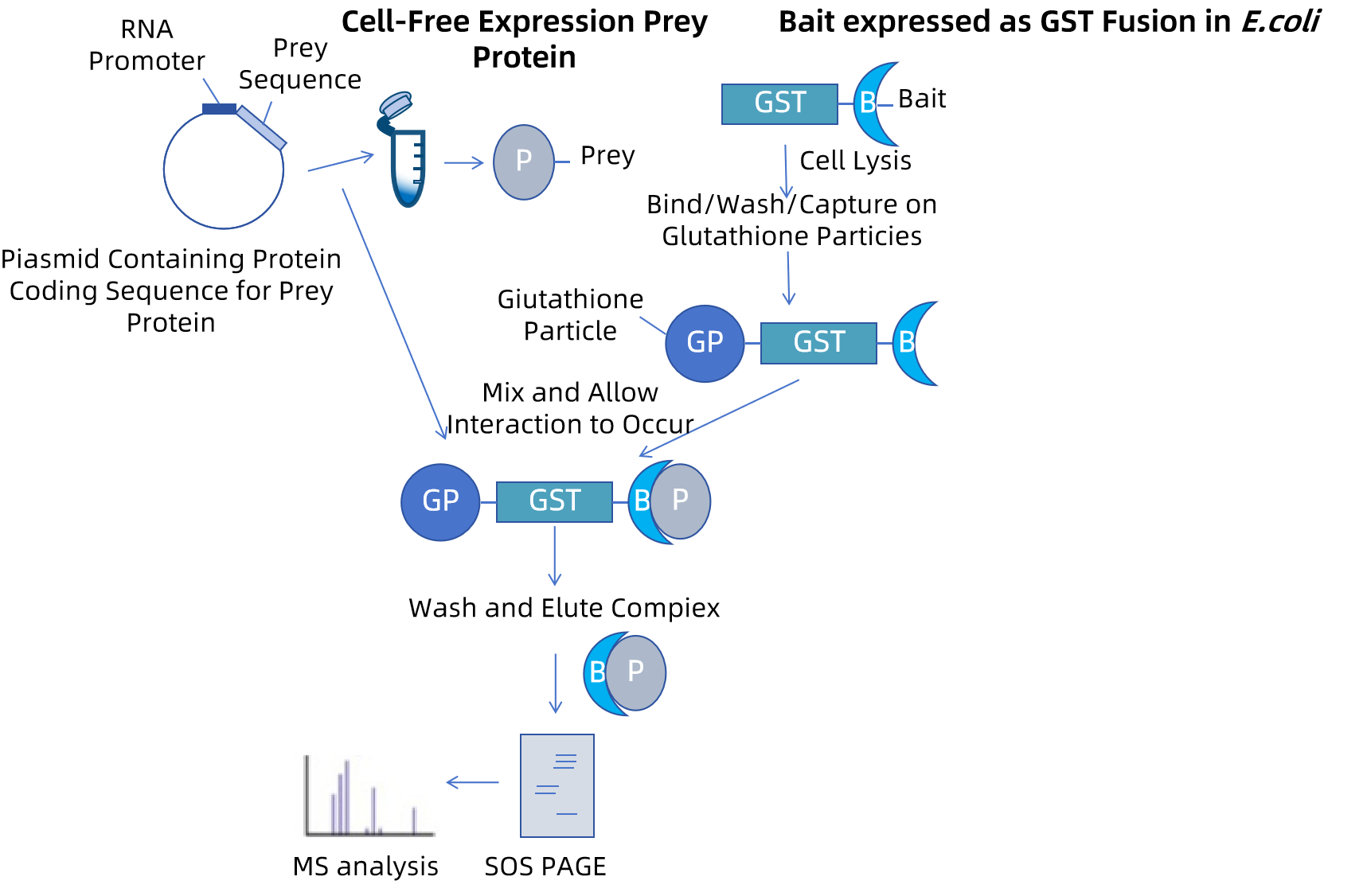
图片24.png

We have established and perfected a series of immune-based detection technologies, including GST fusion protein pull-down, streptavidin-labeled pull-down, Co-IP, and ChIP-qPCR services. Among them, pull-down technology and streptavidin-labeled pull-down technology are used for protein and nucleic acid (RNA/DNA) researches.
Immunological Detection Service - GST Pull-Down Assay

GST pull-down, also known as an in vitro protein-binding assay , is a method used to validate or identify protein-protein interactions under in vitro conditions. 


Project

GST Pull-Down Assay

Experiment Principle

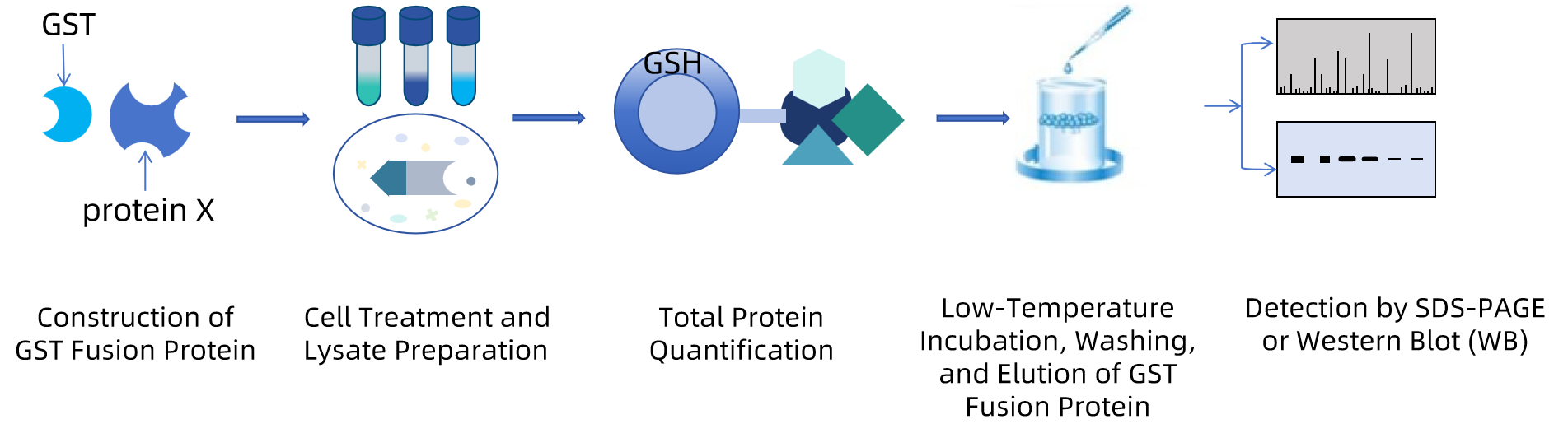
* This technique utilizes the affinity between GST and glutathione (GSH) conjugated beads. First, recombinant expression technology is used to express "bait" proteins tagged with GST. The bait protein is incubated with cell lysates to capture target molecules that can interact with the bait protein. Then, glutathione (GSH)-labeled agarose beads are added. Under the catalytic action of GST, GSH links the protein complex to the agarose beads. Low-speed centrifugation is used to collect the complex for subsequent analysis, such as SDS-PAGE.

Applications

* Verifying potential protein-protein interactions predicted for a given protein.

* Identifying unknown molecules that interact with known proteins.

Advantages

* Commonly uses tags (such as GST) and antibodies for detection, making it widely applicable.

* Simple to perform. It is an effective method for directly detecting protein-protein interactions.


GST Pull-Down Assay Procedure

图片25.png

Immunodetection Service - RNA/DNA Pull-Down Assay

RNA/DNA pull-down is an important technique for studying the interactions between RNA or DNA and proteins under in vitro conditions.


Project

RNA/DNA Pull-Down Assay

Experiment Principle

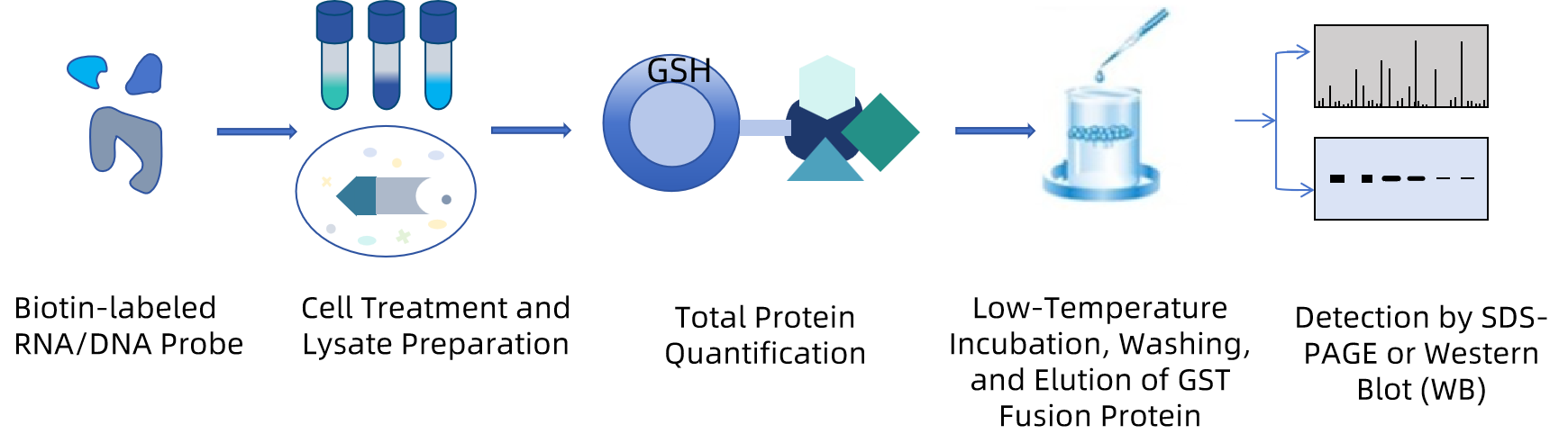
* The technique involves in vitro transcription of part or full-length target RNA, which is biotinylated and incubated with cytoplasmic protein extracts to form RNA/DNA-protein complexes. These complexes are then separated from cell lysates using streptavidin-labeled magnetic beads or agarose beads. After elution, SDS-PAGE or silver staining is used to verify the target molecules.

Applications

* Verifying if a protein interacts with the target RNA/DNA

* The purified protein can be identified through mass spectrometry, allowing for the selection of proteins that bind to the target RNA.

Advantages

* This technique is a common method for capturing RNA/DNA-protein complexes.

* It can be used for verifying or screening interacting proteins for specific RNA or DNA, such as identifying transcription factors for a particular gene.


RNA/DNA Pull-Down Experimental Procedure

图片26.png

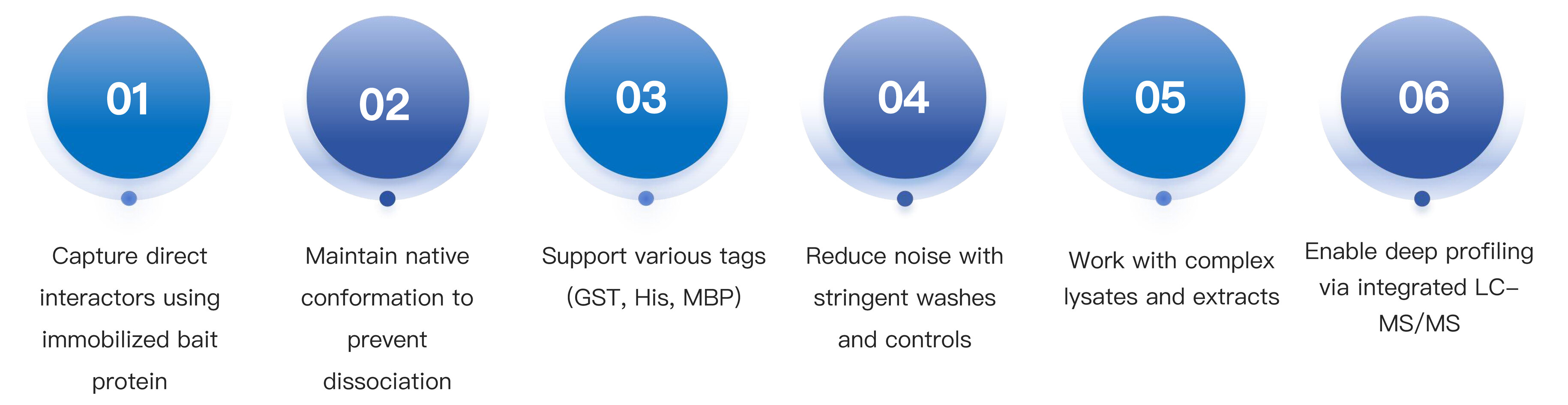
Advantages of Pull-Down Assay Services

21-KMDBioscience-Pull-Down-Experimental-Service.jpg

Login

Don’t have an account?Sign Up Now

Register

Already have an account?Log In Now