


Introduction to Antibody Fab Fragments
- 2026-07-10
- 727
The Fab fragment (Antigen-binding fragment) is the region of an antibody responsible for binding to antigens. It consists of an entire light chain (variable and constant regions) and a portion of the heavy chain (variable region and one constant domain), connected by a disulfide bond. With a compact structure and a molecular weight of 47-48 kDa, the Fab fragment is relatively small.
Unlike single-chain variable fragments (scFvs), the Fab fragment retains both the antigen-binding capability and partial constant regions, giving it not only high antigen-binding affinity and excellent tissue penetration but also greater structural stability. These properties make Fab fragments highly valuable in clinical diagnostics and therapeutic applications.
1. Structure of Fab
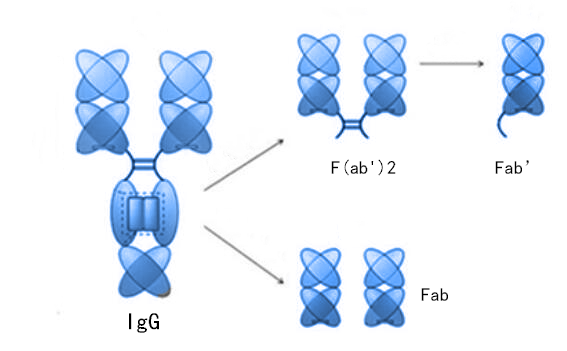
The Fab fragment consists of the light chain variable domain (VL), light chain constant region (CL), heavy chain variable domain (VH), and one heavy chain constant region (CH1). The Fab fragment can be obtained by proteolytic digestion of a full-length antibody.
Under the action of papain, human Immunoglobulin G (IgG) can be cleaved into two Fab fragments and one Fc fragment. Under the action of pepsin, IgG can be digested into one F(ab')2 fragment and one pFc' fragment. The F(ab')2 fragment can be further reduced to form two Fab' fragments.
2. Preparation of Fab Fragments
Currently, Fab fragments can be prepared through various methods, including enzymatic digestion, expression systems, and antibody library screening using phage display technology.
2.1 Enzymatic Digestion Method
Fab fragments can be obtained directly from monoclonal antibodies (mAbs) through enzymatic digestion. This method typically involves degrading human immunoglobulin G using enzymes such as papain or pepsin to produce fragments such as F(ab’)₂, Fab, and Fc. The advantages of this approach include speed and simplicity, but it also has significant drawbacks. First, it requires monoclonal antibody raw materials, which are usually limited in quantity and expensive. Additionally, even after optimizing the enzymatic cleavage of the full antibody, the resulting Fab fragments often exhibit reduced immunoreactivity.
2.2 Preparation Using Expression Systems
Recombinant Fab fragments offer significant advantages. Since they lack the Fc region, they do not require post-translational modifications or glycosylation, allowing for expression in both prokaryotic and mammalian systems. Typically, Fab fragments are produced using either Escherichia coli (E. coli) or mammalian expression systems.The E. coli expression system offers benefits such as low production costs and rapid expression. However, it often leads to the formation of inclusion bodies, and the refolded proteins may struggle to retain proper activity.
In contrast, mammalian cell expression systems enable the correct formation of disulfide bonds, resulting in Fab fragments that more closely resemble their natural structure and exhibit higher activity. Additionally, the expression yield is sufficient for downstream research applications, making mammalian expression systems a superior choice compared to E. coli.
2.3 Fab Antibody Libraries
Using phage display technology, an Fab fragment antibody library is first constructed. Through several rounds of screening and enrichment, high-affinity Fab antibodies can be obtained. Theoretically, the antibody library of mouse B cells is less than 10^8, while that of human B cells is less than 10^12. In contrast, a combinatorial Fab antibody library can reach a size of 10^10 to 10^13, increasing the likelihood of screening for the desired antibody.
3. Applications of Fab
Compared to full IgG, Fab fragments lack the Fc region. Although they can selectively bind to antigens, they do not cause precipitation reactions. Due to their low immunogenicity, they are not recognized by the host's immune cells, significantly reducing the likelihood of hypersensitivity reactions and improving product safety. Fab antibody fragments are characterized by their small molecular weight, strong tissue distribution specificity, low immunogenicity, and suitability for genetic engineering, making them an important component in pharmaceutical research. Fab-based drugs have broad applications in prevention, diagnosis, and treatment. For example, certolizumab pegol (a Fab fragment) has been marketed and is effective against rheumatoid arthritis. Similarly, metuximab I, also a Fab fragment, has been used to treat lung cancer, among other conditions.
KMD Bioscience has established a one-stop antibody service platform. Our recombinant antibody expression service employs a mammalian expression system, offering more efficient and rational solutions. Supported by our proprietary phage display technology platform, we provide services such as human Fab antibody library construction, antibody humanization, and affinity maturation. Feel free to inquire for more details.
- Fab antibody production
- Fab fragment antibody
- Recombinant antibody expression
- Fab antibody library construction

- Protein Platform
- Protein Expression Services
- Protein Modification & Detection Services
- Protein Interaction Services
- Protein Purification Service
- Antibody Discovery Platform
- VHH Antibody Platform
- Phage Display Platform
- Antibody Humanization Platform
- Single B Cell Screening Platform
- Antibody Expression & Validation Platform
- Peptide Library Platform
- Custom Antibody Platform
- Innovative Drug Discovery Platform
- Product Center
- Proteins
- Antibodies
- Raw Materials Reagents
- Small Molecule Reagents
- Peptide Products
- Nanoparticle Products
- Contact Us
- Phone:400-621-6806
- Mobile:13110936064(WeC
- E-mail:[email protected]
- Address:Room 108, Building 10, No. 6 Hechang Road, Wuqing Development Zone, Tianjin City
-

WeChat
-

Service Account
-
 400-621-6806
 -
 3599163699
 -
 Monday to Friday 9:00-18:00
 -

-
 0
0
-
