Home
>>
Technical Platform
>>
Protein Expression Platform
>>
Prokaryotic E. coli Expression System
Download Center
Quick Inquiry & Consultation
Prokaryotic E. coli Expression SystemIntroduction

Prokaryotic expression vectors include systems such as E. coli and Bacillus subtilis. Among them, the E. coli-based expression system is the most commonly used and is generally what is referred to as a prokaryotic expression system. It offers several advantages, including high expression efficiency, fast growth rate, low cost, and well-characterized genetics, making it widely used in bioengineering applications.

However, prokaryotic expression systems also have inherent limitations. Due to the structural differences between prokaryotic and eukaryotic cells, some eukaryotic proteins may not fold correctly or undergo proper post-translational modifications when expressed in E. coli, potentially resulting in inactive or unstable proteins. Additionally, interference from host genomic background may lead to the expression of interfering proteins or instability in the recombinant product.

To address these limitations, we employ a variety of optimization strategies for prokaryotic expression systems. These include screening different host strains, optimizing expression conditions, and engineering vector sequences to enhance protein yield and purity. For proteins that are difficult to express in E. coli, our scientists can also employ eukaryotic or alternative expression systems. KMD Bioscience is committed to helping customers produce highly stable and reliable recombinant proteins.


Types of E. coli Expression Systems:

In a prokaryotic expression system, the gene of interest (i.e., the gene intended to be expressed in E. coli) is ligated into a suitable vector, such as a plasmid. The vector typically contains several essential elements, including a promoter, a terminator, and an origin of replication. Once the plasmid carrying the gene of interest is introduced into E. coli cells, the cells will grow and proliferate under appropriate culture conditions. During cell growth, the promoter drives the transcription of the gene of interest to produce mRNA, which is then translated by the ribosomes of E. coli to synthesize the corresponding protein.
Principle of E. coli Expression System

In a prokaryotic expression system, the gene of interest (i.e., the gene intended to be expressed in E. coli) is ligated into a suitable vector, such as a plasmid. The vector typically contains several essential elements, including a promoter, a terminator, and an origin of replication. Once the plasmid carrying the gene of interest is introduced into E. coli cells, the cells will grow and proliferate under appropriate culture conditions. During cell growth, the promoter drives the transcription of the gene of interest to produce mRNA, which is then translated by the ribosomes of E. coli to synthesize the corresponding protein.
Types of E. coli expression systems

Depending on different expression requirements and the characteristics of the target protein, the E. coli expression system can be categorized into several types. Commonly used types include:

1. Plasmid-based expression system: The heterologous gene is inserted into a plasmid, and the target protein is produced through replication and expression of the plasmid. This system offers advantages such as ease of operation and high expression levels. However, it may also present issues such as plasmid instability and unstable expression products.

2. Chromosomal integration expression system: The heterologous gene is integrated into the chromosome of E. coli, and the target protein is produced through replication and expression from the chromosome. This system ensures stable expression and minimizes gene loss, but the procedure is more complex and may affect the normal growth and metabolism of the host cell.

3. Fusion expression system: The heterologous gene is fused with a gene encoding an endogenous E. coli protein, and the target protein is produced as a fusion protein. This approach offers benefits such as easier purification and improved stability, but may also lead to reduced bioactivity or lower expression levels of the fusion product.

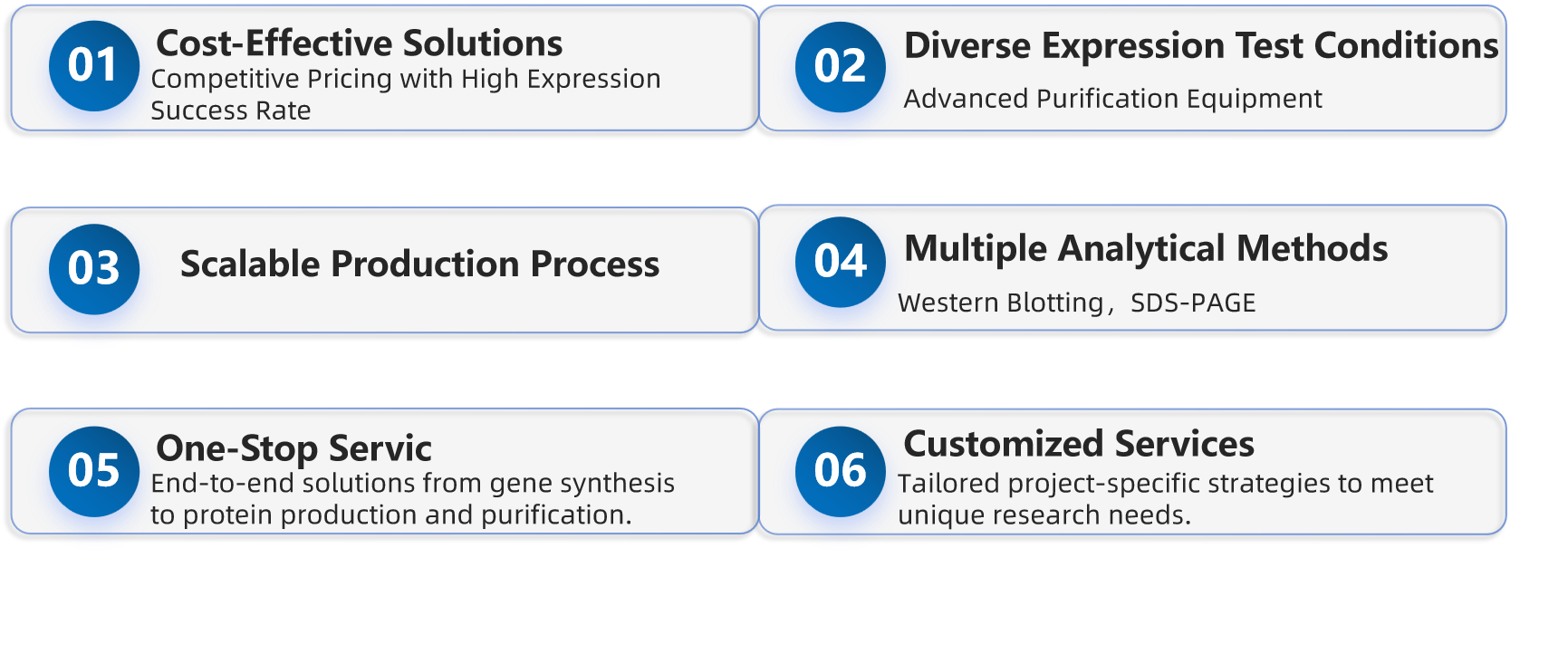
Characteristics of Prokaryotic E. coli Expression Systems

图片6.png

Common Issues in E. coli Expression

1. Low expression levels: The prokaryotic expression system may fail to produce sufficient protein, which can be caused by weak promoter strength, codon usage bias, mRNA instability, or insufficient post-translational modifications. To address this issue, stronger promoters, codon optimization, enhanced mRNA stability, or introduction of suitable post-translational modifications can be attempted.

2. Protein insolubility: Many recombinant proteins may exist as insoluble forms (inclusion bodies) in prokaryotic cells. This may result from incorrect protein folding, overly rapid translation, or lack of appropriate molecular chaperones. Solutions may include reducing expression levels, using fusion tags, introducing molecular chaperones, or optimizing culture conditions.

3. Protein degradation: Expressed proteins may be degraded by host proteases in the prokaryotic system, resulting in reduced expression levels. To resolve that, protease inhibitors can be used, stability-enhancing tags introduced, or protein structure optimized to improve stability.

4. Toxicity issues: Some expressed proteins may be toxic to host cells, leading to inhibited cell growth or cell death. To resolve this, researchers can reduce expression levels, implement conditional expression systems, or apply strategies to mitigate protein toxicity.

5. Endotoxin contamination: Proteins expressed in prokaryotic systems may be contaminated with endotoxins, which can adversely affect downstream applications. Solutions may include using endotoxin-free expression systems, applying endotoxin removal kits, or optimizing purification processes to reduce endotoxin levels.

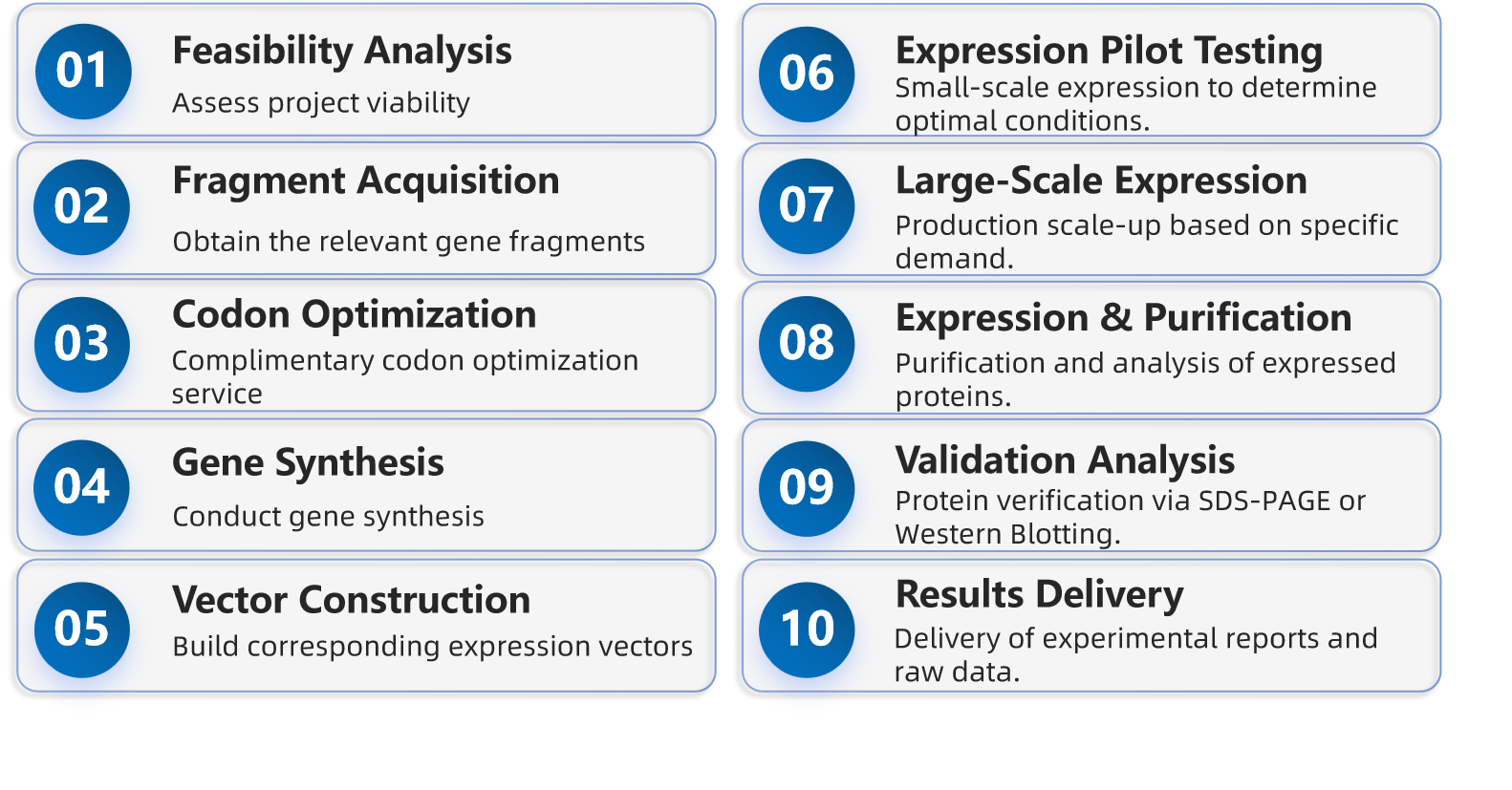
Prokaryotic E. coli Expression Service Process

图片7.png


Login

Don’t have an account?Sign Up Now

Register

Already have an account?Log In Now