Home
>>
Antibody Platform
>>
Peptide Library Platform
>>
Cyclic Heptapeptide Library Construction & Screening
Download Center
Quick Inquiry & Consultation

Cyclic Heptapeptide Library Construction & ScreeningIntroduction

KMD Bioscience's Phage Display Platform is an ultra-high-throughput ligand screening platform. The Phage Display Platform can construct and display up to 1013 clones/mL of peptide or antibody clones. Based on this platform, KMD Bioscience can construct libraries for clients, including 7-mer, 12-mer, and Cyclic 7-mer Peptide Libraries.

Cyclization Modification can confer advantages to peptides, making them more drug-like. Cyclic Peptides generally exhibit greater resistance to proteases and enhanced cell-penetrating ability. Constraining peptides via cyclization is a common strategy, primarily to mimic protein secondary structures (e.g., peptide loops) or to create peptides with enhanced Conformational Stability compared to their linear analogs. KMD Bioscience has constructed a Pre-made C7C Phage Display Peptide Library, aiming to build High-Quality cyclized peptide libraries.
Construction of Phage Display Cyclic 7-mer Peptide Library

The C7C library features a random fragment flanked by a pair of cysteine residues. These cysteines are oxidized to form a disulfide bond during phage assembly, resulting in the displayed peptide being presented to the target in a cyclic conformation. Each library possesses a complexity of 109 independent clones, sufficient to encode most possible 7-mer (1.28 × 109) peptide sequences. However, this represents only a small fraction (less than one millionth) of the approximately 4.1 × 1015 possible 12-mer sequences. Therefore, the 12-mer library is generally considered to have diversity equivalent to the 7-mer library, but distributed across 12 residues.

In both 7-mer and 12-mer libraries, the N-terminal first residue of the peptide-pIII fusion is the first randomized position. In the C7C library, the randomized positions are preceded at the N-terminus by Ala-Cys. All libraries incorporate a short linker sequence (Gly-Gly-Gly-Ser) between the displayed peptide and the pIII coat protein.

Screening of Phage Display Cyclic 7-mer Peptide Library

The primary strategy for Phage Peptide Libraries Screening leverages the varying affinities between biomolecules. Using a biomolecule as the target, specific binding peptides with defined affinity can be isolated from the peptide library through direct or multiple rounds of screening. Phage Peptide Library Screening typically employs biological screening techniques, also known as Biopanning, which use biological operations to isolate desired phage peptides from a random phage peptide library. Screening methods can vary based on the Nature of the Target, the Scale of Screening, and Operator Preference. 

The main steps of Library Screening are:

1. Select Phage Target Capture Method: Prepare the capture surface using target coating and blocking, or choose the affinity magnetic bead method.

2. Incubate the Phage Library with the Target.

3. Wash away unbound Phage using TBST, and elute Bound Phage using low pH buffer or known ligands to the target.

4. Amplify the selected Phage eluate. Concentrate phage by adding PEG/2.5 M NaCl to the culture supernatant.

5. Titer the unamplified eluate and the enriched phage pool to determine the input for the next round of Selection. Increase selection or wash stringency as needed.

6. After Three Rounds of Screening, do not amplify the eluate. Instead, titer the third-round eluate to obtain individual plaques for Phage Sequencing Reactions.

7. Post-Screening Analysis: Determine sequence motifs and/or conduct binding studies with selected clones.

Phage Display Peptide Library: Construction & Screening Workflow

Project Content

Service Content

Timeline

Cyclic 7-Peptide Gene Library SynthesisChemically synthesize randomized cyclic heptapeptide oligonucleotide fragments.3-5 weeks
Cyclic 7-Peptide Library Construction ServicePhagemid construction & transformation: Homologous recombination of the target gene into the pMECS vector, transformation into host strain TG1, construction of M13 phage display cyclic heptapeptide library.4-6 weeks
Cyclic 7-Peptide Library Screening Service3 rounds of screening (KMD Bioscience will decide whether to add additional rounds at no extra cost if special circumstances arise); Pick 50 to 80 Blue Plaques for sequencing.4-5 weeks

Common Target Molecules for Peptide Library Screening

Molecular Type

Introduction

Membrane Receptor Extracellular Domains

Using isolated full membrane receptors as targets in the in vitro library screening environment is challenging due to their high hydrophobicity and dependence on a lipid bilayer environment for maintaining native folding. Membrane receptors often have large multi-domain extracellular regions that may interact with diverse peptide sequences. Isolated ligand-binding domains of receptors are excellent surrogate targets for focused selection of peptides mimicking endogenous ligands. Targeting shorter receptor fragments can also enhance specificity towards particular members of highly conserved receptor families. Conversely, synthetic peptides corresponding to specific receptor domains may adopt conformations different from the native protein; thus, selected peptides might not recognize the receptor in its natural environment. Therefore, it may be Necessary to first Screen Phage Libraries against Synthetic Peptides, followed by Affinity Selection of the resulting enriched library against the Native Protein.

Neutralizing Antibodies against Endogenous Binding Partners

Neutralizing Antibodies against endogenous ligands can serve as surrogate targets for Identifying Bioactive Peptides. The antigen-binding region of the antibody mimics the ligand-binding site of the receptor, providing a "mold" for recovering peptides that cross-react with the receptor. Neutralizing antibodies do not necessarily recognize the exact receptor-binding epitope on the ligand but may exert their antagonism by binding to sites near these regions, blocking ligand-receptor interaction.

Whole Cell Screening

Phage libraries can also be screened against live cells expressing the membrane receptor of interest. This eliminates concerns about target protein misfolding and allows selection against the extracellular region of the receptor in its native conformation. Target cells can be in suspension or adherent. The primary goal is to find peptides binding to tumor-specific receptors for targeted delivery of drugs or diagnostics.

Future Prospects of Phage Display Technology

Two drugs developed through random peptide libraries of Phage Display Screening are peginesatide (marketed as Hematide by Affymax) and romiplostim (marketed as Nplate by Amgen). Peginesatide is a pegylated erythropoietin receptor agonist, while romiplostim is an Fc-fused thrombopoietin receptor agonist. Using Phage Display Technology, two other drugs have also been developed: the anti-TNF-α antibody adalimumab and the small protein inhibitor of plasma protease kallikrein, ecallantide. This success establishes the technique alongside other mature methods in the Drug Discovery field.

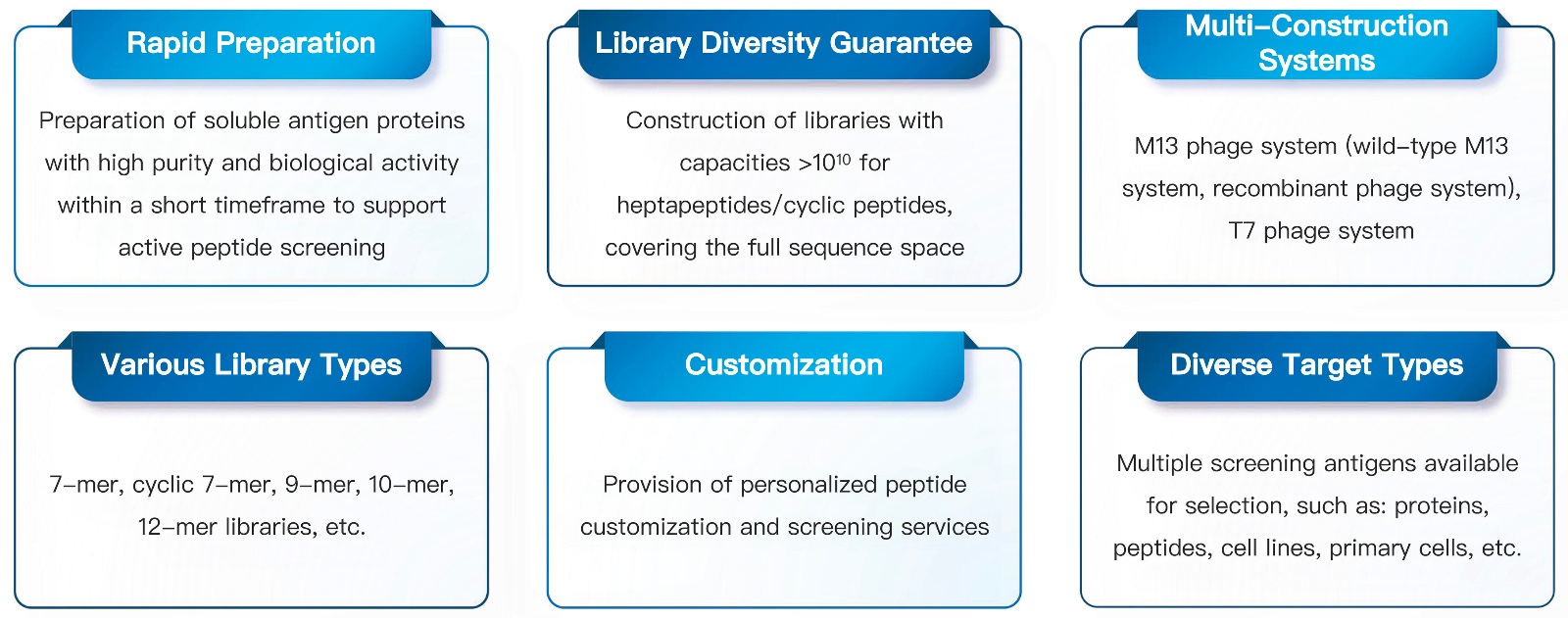
KMD Bioscience Service Advantages

70-KMDBioscience-cyclic-heptapeptide-library-construction-and-screening.jpg

Login

Don’t have an account?Sign Up Now

Register

Already have an account?Log In Now