Home
>>
Technical Platform
>>
Gene Editing Platform
>>
Microbial Gene Knockout (KO) Service
Download Center
Quick Inquiry & Consultation
Microbial Gene Knockout (KO) ServiceIntroduction

Microorganisms are a group of organisms with small sizes and simple structures, often invisible to the naked eye, including bacteria, fungi, protozoa, algae, viruses, and others. They are ubiquitous in nature. By applying genetic engineering to modify microbial genomes at specific loci, microorganisms can be improved, and gene functions can be studied.

Microbial gene knockout can be achieved using the λ-Red homologous recombination method and the CRISPR/Cas9 system. The λ-Red homologous recombination method uses the λ phage Red recombinase system to facilitate homologous recombination with only 40-60 bp of homologous sequences required for efficient recombination. Compared to the traditional λ-Red recombination system, CRISPR-Cas9 tools offer advantages such as simplicity, high efficiency, no need for screening markers, and easy identification of positive clones.

KMD Bioscience, leveraging its extensive experience in genetic engineering and the established Gene Editing Platform, can provide customers with microbial Gene Modification Solutions and Strain Construction Services. These include bacterial species such as E. coli, Klebsiella pneumoniae, Salmonella, Bacillus subtilis, as well as microorganisms like Saccharomyces cerevisiae, Pichia pastoris, and Candida albicans. In addition, we offer downstream services such as Protein Expression and Purification.

Content

When double-strand breaks (DSBs) occur within the cell, it activates the homologous end-joining repair (HDR) and non-homologous end-joining (NHEJ) mechanisms. Eukaryotes primarily rely on HDR (which requires a homologous DNA fragment) and NHEJ (which does not require a homologous fragment), while prokaryotes mainly rely on HDR for repair. The NHEJ pathway is only present in a few bacteria, while most bacteria depend on the HDR pathway for repair. CRISPR-Cas9-based gene editing is widely used in prokaryotes, where the insertion, deletion, or mutation of genes can be achieved when introducing exogenous DNA fragments. E. coli is commonly used in gene editing research due to its well-understood genetic background, ease of operation, and simple culture conditions. Pichia pastoris has advantages such as rapid growth, high-density fermentation, and ease of genetic modification, making it suitable for producing modified proteins or proteins that are difficult to express in prokaryotic systems.

Microorganisms

Common strains

Bacteria

Escherichia coli, Klebsiella pneumoniae, Salmonella, Acinetobacter baumannii, Burkholderia, Bacillus species, Pseudomonas aeruginosa, Staphylococcus aureus, Corynebacterium glutamicum, Lactic acid bacteria species, Streptococcus mutans, Enterococcus faecalis, Streptococcus pneumoniae, Streptococcus suis, Erythrobacter, and other bacterial species.

Fungi

Escherichia coli, Klebsiella pneumoniae, Salmonella, Acinetobacter baumannii, Burkholderia, Bacillus species, Pseudomonas aeruginosa, Staphylococcus aureus, Corynebacterium glutamicum, Lactic acid bacteria species, Streptococcus mutans, Enterococcus faecalis, Streptococcus pneumoniae, Streptococcus suis, Erythrobacter, and other bacterial species.

Note: If you have genetic editing requirements for other strains, please contact us for one-on-one customized services.

Table 1: Types of Microbial Gene Editing

Process

The establishment of a microbial gene knockout system based on CRISPR/Cas9 technology involves several steps, such as sgRNA design, vector construction and transformation, transformant screening, and molecular identification.

For the λ-Red homologous recombination method, homologous arm sequences need to be designed to construct the knockout vector. The homologous arm sequences and vector are then transfected into the host bacteria. Under the action of Red recombinase, homologous recombination occurs between the knockout vector and the target gene, resulting in the target gene being replaced by an antibiotic resistance gene. Finally, selective enrichment with the antibiotic resistance gene allows for the screening of knockout strains.


Step

Content

Timeline

Step 1 sgRNA Design

(1) The customer provides the target gene;

1 week

(2) Perform bioinformatics analysis to identify the target site and design the target sequence based on the PAM site, adding a restriction site at the end;

(3) Synthesize the sgRNA sequence.

Step 2 CRISPR Cas9 Vector Construction

(1) Construct sgRNA vector and transform into E. coli;

2-3 months

(2) Donor DNA fragment: Construct upstream and downstream DNA fragments of the target gene for homologous recombination.

Step 3 Vector Transformation

(1)Transform plasmids containing sgRNA expression cassettes (e.g., pCfB2312) into host bacteria;

Consultation required

(2)Transform sgRNA vector and donor DNA into a host strain stably expressing Cas9 protein.

Step 4 Strain Validation

(1) Antibiotic screening: Screen using G418 or Nat antibiotic;

Consultation required

(2) Isolate single colonies, perform PCR and electrophoresis verification.


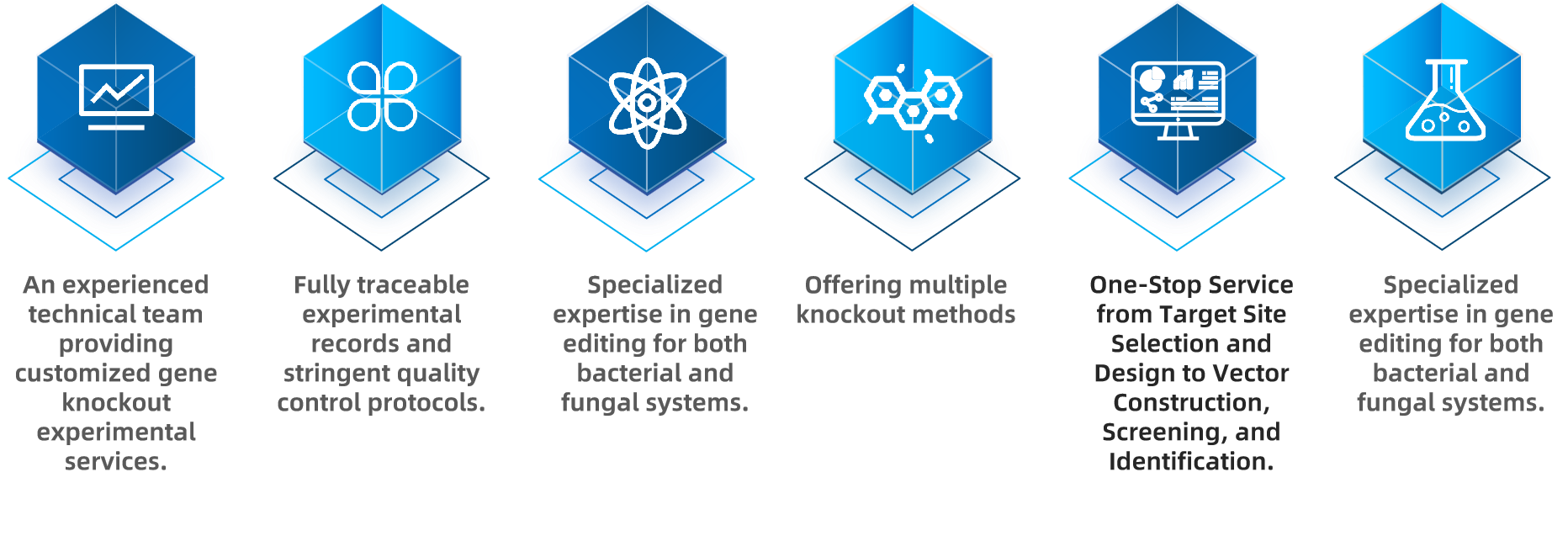
Advantage

图片40.png

Frequently Asked Questions

1.What methods are used for bacterial gene knockout?

Answer: Gene knockout methods for bacteria include the Red homologous recombination method and CRISPR/Cas9 technology. The Red recombinase-mediated gene knockout requires the elimination of the strain’s resistance genes. In contrast, CRISPR/Cas9 enables seamless knockout, meaning there is no residual resistance or recombination site, and it also removes any exogenous plasmids.


2.What are the applications of bacterial gene knockout?

Answer: Applications of bacterial gene knockout include strain improvement, disease mechanism research, immune applications, precision medicine (targeted treatment of genetic diseases), antibiotic development, discovery of industrial enzymes, and applications in the microbial fermentation industry.


3.What is the procedures for bacterial gene knockout experiments?

Answer: The process involves constructing CRISPR/Cas series vectors, transforming competent host bacteria, screening and validating gene knockout strains, and preserving the strains.

Login

Don’t have an account?Sign Up Now

Register

Already have an account?Log In Now