Home
>>
Antibody Platform
>>
Peptide Library Platform
>>
Heptapeptide Library Construction & Screening
Download Center
Quick Inquiry & Consultation

Heptapeptide Library Construction & ScreeningIntroduction

KMD Bioscience provides a Phage Display Platform which is an ultra-high-throughput ligand screening system. This platform is capable of constructing libraries with up to 1013 peptide or antibody clones per milliliter (clones/mL) displayed on phages. Based on the Phage Display Platform, KMD Bioscience offers services including the construction of 7-mer, 12-mer, and Cyclic 7-mer Peptide Libraries.

Phage Display Library Screening is an in vitro selection technique. It enables the display of diverse peptide or protein libraries on the surface of phage particles, whereas the DNA encoding these proteins resides inside the viral particle. Utilizing the physical link between the displayed protein and its encoding DNA, peptides with affinity for a given target molecule (such as an antibody, enzyme, or cell surface receptor) can be rapidly isolated through a simple in vitro selection process known as "Biopanning" against the ligand.

The most basic panning method involves immobilizing the target molecule onto a plate or beads. A phage library displaying variant peptides is then incubated with the immobilized target. Unbound phages are washed away, followed by the elution of specifically bound phages. The eluted phages are amplified. This binding-amplification cycle is repeated to enrich for phages displaying peptide sequences that bind the target molecule. After 3-4 rounds of screening, individual clones are identified through DNA sequencing, blue-white screening, or ELISA.

Construction of Phage Display 7-mer Peptide Library

The 7-mer Library displays linear heptapeptides in the format A-X7-GGGS (where X represents any canonical amino acid). A key feature of this library is the display of randomized peptides in this specific format. The peptide sequence is fused to the N-terminus of the phage minor coat protein pIII. A tetrapeptide linker sequence (Gly-Gly-Gly-Ser) exists between the displayed peptide and the mature pIII protein of the phage.

Using the target molecule provided by the client, phage clones exhibiting high-affinity binding to the target are isolated from the entire Pre-made Phage Random 7-mer Peptide Library through steps of screening, amplification, and enrichment. The amino acid sequence of the peptide displayed by the bacteriophage can be determined by sequencing its DNA.


Phage Display Peptide Library: Construction & Screening Workflow

Project

Service Content

Timeline

7-mer Peptide Library Synthesis

Chemically synthesized randomized oligonucleotide fragments encoding cyclic heptapeptides

3-5 weeks

7-mer Peptide Library Construction Service

pMECS-based target gene homologous recombination assembly, TGI transfomation, and M13 phage display 7-mer library construction

4-6 weeks

7-mer Peptide Library Screening Service

Three rounds of biopanning (KMD Bioscience will determine if additional rounds are necessary under special circumstances, at no extra cost). 50-80 blue plaques are picked for DNA sequencing

4-5 weeks

Common Target Molecules for Peptide Library Screening

Molecular Type

Introduction

Extracellular Domain (ECD) of Membrane Receptors

Using isolated full-length membrane receptors as targets in vitro for library screening is challenging due to their high hydrophobicity; they maintain native folding only within a lipid bilayer environment. Membrane receptors typically possess large, multi-domain extracellular regions that may interact with diverse peptide sequences. Isolated ligand-binding domains of receptors serve as excellent alternative targets for focused selection of peptides mimicking endogenous ligands. Targeting shorter receptor fragments can also enhance specific toward particular members of highly conseved receptor families. Moreover, synthetic peptides corresponding to specific receptor domains may adopt confomations distinct from the native protein. Consequently, selected peptides might not recognize the receptor in its natural context. Therefore, it is necessary to first screen the Phage Display Library against the synthetic peptide, followed by affinity selection of the resulting enriched library against the native protein.

Neutralizing Antibodies Targeting Endogenous Binding Partners

Neutralizing antibodies against endogenous ligands can serve as surrogate targets for indentifying biologically active peptides. The antigen-binding region of an antibody mimics the receptor's ligand-binding site, providing a "mold" for recovering peptides that cross-react with the receptor. While neutralizing antibodies may not recognize the exact receptor-binding epitope on the ligand, they exert antagonism by sterically blocking ligand-receptor interactions through binding to sites adjacent to these regions.

Whole-Cell Screening

The Phage Display Library can also be screened against live cells expressing the membrane receptor of interest. This eliminates concerns about target protein misfolding and enables selection against the receptor's extracellular region in its native conformation. Target cells may be either suspension or adherent. The primary objective is to identify peptides binding Tumor-Specific Receptors for targeted delivery of therapeutics or diagnostic agents.

Future Prospects of Phage Display Technology

Two drugs developed by screening Phage Display Random Peptide Libraries are peginesatide (Hematide, Affymax), a PEGylated erythropoietin receptor agonist, and romiplostim (Nplate, Amgen), an Fc-fused thrombopoietin receptor agonist. Additionally, two other drugs, the anti-TNF-α antibody adalimumab (Humira) and the small protein inhibitor of plasma protease kallikrein, ecallantide (Kalbitor), have been developed using Phage Display Technology. This establishes the technology alongside other well-established methods in the field of drug discovery.


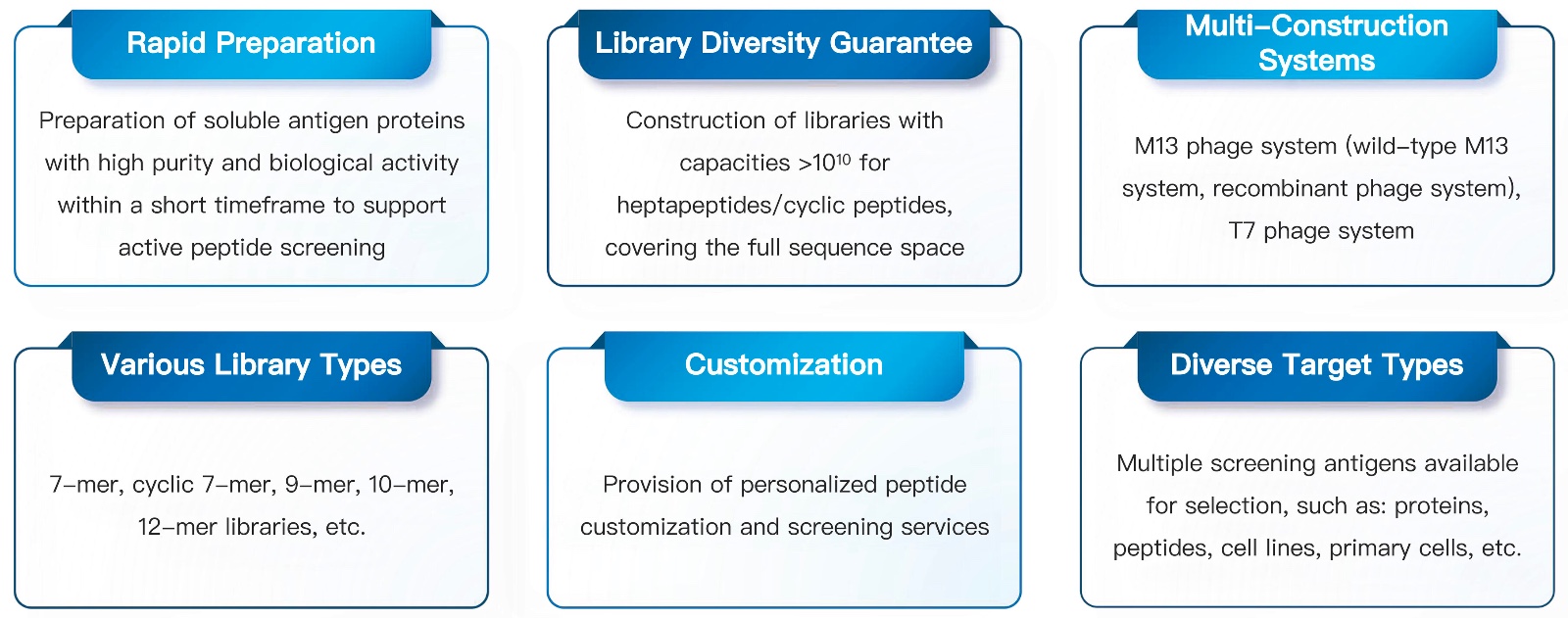
KMD Bioscience Service Advantages

69-KMDBioscience-heptapeptide-library-construction-and-screening.jpg

Login

Don’t have an account?Sign Up Now

Register

Already have an account?Log In Now