Home
>>
Antibody Platform
>>
Innovative Drug Discovery Platform
>>
Aptamer Screening Service

Aptamer Screening ServiceIntroduction

The Aptamer In Vitro Screening Service provided by KMD Bioscience enables rapid and accurate identification of high-affinity and highly specific aptamers for clients, offering a cost-effective solution for their research projects. We provide a one-stop in vitro aptamer screening solution by flexibly leveraging the natural evolution of ligand systems through the Systematic Evolution of Ligands by EXponential Enrichment (SELEX) Technology (e.g., SELEX can identify distinct cells or detect molecular-level differences between two cell types).

Aptamers are short, 20–80 nucleotide (nt) single-stranded DNA (ssDNA) or RNA sequences, or proteins. They bind target molecules with high affinity and specificity by folding into specific three-dimensional structures. RNA sequences constitute the majority of nucleic acid aptamers, as they can be synthesized in vitro via transcription. The presence of the 2'-OH group in RNA may offer more diverse secondary structures compared to ssDNA molecules.

Aptamers are single-stranded nucleic acids (DNA or RNA) capable of binding predetermined targets with high affinity and specificity. They can be defined as "artificial antibodies" and are widely applied in fundamental life science research, clinical diagnostics, drug development, etc. KMD Bioscience has assembled a team of highly skilled experts with extensive experience in Aptamer In Vitro Screening, providing clients with a high-quality service.
Systematic Evolution of Ligands by EXponential Enrichment(SELEX)

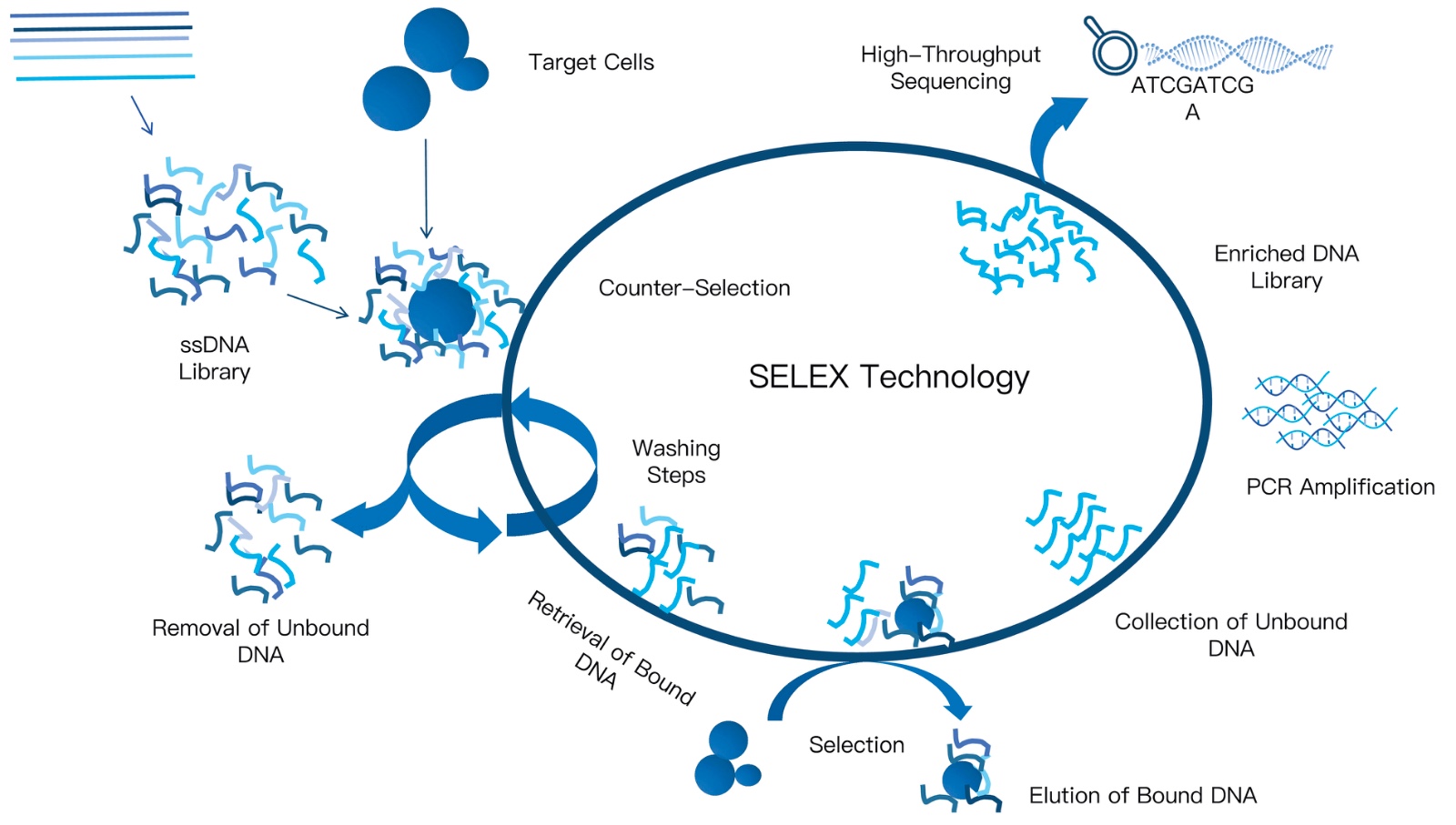
SELEX is an in vitro method widely used to select aptamers (single-stranded DNA or RNA oligonucleotides) that bind specifically to a target ligand from a library of random single-stranded nucleic acid sequences. The fundamental process of SELEX Technology comprises the following steps:

(1) In vitro chemical synthesis of a single-stranded oligonucleotide library.

(2) Incubation of the randomized library with the target ligand to allow oligonucleotide-target binding. 

(3) Washing away unbound nucleic acid molecules.

(4) Elution of bound aptamers.

(5) Amplification of the bound aptamers via PCR to generate a secondary library for the next round of screening.

(6) Repetition of steps (2) through (5) to obtain aptamers exhibiting high affinity and specificity for the target ligand.

The Aptamer In Vitro Screening Technology provided by KMD Bioscience enables rapid identification of candidate target molecules in aptamer screening experiments against proteins (cells or small molecule peptides).

65-KMDBioscience-aptamer-screening-service.jpg

Figure 1. Typical SELEX Procedure

Leveraging SELEX, KMD Bioscience scientists offer Aptamer In Vitro Screening Services, such as Aptamer Screening for Proteins (Aptamer Screening for Cells, etc.). Clients only need to provide the target protein, relevant sequence, or sequence ID. KMD Bioscience will then perform SDS-PAGE analysis of the target protein, followed by library construction and target protein screening. Subsequently, the screened aptamers are dissociated, and iterative rounds of elution screening are performed. This process is followed by PCR, NGS sequencing, and final aptamer synthesis. KMD Bioscience also provides a One-Stop Service, encompassing Gene Synthesis and Analysis, Protein Expression and PurificationAptamer In Vitro Screening, delivering robust support for client research projects.

Service Scope

Services provided by KMD Bioscience include:

-- Protein-Based SELEX Service for Aptamer Development.

-- Whole-Cell-Based SELEX Service for Aptamer Development.

-- Live-Animal-Based SELEX Service for Aptamer Development.

-- Aptamer Pair Development Service for Aptamer Development.

Service Content

Service Items

Content

Timeline

Single-Stranded DNA (ssDNA) Library Construction

* Chemically synthesize of a custom oligonucleotide library comprising randomly generated fixed-length sequences flanked by constant 5' and 3' primer ends

1 week
In Vitro Selection

* Target incubation, binding sequence elution, and amplification; repeated for 3-4 cycles

4-5 weeks
NGS Sequencing

* Identification of candidate aptamers using Next-Generation Sequencing (NGS), bioinformatics, and biophysical methods

2 weeks
Aptamer Synthesis

* High-quality aptamer synthesis and purification via HPLC, accompanied by an MS Report

1 week
Modification

* Selection of specific modification methods (e.g., biotin, 5'-NH2, 5'-thiol, fluorescennt dyes) based on distinct requirements and applications

2 weeks
Binding Affinity Test

* KD determination using techniques such as BLI and SPR

1 week

Customer-Provided

Sample

Requirements

Proteins

* Large tag included

* Buffer devoid of free amino groups

* PBS buffer preferred

* Tris-containing buffers excluded

* Purity > 95%

* Amount: 0.5-1 mg

* Concentration: 1 mg/mL

Small Molecules

* Good water solubility (>1 mM)

* Stable (resistant to oxidation, decomposition, etc.)

* Low dilution heat

* Purity > 95%

* Amount: ≥ 10 mg

Cells and Bacteria

Contact us for consultation

Delivery Content

--A comprehensive experimental report and the client-specified aptamer sequences.

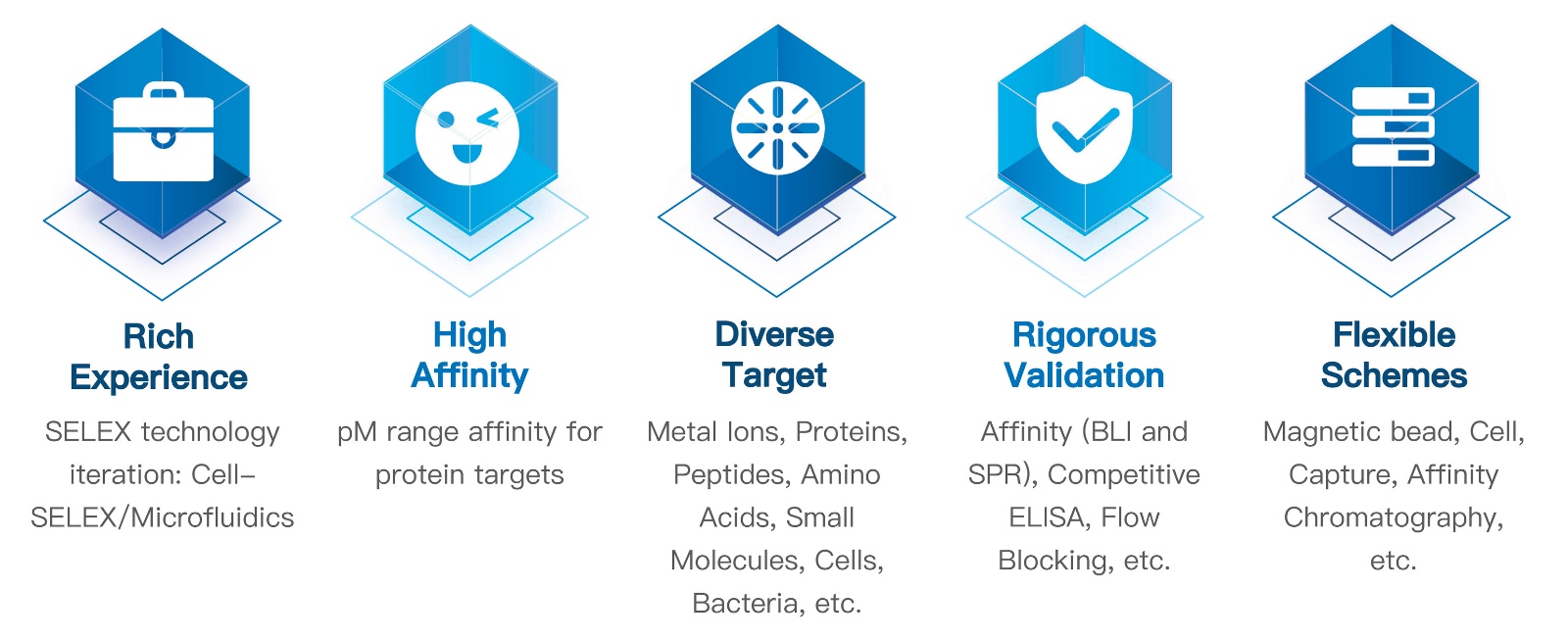
Service Advantage

66-KMDBioscience-aptamer-screening-service.jpg

Login

Don’t have an account?Sign Up Now

Register

Already have an account?Log In Now