Home
>>
Technical Platform
>>
Gene Editing Platform
>>
Animal Gene Knock-In Service
Download Center
Quick Inquiry & Consultation
Animal Gene Knock-In ServiceIntroduction

Mice are small mammals belonging to the order Rodentia and the family Muridae. They are one of the most commonly used model organisms in laboratories. The mouse genome shares a high degree of homology with the human genome, with about 99% of human genes having corresponding homologs in mice. Therefore, studying mouse gene functions can be directly applied to human biology. Using gene editing technology, human diseases can be simulated in mice to create disease models for observing disease progression and drug efficacy.

The core application of gene knock-in technology lies in constructing human disease models. Single base mutations or gene misplacement discovered in human genomics research are the root causes of many diseases, especially genetic disorders. By introducing point mutations or exogenous fragments into target sites via gene knock-in, disease models can be established in cultured cell lines or model organisms.

KMD Bioscience, with its extensive experience in genetic engineering, has established a gene editing platform based on the CRISPR/Cas9 system. The company provides animal gene knock-in vector construction services, including for model animals such as mice, zebrafish, and rabbits.


Animals

Disease Models

Mouse

Tumors (lung cancer, pancreatic cancer, prostate cancer, gastric cancer, liver cancer, colon cancer, etc.); Metabolic (pulmonary fibrosis, diabetes models, obesity models); Depression models;

Rabbit

Diabetes models, progeria models, rickets models, intracerebral hemorrhage models, spinal cord glioma models, brain glioma models, migraine models, Parkinson’s disease models, Alzheimer’s disease models;

Pig

Diabetes models, progeria models, rickets models, intracerebral hemorrhage models, spinal cord glioma models, brain glioma models;


Content

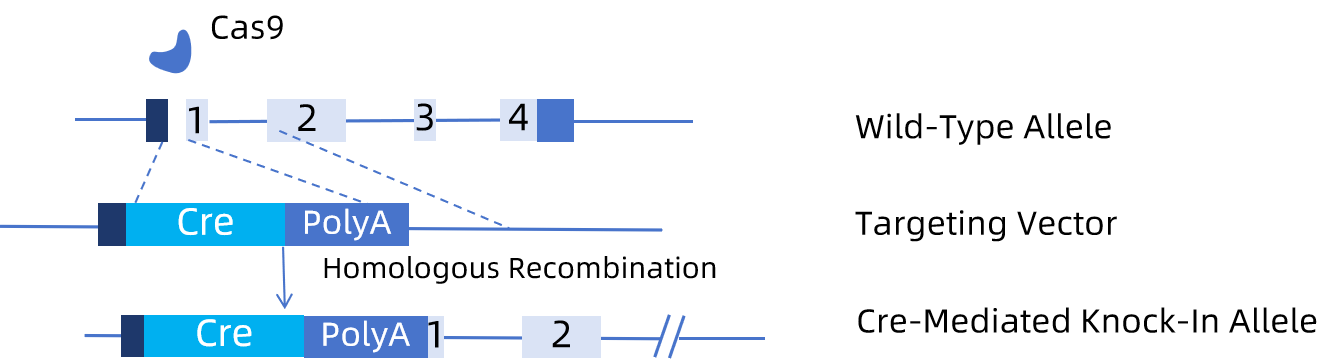
Knock-In Strategies:

1. Co-expression of Exogenous Genes

图片36.png

2. Exogenous Gene Replacing Endogenous Gene Expression

图片37.png

Figure 1. Gene Knock-in Based on the CRISPR-Cas9 System

Step

Content

Step 1 sgRNA Design

(1) The customer provides the target gene;

(2) Perform bioinformatics analysis to identify the target site and design the target sequence based on the PAM site, adding a restriction site at the end;

(3) Synthesize the sgRNA sequence.

Step 2 CRISPR-Cas9 Vector Construction

(1)Ligate the synthesized sgRNA sequence into the vector. Transform the host bacteria and verify via sequencing.

Step 3 Co-transfection of Vectors into Cells

(1) Cell seeding;

(2) Plasmid dilution;

(3) Production of plasmid–transfection reagent complexes;

(4) Co-transfection of cells with sgRNA vector, cas9 vector, and fluorescent reporter vector;

(5) Flow cytometry sorting of monoclonal cells.

Step 4 In Vitro Transcription

(1) Extraction of genomic DNA from cells;

(2) Production of transcription templates for sgRNA and Cas9;

(3) In vitro transcription of sgRNA and cas9 mRNA.

Step 5 Superovulation and Microinjection in Animal Cells

(1) Treat female animals with estrogen and gonadotropins, collect fertilized eggs;

(2) Microinject the mixture of sgRNA and cas9 mRNA into the cytoplasm of fertilized eggs.

Step 6 F0 Mutation Detection

(1) Verify mutations via restriction digestion and sequencing.


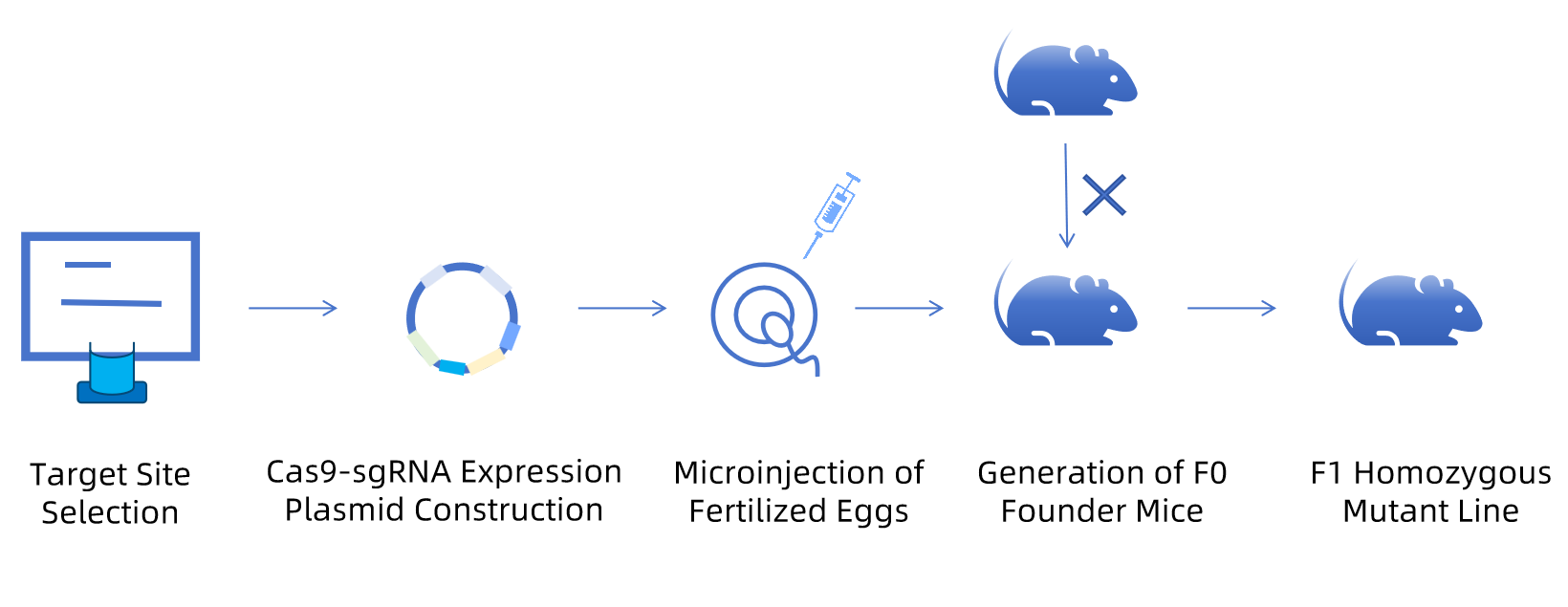
Process

图片38.png

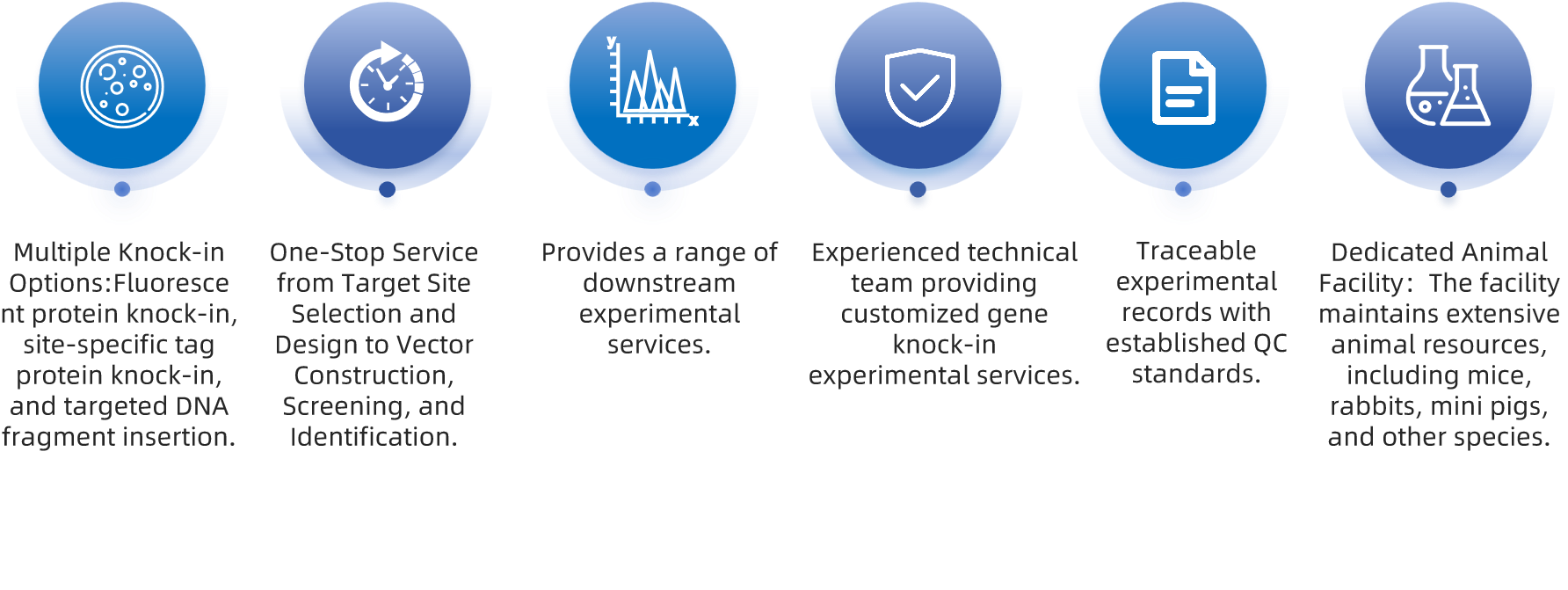
Advantage

图片39.png

Frequently Asked Questions

1. What is animal gene knock-in?

Answer: Animal gene knock-in is a gene editing technology that allows the insertion of exogenous DNA sequences into specific loci in animal cells. This enables the expression or modification of new genes. This technology is useful for studying the function and regulation of specific genes, as well as their impact on the organism.


2. What are the applications of gene knock-in technology?

Answer: Gene knock-in technology is used to create genetically modified animal models to simulate human genetic diseases, thus enhancing our understanding of disease mechanisms. It is also applied in studying the function and regulation of specific genes, and their impact on development, physiology, and diseases in organisms.


3. How to perform animal gene knock-in experiments?

Answer: First, the target gene and knock-in site must be identified, and a suitable knock-in strategy designed, including selecting an appropriate vector and designing homologous recombination sequences. Then, the constructed vector is introduced into animal cells, and the gene editing system induces DNA double-strand breaks. The exogenous gene or tag is then inserted into the target gene locus through the homologous recombination repair mechanism. Finally, the successfully knocked-in cells are screened and validated, including methods like PCR and sequencing, to confirm the precise insertion of the gene at the target site and to assess the expression and function of the gene.

Login

Don’t have an account?Sign Up Now

Register

Already have an account?Log In Now