Home
>>
Protein Platform
>>
Protein Expression Services
>>
Mammalian Cell Protein Expression
Mammalian Cell Protein ExpressionIntroduction

The mammalian protein expression system is suitable for researchers requiring in vitro recombinant expression of proteins in their native conformation, including modifications such as glycosylation and phosphorylation. Utilizing this system combined with high-density fermentation techniques, our scientists have achieved recombinant antibody expression levels up to 6.3 g/L, making it ideal for the high-level expression of recombinant monoclonal antibody drugs. Our cell culture personnel are all trained under strict GMP and quality control systems, ensuring traceable documentation for Protein Expression and Production.

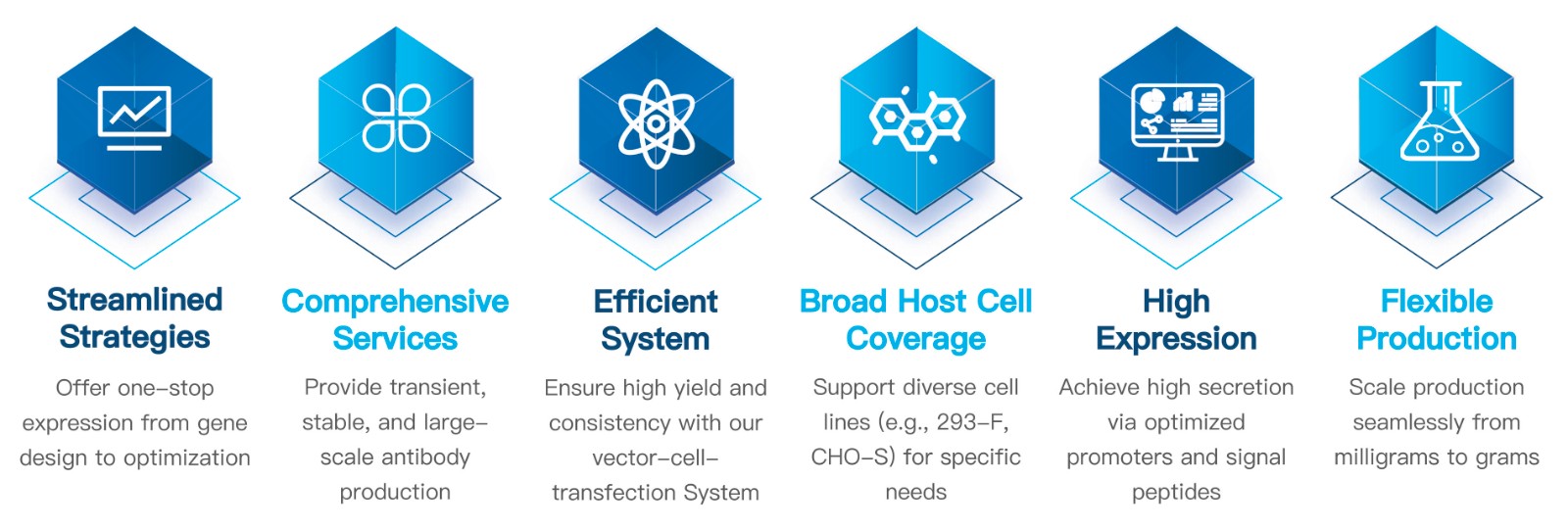
We have established a comprehensive Recombinant Protein Mammalian Expression System, including but not limited to FreeStyle 293-F, Expi293-F, ExpiCHO-K1, and ExpiCHO-S cell lines. Combined with our proprietary high-expression vectors, featuring CMV promoters and optimized secretion signal peptide sequences, we can offer clients higher expression levels of recombinant proteins through Mammalian Cell Expression and Production. With the use of purification resins and equipment provided by GE, large-scale fermentation, and a single-use cell culture factory for Protein Expression and Production, we can deliver high-quality recombinant proteins in batches. This technical platform enables fermentation and transfection to be completed in one step, significantly shortening the production timeline.
Recombinant Protein Mammalian Expression Systems

Type

Definition

Advantages

Transient Expression System

The exogenous DNA fragment cannot replicate along with cell division, resulting in short-lived expression as the plasmid DNA is gradually lost.

Short experimental cycle and simple operation.

Stable Expression System

The exogenous DNA fragment integrates into the host genome and is stably passed on during cell division.

Sustained and stable expression of the target protein.

Inducible Expression System

Transcription of the target gene is activated only upon induction by small exogenous molecules.

Utilizes heterologous promoters, enhancers, and amplifiable genetic markers to increase protein yield.

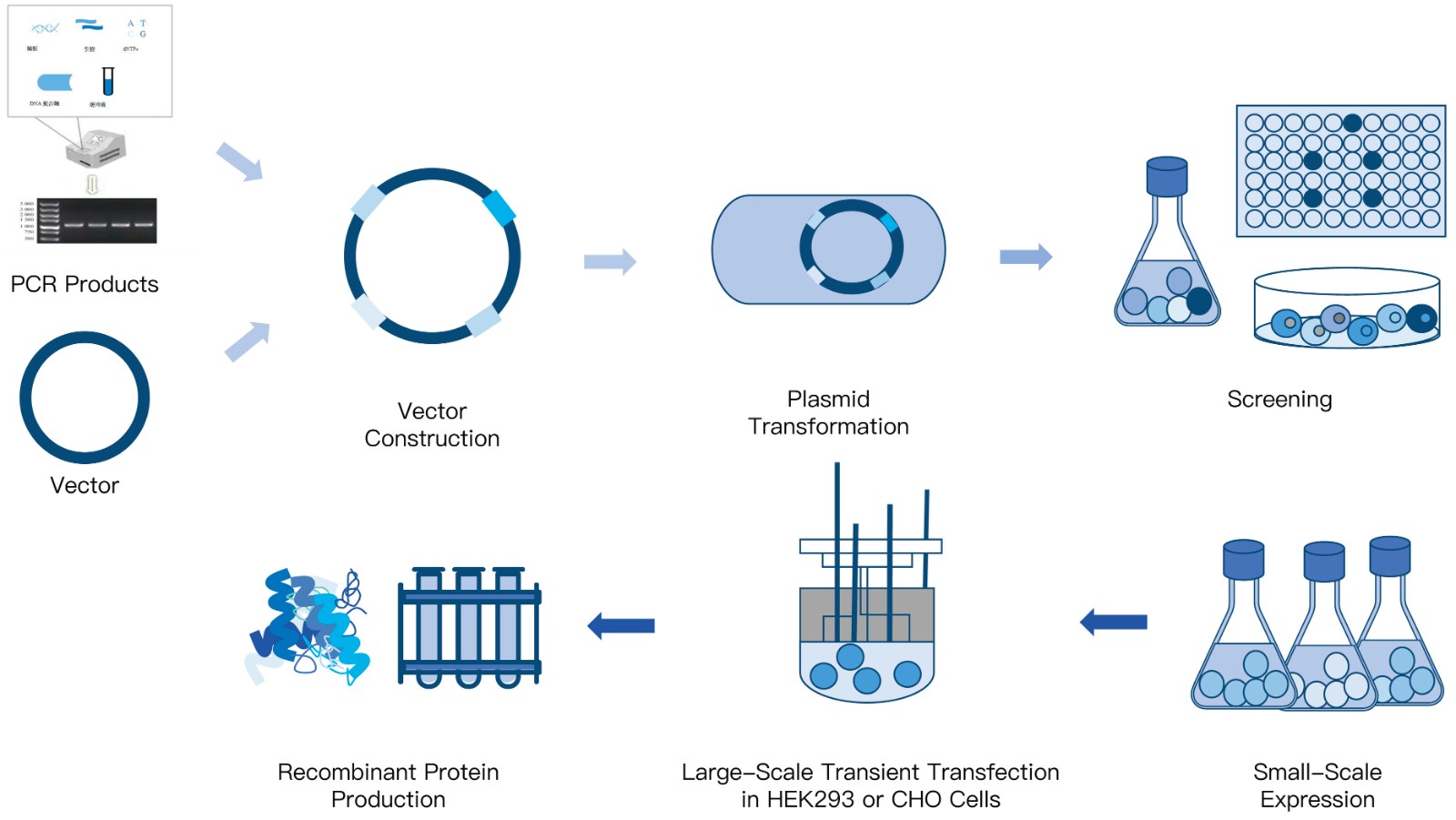
Recombinant Protein Mammalian Expression Service Workflow

1-KMDBioscience-Recombinant-Protein-Mammalian-Expression-Services.jpg

Recombinant Protein Mammalian Expression Experimental Workflow

Step

Service content

Timeline

Gene Cloning and Vector Construction

* Amplify/identify gene fragments or synthesize target genes, and insert them into mammalian expression plasmids.

2-3 weeks

* PCR and sequencing to verify subcloned gene.

* Delivery: expression vector, cloned strain, and plasmid construction QC report.

Transient Protein Expression

* Transfection of recombinant plasmids into cells (293F, CHO) : Transient expression.

3-4 weeks

*SDS-PAGE and Western Blot analysis.

* Delivery: recombinant protein, purity >85% (SDS-PAGE), experiment report.

Stable Expression

* Construction and screening of CHO or 293F stable cell lines for recombinant protein expression.

12-14 weeks

* Delivery: stable cell line, construction report. marginal products, 3 clones, and fermentation products.

Small-Scale Protein Expression

* Small-scale expression and optimization of expression conditions (1L culture).

3-4 weeks

* Delivery: optimization report, culture conditions, and all recombinant proteins.

Large-Scale Protein Production and Purification

* 30L, 80L, 130L, and 250L fermenters, as well as various specifications of cell factories (40 layers × N).

5-8 weeks

* Purification of expressed recombinant proteins using multiple chromatography methods including affinity, ion exchange, hydrophobic interaction, and gel filtration.

* Delivery: recombinant proteins and purification reports. Final proteins can be provided with purification tags (Tag) retained or removed according to customer requirements.

Special Protein Expression

* Customers can provide specified cell lines, which KMD Bioscience will resuscitate and expand.

Negotiable

* Customized microcarrier suspension culture technology, suitable for high-density cell fermentation and protein expression of adherent cells (cell density: 107/ml).

* Cell factory-based cultivation.

Differences Between CHO and HEK293 Cell Lines

CHO Cell Line

HEK293 Cell Line

The CHO cell line is the main cell line for mammalian protein production, highly adaptable, capable of high-density growth in suspension culture media, and easily adapted to serum-free conditions. However, it has poor clone stability. CHO cells include different lineages: CHO-K1, CHO-S, CHO-DG44, and CHO-DXB11. CHO cells have low transfection efficiency and are suitable for stable expression. They are the preferred cell line for developing therapeutic proteins or commercial recombinant production of therapeutic antibodies.

A special cell line derived from human embryonic tissue and kidney cells, featuring high plasmid transfection efficiency and ease of culture. A derivative of this cell line, 293T/17, also exhibits good transfection efficiency. The main disadvantage is its relatively low adhesion capacity during developmental stages, which is easily lost during experiments, potentially affecting results. HEK293 cells have high transfection efficiency and are suitable for transient expression, making them the preferred cell line for transient transfection in mammalian protein expression.

Advantages of Mammalian Cell Expression Systems

Proteins expressed by this system exhibit glycosylation patterns and structural features consistent with those of native proteins, and allow correct assembly of multi-subunit complexes. High cell densities can be achieved in suspension or serum-free media, with culture volumes exceeding 1000 L. Mammalian cells produce minimal endogenous contaminating proteins, and under the guidance of signal peptides, the expressed products can be secreted extracellularly, facilitating the separation and purification of target proteins.

Advantages of Mammalian Recombinant Protein Expression Services

2-KMDBioscience-Recombinant-Protein-Mammalian-Expression-Services.jpg


Login

Don’t have an account?Sign Up Now

Register

Already have an account?Log In Now