Home
>>
Protein Platform
>>
Protein Purification Service
>>
Fusion Protein Purification
Fusion Protein PurificationIntroduction

KMD Bioscience has been engaged in Recombinant Protein Expression and Production research for many years. With an experienced technical team and extensive expertise in recombinant antibody and protein production, we have established a comprehensive protein expression and purification system, offering multiple options tailored to proteins of different species and characteristics. Our scientists can design optimal expression strategies based on protein properties and client needs, select appropriate expression systems, and apply various purification techniques to deliver high-quality, high-purity recombinant protein services.

GST fusion proteins are fundamental tools in molecular biology and are widely used in studies of protein–DNA and protein–protein interactions. For example, GST pull-down assays utilize the affinity of GST for glutathione (GSH)-conjugated beads. By binding GST-tagged proteins to these beads, proteins that interact with the GST fusion protein can be selectively purified from complex protein mixtures. GST is a 211-amino-acid protein that is typically fused to the target protein to facilitate its purification or detection. Due to the high specificity of GST for glutathione, proteins purified using this method generally exhibit high purity.

We offer professional GST Fusion Protein Purification Services, with strict quality control systems to ensure the purity and quality of the delivered proteins. Equipped with bioreactors of various volumes and a diversified Recombinant Protein Purification Platform, we are capable of handling both high-throughput and large-scale protein expression. With our integrated platform covering Antibody Development, Protein Production, Gene Synthesis, Vector Construction, Protein Expression, and Purification, we provide one-stop services to fully meet your research needs.

Introduction to GST Fusion Protein Purification

GST (Glutathione S-transferase) is a 211-amino-acid protein with a molecular weight of approximately 26 kDa. It is widely used in recombinant protein expression and affinity purification experiments. Due to its strong hydrophilicity, GST is also commonly used to improve the solubility of target proteins. For instance, when certain proteins exhibit poor solubility after being expressed with 6´His tag, switching to a GST fusion expression system by changing the plasmid vector can significantly enhance the solubility of the target protein.

The GST purification system leverages the covalent disulfide-bond-based affinity between GST fusion proteins and immobilized glutathione (GSH). Through glutathione-mediated exchange and elution, the fusion protein can be efficiently purified. GST catalyzes the formation of a GS-GST complex with GSH. By covalently coupling GSH to agarose beads, the system facilitates the formation of a Bead–GS–GST–protein complex, enabling the selective purification of the target protein from complex mixtures.

protein purification-KMD Bioscience(1).png

GST Fusion Protein Purification Services

Step

Service content

Step 1

* Pick a single colony from the LB agar plate and inoculate into 2 mL LB medium (Amp+). Shake at 220–250 rpm, 37 °C until OD 600 ≈ 0.6.

Step 2

* Inoculate the activated culture into TB medium, record starting OD 600, and continue shaking at 37 °C. When OD 600 increases by 0.6–1.0 units, add IPTG to a final concentration of 10 μM and incubate for another 3–4 hours.

Step 3

*Centrifuge at 4000 rpm for 10 minutes to harvest the bacterial cells.

Step 4

* Resuspend the pellet in 5–10 column volumes of lysis buffer. Add PMSF or other protease inhibitors. Lyse the cells by sonication at 400–600 W.

Step 5

* Centrifuge at 8000 rpm, 4 °C for 20 minutes. Load the supernatant onto a glutathione agarose column.

Step 6

* Before and after column loading, wash the column with 5´ column volume of lysis buffer. collect the flow-through

Step 7

* Elute with elution buffer. Collect pre-peak, peak, and post-peak fractions. Analyze purity using SDS-PAGE

Step 8

* GST-tag removal: perform enzymatic digestion (e.g., thrombin cleavage). Follow with non-denaturing gel separation and purification

Advantages of GST Fusion Proteins

--Enhance the solubility of heterologous proteins

--Broad applicability. Compatible with expression in various host systems

--Facilitates easy removal using different proteases

--High specificity, enabling mild and efficient purification

--Improves the stability of exogenous proteins

--Retains antigenicity and biological activity of the target protein

Advantages of GST Fusion Protein Purification Services

10-KMDBioscience-GST-Fusion-Protein-Purification-Service.jpg

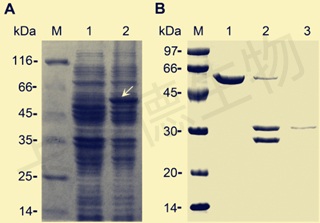
Example of GST Fusion Protein Purification Experiment

50412556.jpg

--Recombinant GST-VER2 Purification: Lane 1, lysate from uninduced cells. Lane 2, IPTG-induced sample, with the target protein indicated by the arrow. Lane M, markers.

--Purification of VER2 Protein: Lane 1, purified recombinant GST-VER2 protein. Lane 2, thrombin-digested GST-VER2. Lane 3, purified VER2 protein. Lane M, markers.

For more technical details regarding GST fusion protein purification, please refer to our technical resources or contact our technical support team for further assistance.

Login

Don’t have an account?Sign Up Now

Register

Already have an account?Log In Now