--Enzyme Labeling Service:
The enzyme labels in our Protein Labeling Services typically refer to horseradish peroxidase (HRP) and alkaline phosphatase (AP), both of which are commonly used for antibody labeling in ELISA detection.
Our team uses HRP and AP sourced from Sigma. With our extensive protein quantification experience, we ensure the protein-to-enzyme labeling ratio is close to 1:1, ensuring accurate results. Additionally, we offer Biotin Labeling Services for the research community.
| Type | Service content |
| HRP Labeling | * HRP is composed of multiple isoenzymes, with a molecular weight of 40,000 and an isoelectric point between pH 3-9. The optimal pH for enzyme catalysis may vary depending on the hydrogen donor, but typically falls around pH 5.
* HRP is suitable for rapid color reactions. In ELISA testing, the substrate added will yield an OD450 value of 1.8-2.5 within 5-10 minutes. |
|
| AP Labeling | * AP is better suited for slower color reactions, with a reaction time of 4-8 hours. The yellow compound formed through catalysis is stable, making it ideal for enzyme kinetics quantification. |
| Biotin Labeling | * Biotin can be used as a fusion tag for recombinant expression with target proteins to facilitate purification and screening. For example, when used in phage display libraries, it offers high screening efficiency. It is also suitable for monitoring tissue-specific expression in IHC.
* After biotin labeling, proteins can be directly used in IP or magnetic bead sorting. |
|
--Protein Isotope Labeling Service:
Protein isotope labeling is a classic protein tracing and proteomics quantification technique. Compared to in vitro labeling techniques, isotope labeling is an in vivo labeling method.
Principle: Essential amino acids labeled with natural isotopes (light) or stable isotopes (heavy) replace the corresponding amino acids in the cell culture medium. After 5-6 doubling cycles, the stable isotope-labeled amino acids are fully incorporated into the newly synthesized proteins, replacing the original amino acids. Proteins from different labeled cells are mixed in proportion to cell number or protein amount. After separation and purification, mass spectrometry identification is performed, and relative quantification is carried out by comparing the areas of two isotope-type peptide segments in the MS1 spectrum.
With our own Protein Expression Platform and Cell Culture Platform, we provide protein Isotope Labeling Services with 13C, 15N, 15N-13C, 35S, and 3H isotopes. Protein Isotope Labeling Services can also use 125I and 131I. Tyrosine in proteins can be labeled using HPLC or open column chromatography (depending on the properties of the iodinated molecules), and free iodine is removed. Radioactive iodine is then labeled onto proteins and other molecules, serving as a tracer or probe. Typically, TLC is used to detect labeled products to ensure that the free iodine percentage is<5%.<>
--Fluorescent Protein Labeling Service:
Fluorescent dye labeling of proteins/peptides is a common in vitro protein labeling technique. In addition to fusion expression of fluorescent proteins such as GFP and GYP, fluorescent dye labeling of target proteins allows for live-cell tracing, cell sorting, and more. For each peptide or protein to be labeled, our technicians strictly evaluate the physicochemical properties of the peptide or protein, such as peptide labeling, linker length, and crosslinking position. We offer a wide range of Fluorescent Dye Labeling Services.
FITC、FAM、RBITC |
Colloidal Gold Labeling Co-Au、Cy3、Cy5、Cy5.5、Cy7 |
APC、PE |
Alexa Fluor 350、Alexa Fluor 488、Alexa Fluor 555、Alexa Fluor 594、Alexa Fluor 647 |
--Protein Quantum Dot Labeling Service:
We offer Quantum Dot Labeling Services based on an inorganic structure of ZnCdSe/ZnS:
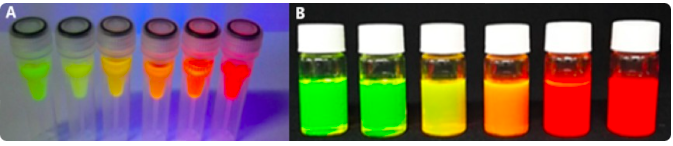
Carboxyl and Amino Water-Soluble Quantum Dots (Figure A): These are obtained by surface modification of oil-soluble quantum dots with polymers, enabling them to disperse uniformly in aqueous solutions (such as borate buffer, PBS buffer, etc.). The carboxyl and amino groups on the surface are reactive, with particle sizes ranging from 12 ~ 18 nm.
Oil-Soluble Quantum Dots (Figure B): These are coated with hydrophobic ligands on the inorganic structure of ZnCdSe/ZnS, allowing them to disperse uniformly in non-polar organic solvents (such as hexane, toluene, chloroform, etc.), making them easier to process. With particle sizes ranging from 5 ~ 10 nm, oil-soluble quantum dots can be used as LED backlight sources to enhance display color gamut after encapsulation. Additionally, surface modification of oil-soluble quantum dots with reactive groups allows for coupling with biomolecules, making them suitable for applications in biological labeling/detection, high-throughput encoding, live imaging, and dynamic tracking.
--Protein Magnetic Bead Labeling Service:
Magnetic Nanoparticles (MNS) are polymer-based core nanoparticles coated with magnetic nanomaterials and functional groups (carboxyl, amino). These nanoparticles offer good dispersion, quick magnetic response, abundant surface functional groups, easy coupling, and simple separation. They are widely used in various biomedical fields such as nucleic acid purification, protein purification, affinity chromatography, cell sorting, immunoassays, and clinical diagnostics.
Protein PEG Labeling Service:
Our team provides PEG Labeling Services with varying molecular weights. For specific details, please refer to our Protein PEGylation Service.







 0
0
