Home
>>
Protein Platform
>>
Protein Expression Services
>>
Baculovirus Expression Service
Baculovirus Expression ServiceIntroduction

Recombinant protein expression in insect cells involves the production of two generations of viruses, referred to as P1 and P2. The P1 virus is mainly used for preliminary protein expression experiments and amplification of the P2 virus, while the P2 virus is used for large-scale Protein Expression and Production Services. The insect cell protein expression system is suitable for recombinant expression of membrane proteins. Membrane proteins with up to four transmembrane domains can be effectively expressed and purified in insect cells. Purification of membrane proteins is a time-consuming and labor-intensive process. KMD Bioscience can provide customized membrane protein products with purity up to 95%.

The baculovirus expression system in insect cells is one of the eukaryotic expression systems, characterized by high exogenous gene expression levels, ease of expressing heterologous multimeric proteins, and high safety. Recombinantly expressed protein products have correct post-translational modifications and biological activity, such as disulfide bond formation, phosphorylation, glycosylation, etc. Compared with mammalian cell protein expression systems, proteins produced by the baculovirus insect expression system have a lower degree of glycosylation. However, the advantage of the insect protein expression system is that transfection using viruses is relatively simple, and the transfection system is easier to establish compared to transient transfection in mammalian cells. We have rich experience in recombinant protein insect expression (baculovirus expression) production and can provide you with high-purity transmembrane protein products. We also offer multiple scales of Protein Fermentation Services. Combined with our comprehensive Protein Purification Platform, we can deliver high-quality recombinant protein products to clients within a short time.
Protein expression in insect host cell lines

Cell Line

Origin

Application

Sf9

* Isolated from IPLBSF21-AE

* Suitable for transfection, purification, high-titer virus production, cell seeding, and recombinant protein expression.

Sf21

* Derived from the IPLBSF-21 cell line

* Transfection, purification, high-titer virus production, plating, and recombinant protein expression. Sf21 cells outperform Sf9 cells in certain structural protein expressions, such as crystal proteins.

Hi5

* Derived from cabbage looper ovary cells, Trichoplusia ni cells.

* Suitable for recombinant viral particle expression, also commonly used for transfection and plaque purification. The Hi5 cell line is more suitable for the expression of secreted recombinant proteins.

S2

* Derived from late-stage Drosophila embryonic cells, mostly female tetraploid cells with some diploid cells.

* Relatively suitable for recombinant expression of viral structural proteins.

Steps for Recombinant Protein Expression in Insect Cells Service

Step

Service content

Timeline

Subcloning

* If gene template is not provided by the customer: codon optimization and gene synthesis.

2 weeks

* If plasmid is provided by the customer: amplification and extraction of plasmid containing the target gene.

* Sequence verification: sequencing.

*Delivery: correctly constructed recombinant expression plasmid and raw sequencing report.

P1 Virus Production and Small-Scale Expression Test

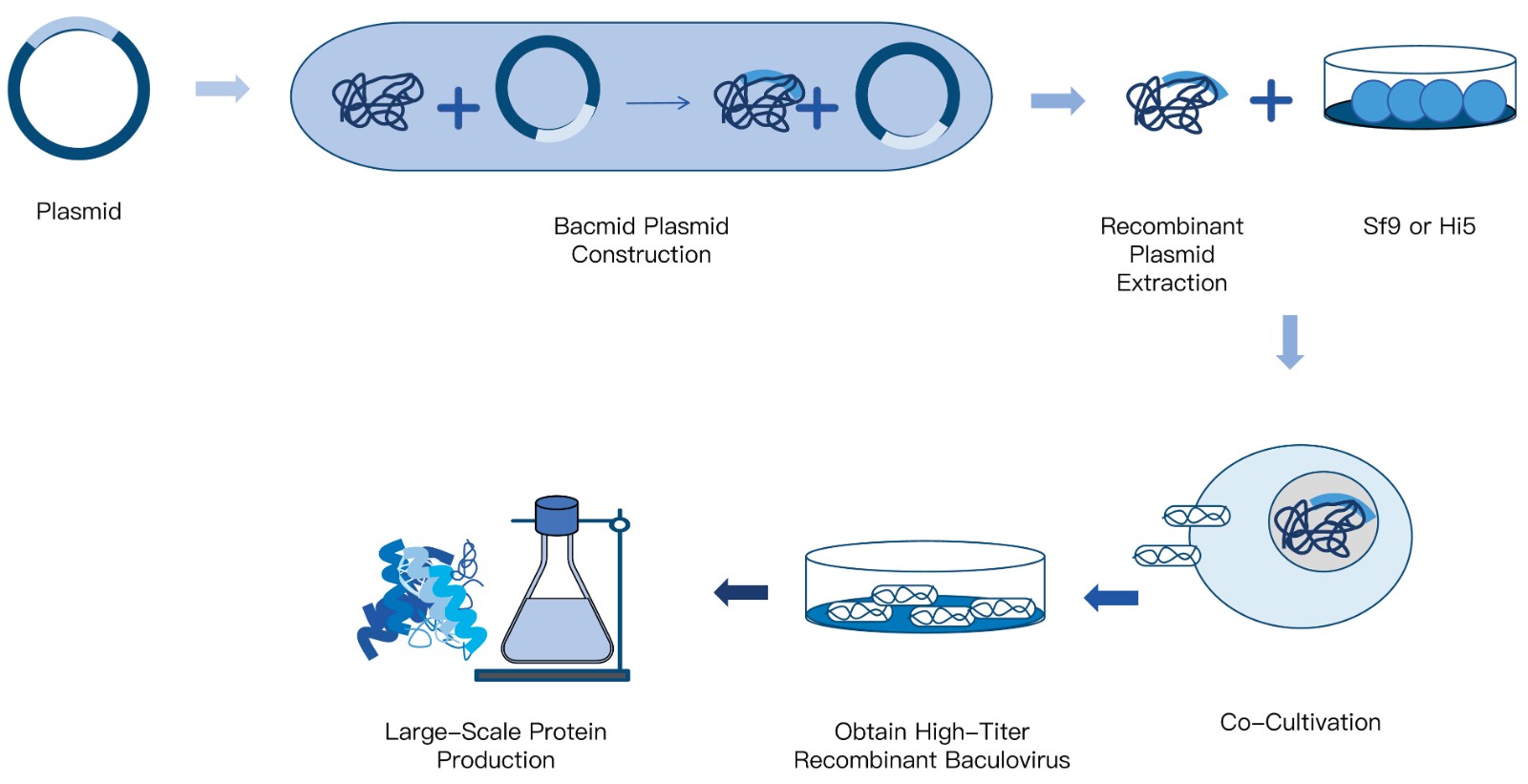
* Recombinant Bacmid DNA large-scale culture and transfection into insect cells to produce P1 and P2 viruses.

3-4 weeks

* P1 virus titer determination (titer 106–108), and verification of small-scale protein expression.

* Delivery: experiment report and images.

Expression Optimization and Testing

* P2 virus amplification and virus titer determination (titer 107–109).

3-4 weeks

* P2 virus transfection into insect cells, protein expression and purification.

* SDS-PAGE and WB analysis.

* Delivery: images, experiment report, purified protein product.

Large-Scale Recombinant Protein Expression and Purification

* Choice of 1L (default), 5L, 10L, 30L, 80L, 130L, and 250L.

Negotiable

* Purification of expressed recombinant protein through affinity, ion exchange, hydrophobic interaction, and gel filtration chromatography.

* SDS-PAGE and WB verification of protein expression.

Insect Cell Expression Workflow

5-KMDBioscience-Recombinant-Protein-Insect-Expression-Service.jpg

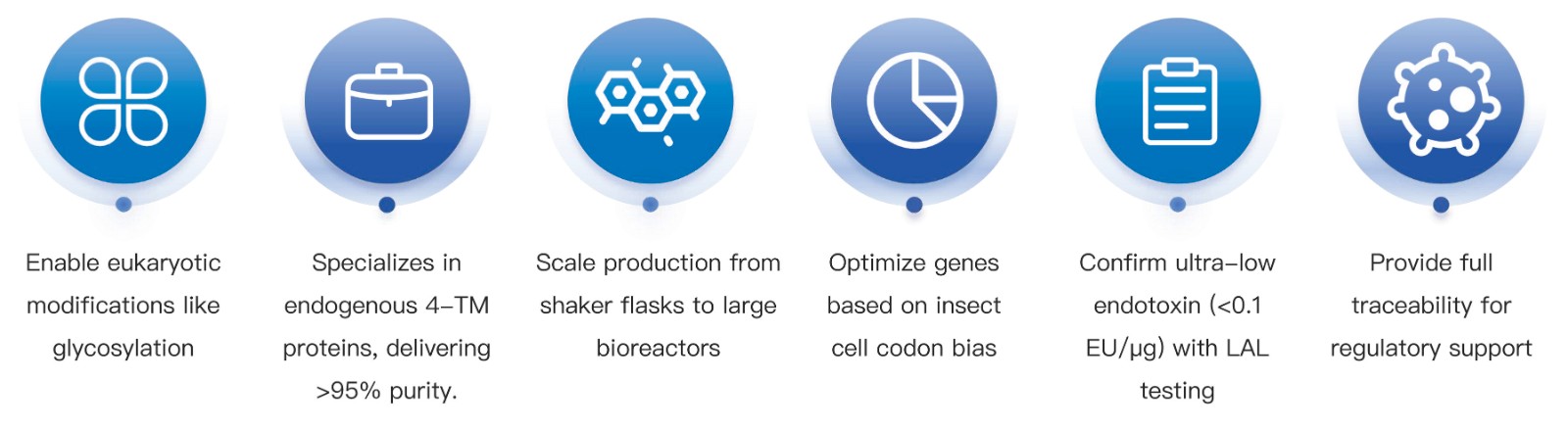
Advantages of Recombinant Protein Expression in Insect Cells

6-KMDBioscience-Recombinant-Protein-Insect-Expression-Service.jpg

Login

Don’t have an account?Sign Up Now

Register

Already have an account?Log In Now