Home
>>
Technical Platform
>>
Process Development Platform
>>
Lyophilization Process Development
Lyophilization Process DevelopmentIntroduction

KMD Bioscience has been engaged in protein expression and production research for many years. With the rapid development of the protein therapeutics market, the demand for large-scale protein production has steadily increased. Recombinant proteins typically exhibit poor intrinsic stability, which limits their development and application. Lyophilization is one of the most effective solutions to address this issue. We operate GMP-grade lyophilization production lines equipped with large-scale freeze-drying facilities that enable us to provide high-throughput protein filling and lyophilization services. Through a rigorous control system and skilled operations, we ensure lyophilized products are sterile, pyrogen-free, and meet the required residual moisture specifications.

We have established a comprehensive Antibody and Protein Technology Platform, equipped with various fermenters, high-speed centrifuges, protein purification systems, and freeze-dryers of different capacities. Our experienced protein production specialists have extensive expertise in recombinant protein expression, fermentation, and purification. We provide one-top services covering Protein Expression and Production, Large-Scale Fermentation, Purification, Lyophilization, and subsequent Characterization.
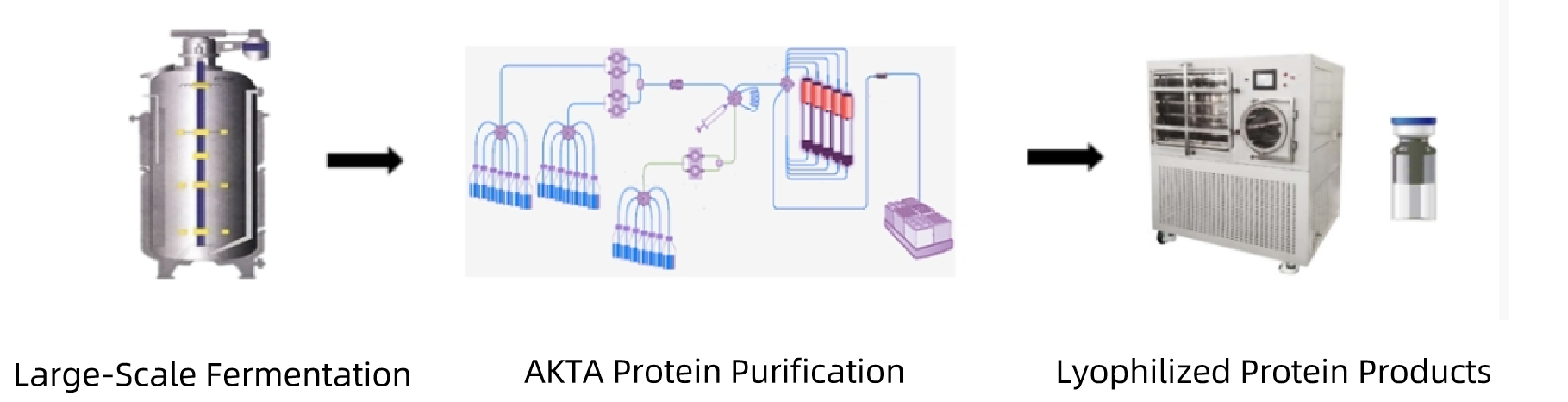

The main process of freeze-drying technology

图片8.png

Differences Between Liquid and Lyophilized Protein States

Characteristics of Protein Solution

Characteristics of Lyophilized Protein

* Protein solutions are mostly colorless or pale yellow and exhibit a certain concentration.

* The lyophilized product shows a porous and loose structure with excellent rehydration properties.

* Protein solutions contain multiple active components as well as salts or other inactive buffer components.

* Water is removed through drying at low temperatures, avoiding protein denaturation or loss of bioactivity.

* Proteins in liquid form are prone to degradation and are not suitable for long-term storage.

* Lyophilized proteins maintain stable structure and properties, resist oxidation, and are suitable for long-distance transportation and long-term storage.

Principles of Freeze-Drying (Lyophilization) Technology

The basic principle of lyophilization technology is to freeze the recombinant protein solution at low temperature and then dry it under vacuum conditions to form a recombinant protein solid production. The drying process can be divided into primary drying to remove crystalline water and secondary drying to remove bound water. However, since the lyophilization process essentially involves the transformation of matter and energy, the protein may undergo a certain degree of denaturation.

To understand the denaturation mechanism of proteins during lyophilization and to develop a reliable lyophilization protocol, we adopt a proprietary optimized lyophilization process to produce high-quality proteins with stable structures. The lyophilized proteins retain most of their volatile components, which minimizes denaturation, and maintain nearly unchanged biological activity.

Mechanism of Protein Denaturation

1. Denaturation Mechanism during the Freezing Process

* Low-temperature denaturation mechanism: The solubility of nonpolar groups in water increases as the temperature decreases, leading to a reduction in hydrophobic interactions within the recombinant protein.

* Freezing denaturation mechanism: Freezing denaturation is mainly influenced by four factors: concentration, ice-water interface, PH changes, and phase separation.

2. Denaturation Mechanism during the Drying Process

* Denaturation during the drying process mainly occurs in the secondary drying stage where bound water is removed. Recombinant proteins are hydrated in aqueous solutions, with a hydration layer on their surface. The removal of this hydration layer during drying disrupts the hydrogen bond structure on the protein surface, potentially causing denaturation of the native protein structure.

Freeze-drying protectant

To protect protein activity, protectants for active substances are typically added. Lyophilization protectants can effectively reduce or prevent denaturation effects on proteins during the lyophilization process. Common types of protectants are as follows:

Type

Charteristic

Sugars

* Sugars are one of the most common and widely used types of lyophilization protectants.

* Disaccharides are often used, with sucrose and trehalose being among the most effective.

* Trehalose has a high glass transition temperature, low hygroscopicity, and does not form hydrogen bonds within its own molecule, making it favorable for forming hydrogen bonds with recombinant proteins and providing better protection.

Polymers

* Serum albumin is commonly used and serves as an excellent protein stabilizer.

* It can function as both a freezing protectant and a drying protectant, offering effective protein protection.

Polyhydroxy Compounds

* These are commonly used protein protectants.

* Examples include glycerol, mannitol, sorbitol, inositol, and polyethylene glycol.

The services we can provide

The lyophilization process is complex and influenced by numerous factors. With years of expertise in protein research, we have an in-depth understanding of lyophilization mechanisms and operations. We can provide comprehensive solutions tailored to customer research requirements. Our team can select appropriate lyophilization conditions, optimize and establish lyophilization workflows, and particularly support research on lyophilized formulations. Leveraging our complete process production lines, we can also directly deliver the final finished products to customers.

Service advantages

-- Equipped with high-quality industrial-scale lyophilizers, capable of providing protein lyophilization services for 3 ml, 100,000 vials.

-- Able to optimize lyophilization processes for multiple protein samples simultaneously.

-- Lyophilization is conducted under sterile conditions to ensure sample sterility.

-- Equipped with GMP-like production workshops and standardized production management environments to ensure product quality.

-- Strict quality control system, highly skilled technical staff, advanced production facilities, and short delivery times.

-- Comprehensive protein platform construction provides downstream services related to proteins.

-- Able to provide one-stop technical services from Protein Expression and Production to Large-Scale Protein Production, Purification, Lyophilization, and subsequent Characterization, saving valuable time and costs for customers.

-- Project traceability: Regular reporting ensures customers can remotely monitor experimental progress with full project transparency.

Login

Don’t have an account?Sign Up Now

Register

Already have an account?Log In Now