Home
>>
Technical Platform
>>
Gene Editing Platform
>>
Gene Knockout Cell Line Service
Download Center
Quick Inquiry & Consultation
Gene Knockout Cell Line ServiceIntroduction

A cell line refers to a population of cells that has been cultured successfully from primary cells after the first passage and is capable of continuous propagation. Based on the life cycle characteristics of the cell line, if the cell's life span is limited, it is termed a finite cell line. Conversely, if the cell line has acquired unlimited reproductive capacity, it is known as a continuous or immortal cell line.

Cell lines are crucial for studying cell function, physiological and biochemical properties, and for conducting cell and molecular biology experiments. Stable cell lines enable researchers to explore gene functions, disease mechanisms, and drug screening, providing essential tools for life sciences. Moreover, cell lines can produce large quantities of homogeneous cells, ensuring experimental accuracy and reproducibility.

KMD Bioscience has established a Cell Gene Editing Platform based on advanced CRISPR/Cas9 technology and a robust cell culture system, providing gene knockout services for various cell types, including HEK293, CHO cells, tumor cells, immortalized cells, and IPS/ES cells. Additionally, we offer downstream services such as stable cell line development, large-scale cell production, and recombinant protein production.


Cell Type

Typical Cells

Quality Control

Timeline

Tumor Cells

Jurkat、HepG2、SK-MES-1、hepa1-6

qPCR, Western Blot

As fast as 4 weeks

Non-Cancer Immortalized Cells

HK-2、AC16

Stem Cells

H1、H9、iPSC

Deliverable: Cell Pool or monoclonal Homozygous Cell Line, Experimental Report.


Content

The methods for gene knockout in cells include gRNA plasmid-based, lentivirus-based, and RNP-based methods. The core of the RNP method lies in the assembly of Cas9 protein and sgRNA into an RNP (ribonucleoprotein) complex in vitro. This complex is then introduced into the target cells through electroporation. Gene knockout is achieved through homology-directed repair (HDR) or non-homologous end joining (NHEJ). The lentivirus-based method involves delivering the CRISPR/Cas9 gene editing system into the host cell via a lentiviral vector. Lentiviral vectors are ideal tools for gene delivery due to their stable genomic integration and broad cell transfection capabilities, significantly enhancing the gene editing efficiency of target cells.

Conditional gene knockout technology is used to study potentially lethal genes. The Cre-LoxP system is commonly used in conditional knockout. In this approach, LoxP sites are inserted on both sides of the target gene to create a “floxed” gene. Without Cre recombinase, the gene remains active. When Cre recombinase is introduced, it recognizes the LoxP sites and excises the gene sequence between them, resulting in gene knockout.

We can design gene knockout cell line solutions based on customer needs, including small fragment knockout, large fragment knockout, and frameshift mutations. In small fragment knockout, gRNA is designed in the introns flanking the exons. For frameshift knockout, gRNA is placed in the exons. In large fragment knockout, the entire coding sequence of the gene is knocked out to achieve a large fragment knockout.

Step

Content

Timeline

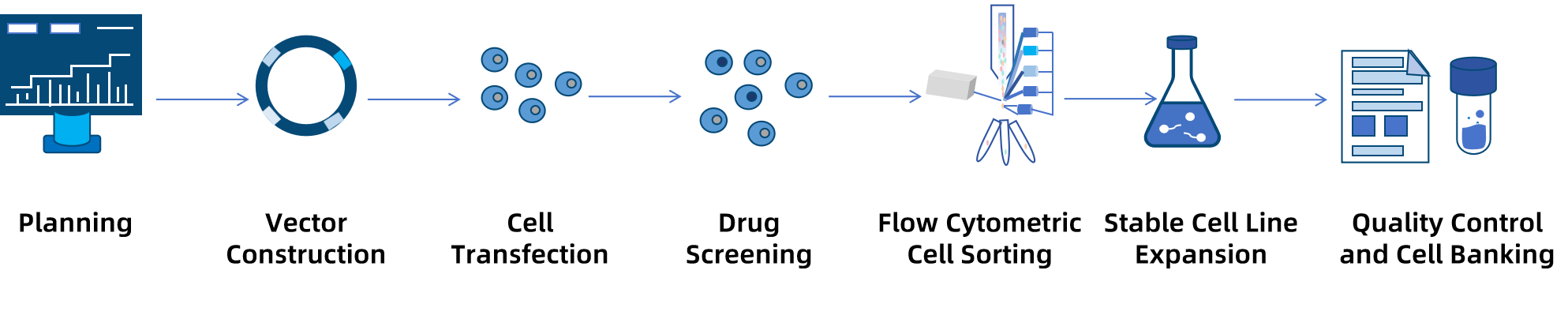
Step 1 sgRNA Design

(1) The customer provides the target gene;

40 days

(2) Design and synthesize the sgRNA.

Step 2 CRISPR Cas9 Vector Construction

(1) Construct a recombinant vector containing sgRNA sequence;

(2) Sequence verification of the recombinant vector.

Step 3 Co-transfection of Vector Into Cells

(1) Co-transfect recombinant vectors into cells;

(2) Drug Screening;

(3) Pool efficiency validation.

Step 4  monoclonal

(1) Sort single-clone gene-edited cells by flow cytometry.

Step 5 Knockout Efficiency Validation

(1) Validate knockout efficiency by Sanger sequencing and WB.

Step 6  Cell Cryopreservation

(1) Cryopreserve cells using DMSO in liquid nitrogen.


Process

图片45.png

Advantage

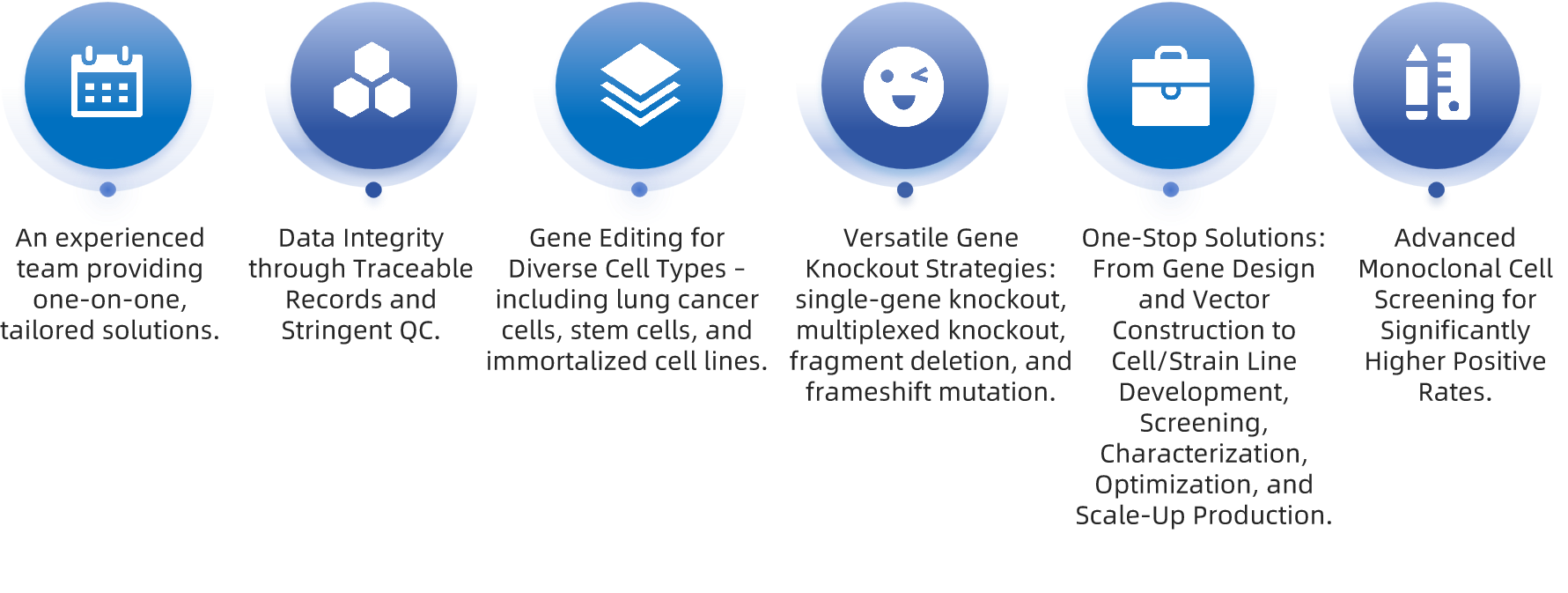
图片44.png

Case presentation

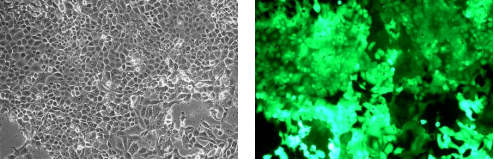
服务案例展示.png

hepa 1-6 Cell Line T7EI Detection Results

Frequently Asked Questions

1. How to select monoclonals for gene knockout cells?

Answer: monoclonals can be selected using the limited dilution method by plating single cells on a 96-well plate. After culturing for a period of time, the formation of monoclonals can be observed under a microscope. Once the single cells have amplified to a sufficient number, monoclonal selection and identification can be performed.


2. What are the challenges in constructing gene knockout cell lines?

Answer: Challenges include delivery methods, culturing, transfection, and monoclonal production. It is recommended to use RNP for delivery, as it offers high efficiency and low off-target effects. Optimizing cell culture conditions, transfection methods, and monoclonal production is crucial to ensure the best conditions before performing the knockout experiments.


3. How to determine the transfection efficiency of cells when using the CRISPR-Cas9 system?

Answer: Fluorescent protein reporter genes: Transfect EGFP mRNA or other fluorescent protein mRNAs to determine the transfection efficiency of the cells.

Login

Don’t have an account?Sign Up Now

Register

Already have an account?Log In Now