Home
>>
Technical Platform
>>
Plant Genetic Transformation Platform
>>
Malvaceae Genetic Transformation
Download Center
Quick Inquiry & Consultation
Malvaceae Genetic TransformationIntroduction

The Malvaceae family, classified under the order Malvales of the class Magnoliopsida, is characterized by diverse morphological features and a broad geographic distribution. It is renowned for its morphological diversity, extensive application value, and rich species diversity. Cotton, the seed fiber of plants from the genus Gossypium in the Malvaceae family, originates in subtropical regions. As one of the world’s major crops, cotton has widely adopted genetic engineering methods to enhance its resistance to biotic and abiotic stresses, which has proven to be an effective approach.

When exogenous genes are integrated into transgenic plants at low copy numbers, they tend to exhibit better expression and more stable inheritance. Therefore, the transformation method with a higher success rate in cotton is Agrobacterium-mediated transformation. KMD Bioscience possesses advanced molecular biology laboratories and an expert technical team, and has optimized the cotton genetic transformation system, including medium components, cultivation periods, and culture conditions, to achieve high transformation efficiency.

Content

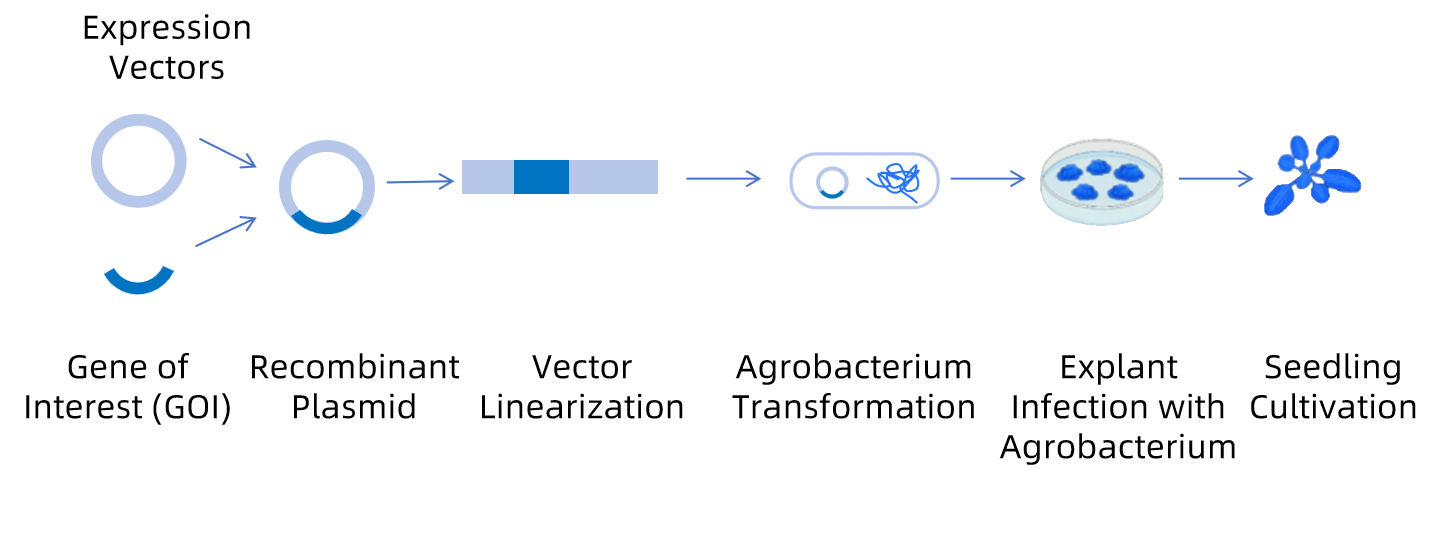
Currently, Agrobacterium-mediated shoot apex and callus methods are commonly used for cotton transformation. The shoot apex method utilizes the characteristic that shoot apices can differentiate into complete plants. In this method, shoot apices are used as explants and co-cultured with Agrobacterium. Regenerated seedlings can be formed in 2–3 months. This method offers advantages such as being genotype-independent and having a shorter transformation cycle, making it an ideal cotton transformation system. The callus method uses callus tissue as explants, which are infected with Agrobacterium carrying the target gene. After selection on medium containing Basta, cotton resistant shoots can be obtained.

Step

Content

Timeline

Step 1 Gene synthesis and vector construction

Standard vectors

1-2 weeks

Overexpression/RNAi/amiRNA vectors

Gene-editing vectors CRISPR/Cas9 vectors

Step 2 Transformation

Cotton: Agrobacterium-mediated callus method and shoot apex method.

1-2 months

Step 3 T0 generation plants

Differentiate and culture resistant shoots, transfer to rooting medium.

Consultation required

Step 4 PCR identification of T0 generation plants

Perform PCR identification of target genes in regenerated T0 plants and transfer positive plants to cultivation soil.

1 week

Step 5 Biological testing or phenotypic analysis of regenerated T0 plants (optional)

Perform physiological testing or functional analysis of T0 plants.

Consultation required

Deliverables: Positive T0 seedlings from standard transformation: ≥10 plants;  Positive T0 seedlings with successful mutations from gene-editing vector transformation: ≥5 plants; Experimental data and images; Standard genetic transformation experimental report.

-- Available varieties: R15 for the callus method. No variety limitation for the shoot apex transformation method.

-- Customers may specify other varieties as needed or request T1 generation seeds. Please consult our technical staff for details.

-- Vectors: pCAMBIA series, pBin series, pGreen series, pUC series.

-- Deliverables include positive plants, experimental data, images, and a standard genetic transformation report.

Process

图片49.png

Advantage

-- Efficient experimental workflow, unrestricted by plant material; aseptic seedlings of commonly used plants for genetic transformation are maintained year-round, enabling experiments to begin at any time.

-- Utilizes Agrobacterium-mediated transformation, which is rapid, efficient, stable, and primarily single-copy insertion. It supports various eukaryotic resistance markers such as hygromycin, G418, Basta, and kanamycin.

-- Seedling acclimatization services are available to support customers’ subsequent research.

-- Project traceability: Regular reporting ensures remote tracking of experimental progress and transparent project management.

Frequently Asked Questions

1. What is cotton genetic transformation?

Answer: Cotton genetic transformation refers to introducing exogenous genes into cotton plants via biotechnological methods and ensuring their stable expression in the cotton genome, thereby producing cotton varieties with improved traits or novel functions. This process generally includes gene cloning, vector construction, genetic transformation, and screening/identification steps.


2. How are transgenic cotton plants identified?

PCR screening: Specific primers are used to perform PCR amplification on screened cotton plants, producing target bands of approximately 500 bp.

ELISA method: Detects exogenous protein expression in transgenic plants at the protein level, allowing exclusion of plants containing the CP4-EPSPS gene (PCR positive) but not expressing the target protein.


3. What are the main methods of cotton genetic transformation?

The main methods include Agrobacterium-mediated transformation, gene gun method, and pollen tube pathway method. Among these, Agrobacterium-mediated transformation is widely used due to its efficiency, stability, and ease of operation. This method involves infecting cotton recipient tissues with Agrobacterium carrying the target gene, integrating the exogenous gene into the cotton genome.

Login

Don’t have an account?Sign Up Now

Register

Already have an account?Log In Now