Home
>>
Technical Platform
>>
Viral Vector and Cell Technology Platform
>>
Immortalized Cell Line Construction
Download Center
Quick Inquiry & Consultation
Immortalized Cell Line ConstructionIntroduction

KMD Bioscience has extensive experience in constructing immortalized cell lines. Leveraging years of expertise, our technical specialists have successfully immortalized cell types from humans, mice, rats, goats, and yaks. With advanced experimental techniques, KMD Bioscience excels in virus isolation and culture, and our viral transduction methods are uniquely optimized to ensure a high success rate. These advantages enable us to provide reliable and efficient immortalized cell line construction services through our well-established platform.

Normal primary cells enter senescence after being passaged dozens of times (depending on the cell type), while immortalized cells possess the unique ability to divide and proliferate indefinitely. The primary reason for cellular immortality lies in their ability to maintain telomere length. Telomeres are protective caps at the ends of chromosomes that prevent chromosome degradation and fusion during cell division. However, in most human cells, telomeres gradually shorten with each replication, eventually leading to cell senescence or death. Immortalized cell lines express an enzyme called telomerase, which counteracts natural telomere shortening. By preserving telomere length, telomerase enables these cells to divide indefinitely.

Characteristics of immortalized cell lines: Easy to culture; Rapid and continuous growth; Cost-effective; Genetically and phenotypically homogeneous.
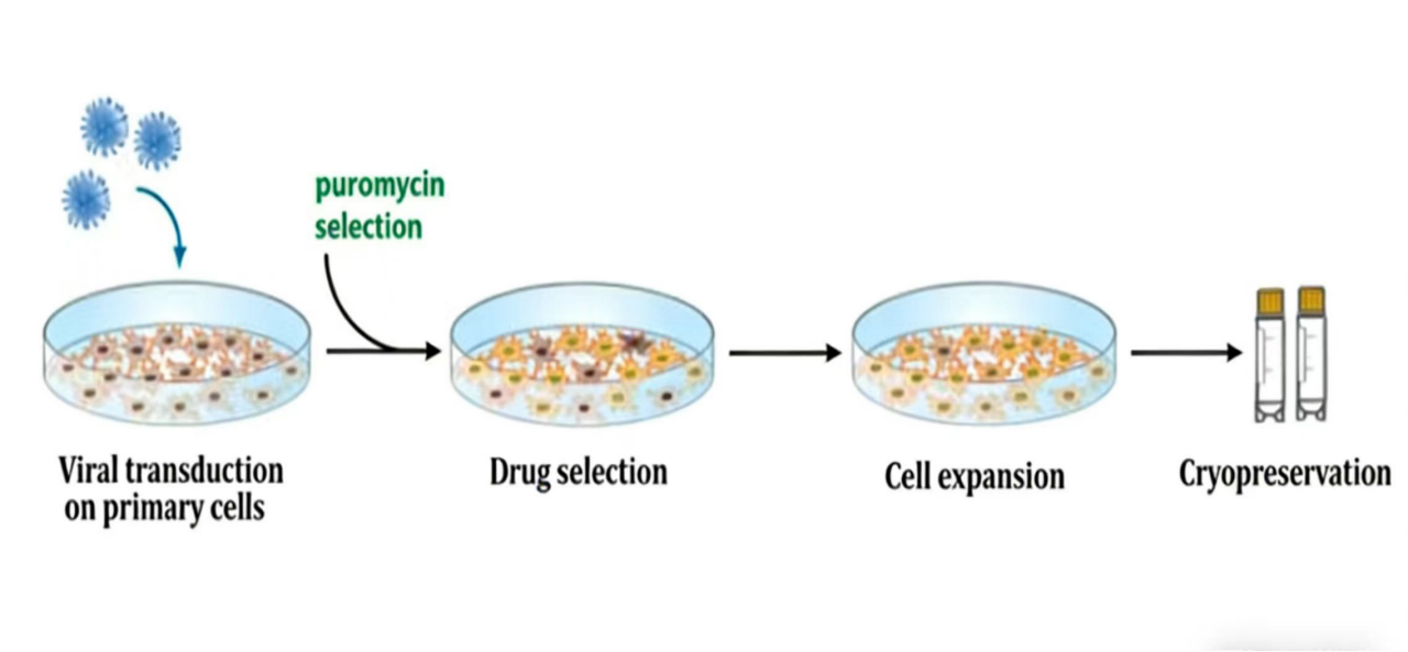
image.png

Process of Cell Immortalization

Applications of Cell Immortalization

Cancer Research:Understanding the mechanisms of cell immortalization is critical for cancer studies. Targeting these mechanisms may provide new strategies for developing cancer therapies, as inhibiting the unlimited proliferation of cancer cells represents a potential therapeutic approach.

Stem Cell Biology:Immortalized cell lines are frequently employed in stem cell research. By studying the factors that drive cell immortalization, researchers gain insights into the regulation of stem cell proliferation and differentiation. These cell lines serve as valuable tools for exploring the potential of stem cells in regenerative medicine.

Disease Modeling:Immortalized cell lines are widely used as models for investigating various diseases. Researchers can create immortalized cell lines that mimic specific diseases or conditions, enabling them to study disease mechanisms, evaluate potential therapies, and perform drug screening in a controlled laboratory environment.

Biomedical Research and Drug Development:Immortalized cell lines are fundamental tools in biomedical research. They provide a stable and reproducible platform for studying cellular processes, drug responses, and toxicity. Their ability to be cultured indefinitely facilitates long-term experiments and ensures consistent data generation.

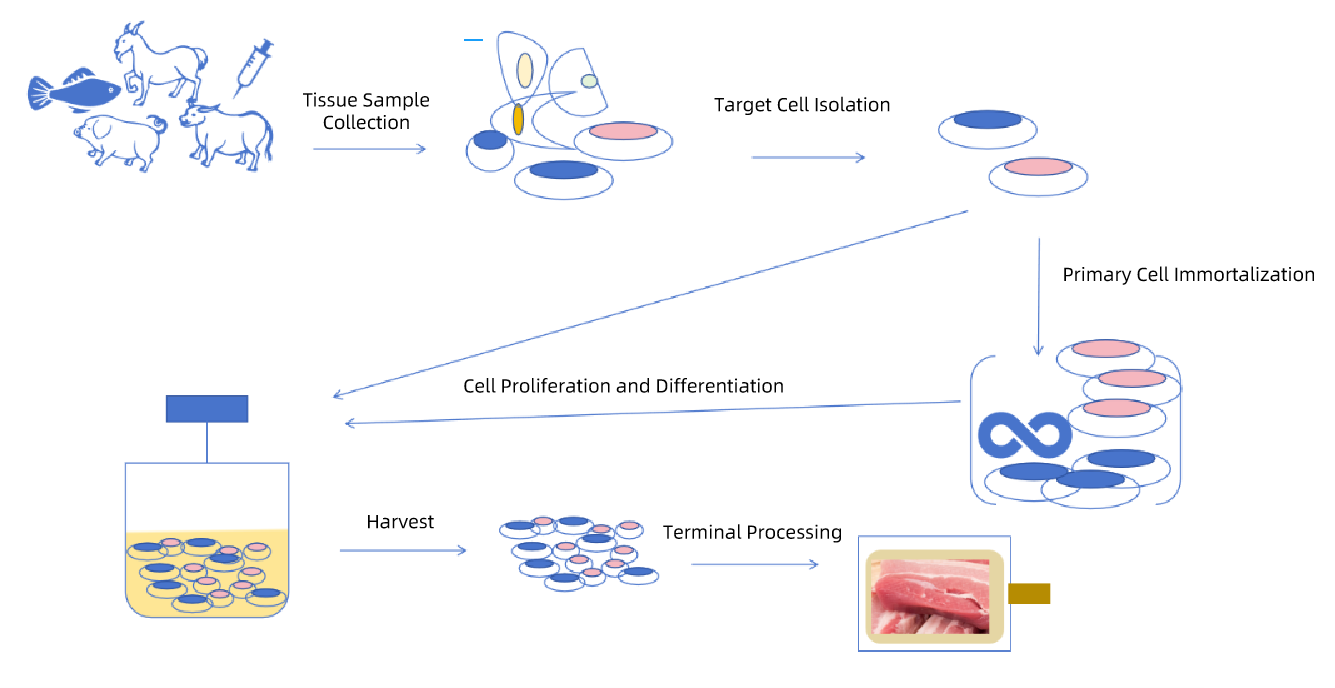
Other Applications:Another significant application of cell immortalization lies in the production of cultured meat. In this process, animal cell cultures are generated in vitro by isolating desired cells from animal tissues, immortalizing the primary cells, and then inducing their proliferation and differentiation. This approach enables the large-scale production of lab-grown meat to meet supply demands.

图片26.png

Methods for Cell Immortalization

We provide multiple approaches for cell immortalization and can offer different technical solutions. The four methods listed below are those we most commonly use:

-- Simian virus 40 (SV40) cell immortalization system.

-- HPV E6/E7 cell immortalization system.

-- hTERT cell immortalization system.

-- EBV cell immortalization system.

-- MycT58A cell immortalization system.

-- RasV12 cell immortalization system.

Sample provision

Customers can provide samples through various methods. For animal samples, if the animal is rare or uncommon (for example, plateau pika or yak), customers may provide the cells for immortalization. For common animals (such as goat, sheep, mouse, rabbit, or pig), we can procure the animals and immortalize the required cell type as specified by the customer.

If cells are provided directly:

-- The specific cells required by the customer.

-- At least four tubes (>1×10⁶ cells/tube) shipped on dry ice.

-- Literature-based culture conditions or explicit instructions regarding the culture conditions must be provided.

-- We can also provide cell production services (please contact our staff for details).

If the cells require media other than DMEM or RPMI, we will require 1–2 L of the medium and any applicable growth factors provided by the customer for the project.

Service advantages

-- For different cell types, adherent cells inherently possess the ability to passage and can be subcultured directly. In contrast, suspension cells, which are generally more challenging to passage, can also be immortalized by us to enable subsequent passaging.

-- We have extensive successful case experience, including human B-cell immortalization, and we also possess expertise in immortalizing T cells, macrophages, neuronal cells, cumulus cells, fibroblasts, and epithelial cells.

-- Short project timelines, experienced scientists, and numerous successful cases.

Technical Resources

Login

Don’t have an account?Sign Up Now

Register

Already have an account?Log In Now