Q 1: Compared with traditional cell-based systems, what are the core advantages of cell-free protein expression technology?
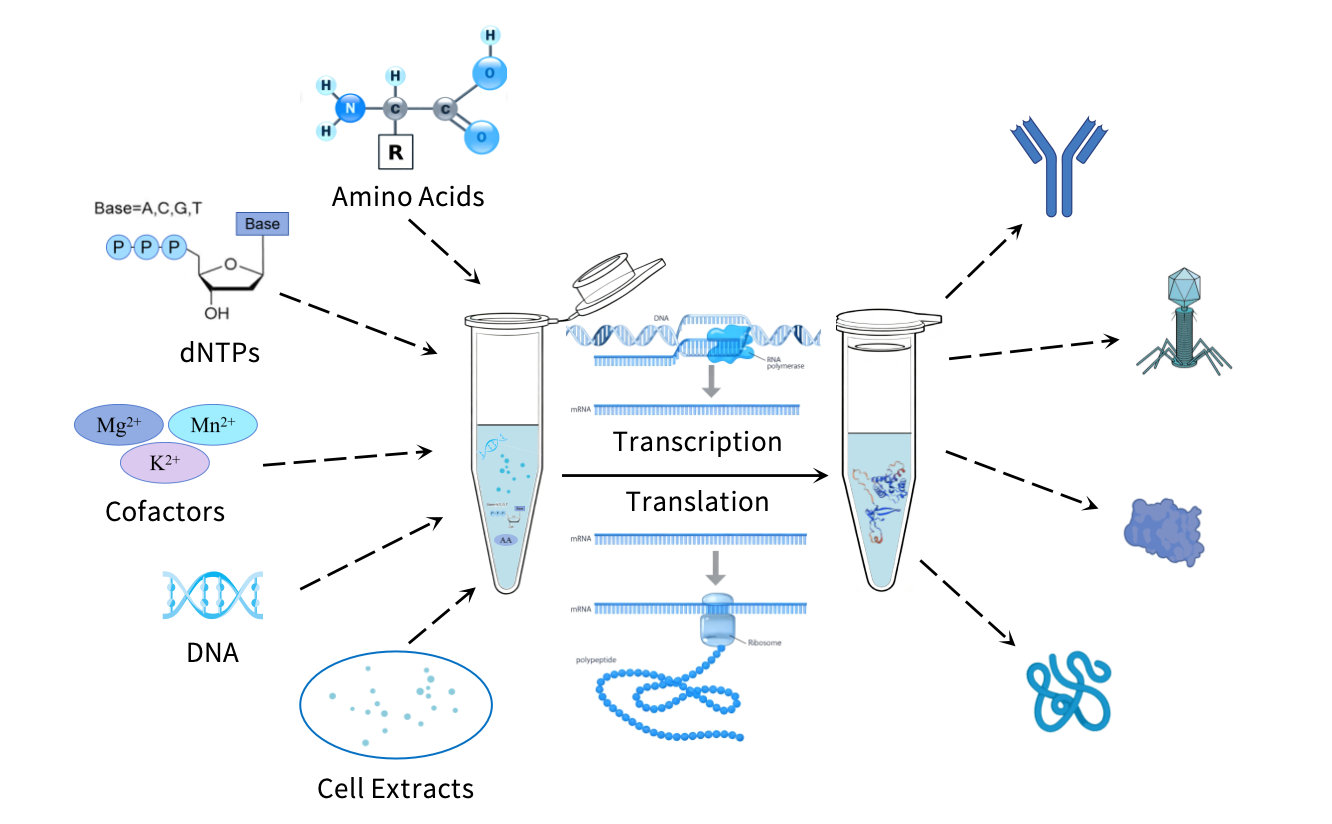
The fundamental advantage of cell-free expression technology lies in its ability to free the protein synthesis process from the complex physiological constraints of living cells. This provides several key benefits:
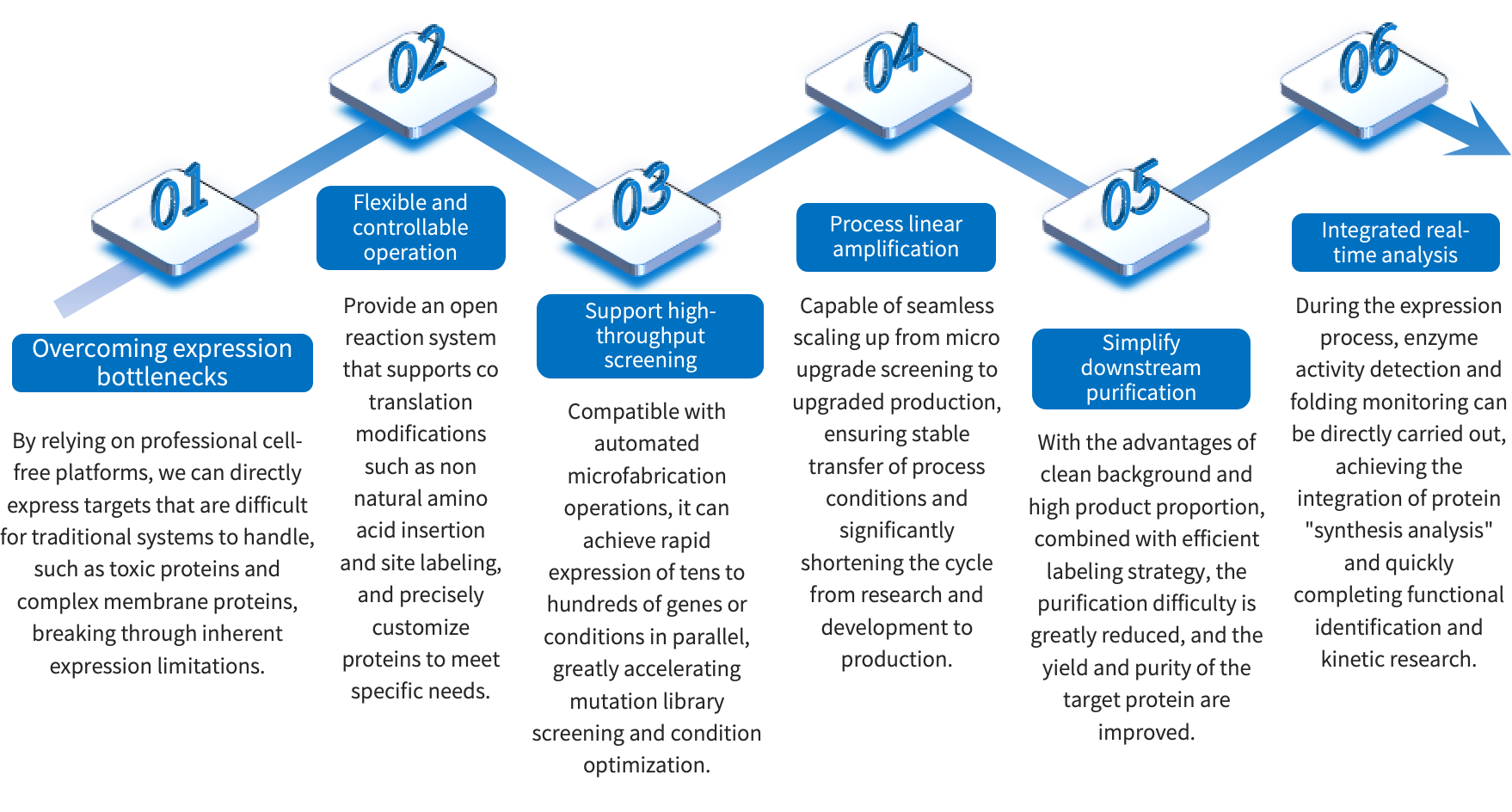
First, it offers unparalleled speed and efficiency. There is no need for time-consuming cell transfection, screening, or amplification. Simply add the DNA or RNA template encoding the target protein to a carefully optimized reaction system; high-yield protein can typically be obtained within a few hours. This is critical for the rapid screening of large numbers of mutants, functional validation, or R&D projects requiring immediate results, as it can compress workflows that traditionally take weeks into just a few days.
Second, it offers unprecedented flexibility and control. This technology enables direct and precise regulation of the reaction environment. You can freely add specific chaperones to promote the correct folding of proteins that are difficult to express; control the redox environment to form the correct disulfide bonds; and even directly introduce non-natural amino acids for site-specific labeling. This makes the technology an ideal choice for expressing proteins that are cytotoxic, prone to proteolytic degradation, or require special modifications, such as membrane protein fragments.
Third, it offers a high degree of simplicity and consistency. The entire reaction is carried out in a single test tube, eliminating the need to maintain cell viability and thereby completely avoiding the risks of contamination, the accumulation of metabolic by-products, and batch-to-batch variations in expression levels associated with cell culture. This provides a solid foundation for process scale-up and standardized production, ensuring the reproducibility and predictability of experimental results.
Q 2: What types of proteins can be expressed in a cell-free expression system? What are its limitations?
Cell-free expression systems are renowned for their broad range of applications and are particularly adept at handling challenging proteins that are difficult to process using conventional cell-based systems:
--Toxic protein: A protein that can be efficiently expressed to inhibit cell growth or induce cell apoptosis, without raising concerns about adverse effects on the "host."
--Membrane protein domains: Although the correct folding and embedding of intact membrane proteins remain challenging, this system enables the efficient production of water-soluble membrane protein domains or fragments for use in antibody development and structural studies.
--Proteins containing non-natural amino acids: By simply introducing specific non-natural amino acids and their corresponding tRNAs/synthetases into the reaction system, site-specific incorporation can be achieved, providing a powerful tool for protein function studies and the development of novel biologics.
--Isotope-labeled proteins: They facilitate nuclear magnetic resonance (NMR) structural analysis by allowing stable isotope-labeled amino acids to be directly incorporated into the reaction mixture.
--Protein complexes: Functional multimeric protein complexes can be reconstituted in vitro by co-expressing multiple subunits.
Regarding limitations, the primary challenge facing this technology at present lies in replicating the complex post-translational modifications found in higher eukaryotes, particularly highly humanized glycosylation patterns. Although basic modifications can be achieved by incorporating microsomes or specific glycosyltransferase systems, mammalian cell expression systems remain the more mature choice for producing therapeutic antibodies that require precise glycoforms to ensure their efficacy and pharmacokinetic properties. Before initiating a project, a thorough discussion of the modification requirements of the target protein is essential for selecting the optimal expression platform.
Q 3: How can we ensure that proteins produced through cell-free expression fold correctly and remain functional?
Ensuring the correct folding and biological activity of protein products is the cornerstone of the quality of cell-free expression services. This is achieved through a multilayered and rigorous quality control strategy:
First, at the system-design level, the reaction mixture in a high-quality cell-free expression system is thoroughly optimized; it contains not only the components essential for protein synthesis but also deliberately added factors that promote correct folding. These include precisely proportioned redox couples (such as glutathione) to facilitate the correct formation and pairing of disulfide bonds, as well as a chaperone system that assists folding (such as GroEL/GroES), thereby creating an optimal environment for proteins to attain their native conformations at the fundamental level of the reaction.
Secondly, at the product analysis level, we accept the customization of relevant activity assays—such as enzymatic kinetics, ligand-binding assays, and cell-based reporter gene assays—in accordance with the specific biological functions of the target protein, thereby directly using the data to demonstrate its functional integrity.
Q 4: What is the process required to use a cell-free expression service from initiation through sample receipt? What materials must the customer provide?
The use of cell-free expression services typically follows a clear, standardized workflow designed to ensure the efficient progression of projects.
The key material required from the client is the coding sequence of the target protein. The optimal form is a codon-optimized DNA template, which may be a plasmid, a linearized PCR fragment, or a synthetic gene. It is also essential to provide as detailed background information as possible, including: the desired purification tag (e.g., His, GST); the intended final application (structural studies, immunoassays, activity assays); and any known expression challenges or special requirements (e.g., whether non-natural amino acids need to be introduced). This information will help the service provider design the optimal experimental protocol.
A standard service process generally comprises the following steps:
1. Project Consulting and Solution Confirmation: The technical teams of both parties will communicate and finalize the final experimental plan and quotation based on the client's requirements.
2. Template preparation and quality control: The service provider constructs the template from the received gene sequences (e.g., by linearizing plasmids) and performs sequencing validation to ensure that the template is accurate and error-free.
3. Small-scale expression assay: Conduct expression reactions at a micro-scale and rapidly verify whether the protein has been successfully expressed using SDS-PAGE and Western blot.
4. Process scale-up and production: After successful pilot-scale testing, the reaction system is scaled up according to the production volume required by the customer for large-scale manufacturing.
5. Protein purification and refinement: The crude expression product is purified using techniques such as affinity chromatography and ion-exchange chromatography, and the buffer is exchanged to the storage buffer specified by the customer.
6. Quality Control and Product Delivery: Conduct comprehensive QC analyses on the purified protein (purity, concentration, molecular weight, activity, etc.) and deliver the samples to the customer via the cold chain.
Q 5: What specific applications does cell-free expression technology have in antibody discovery and engineering?
Acellular expression technology is revolutionizing the antibody discovery pipeline, with its primary applications spanning the early screening and optimization stages:
Rapid production of antibody fragments: Traditional full-length antibody production involves long cycles and high costs. Acellular systems are particularly well suited for the rapid expression of antibody fragments, such as scFv (single-chain antibodies), Fab (antigen-binding fragments), and VHH (nanobodies). These fragments retain intact antigen-binding capacity while having low molecular weights and being easy to express, making them ideal for preliminary functional validation and screening.
High-throughput mutant library screening: During antibody humanization or affinity maturation, tens of thousands of mutants are generated. By leveraging the high-throughput advantages of cell-free systems, the entire mutant library can be expressed in parallel; through in vitro display techniques such as ribosome display or mRNA display, the "expression–screening–enrichment" cycle can be completed directly in a test tube, shortening the screening cycle from several months to just a few weeks.
Functional validation via co-expression: The expressed heavy and light antibody chains can be mixed in the same reaction system, allowing direct observation of whether they can correctly assemble into functional antibodies or Fab fragments and enabling rapid assessment of the efficacy of different chain combinations.
Production challenges for antibodies or bispecific molecules: For antibodies that exhibit unstable expression or extremely low yields in mammalian cells, cell-free systems provide an alternative production approach. Moreover, structurally unique bispecific or multispecific antibody molecules can be readily designed and expressed without concern for intracellular chain mispairing.
In summary, this technology provides a rapid, flexible, and efficient "testing platform" for antibody development, greatly accelerating the process from the identification of candidate molecules to the optimization of lead compounds.







 0
