


When a conventional antibody is difficult to use, the answer is not automatically to screen more conventional antibodies. Researchers working with challenging targets, compact molecular formats, or specialized assay requirements increasingly consider nanobody discovery as a distinct strategy. A nanobody campaign can offer meaningful advantages—but only when the target, screening design, and intended application justify it.
Researchers choose nanobody-based discovery strategies because VHH domains combine a compact single-domain structure with the potential for strong target recognition, access to certain recessed epitopes, and flexible engineering into research tools or therapeutic-development candidates. They are especially worth evaluating for difficult targets, intracellular research concepts, multispecific constructs, and applications where molecular size matters. However, nanobodies are not universally better than conventional antibodies: affinity, specificity, stability, expression, developability, and functional performance must be demonstrated for each candidate.

Quick Summary: When Is Nanobody Discovery Worth Considering?
| Research requirement | Why VHH discovery may help | What to verify |
|---|---|---|
| Access to challenging epitopes | Some VHHs can recognize recessed or sterically restricted target regions. | Confirm epitope accessibility and binding in the native target context. |
| Compact molecular format | A single-domain binder is smaller and structurally simpler than a conventional two-chain antibody. | Check whether size improves the actual assay or delivery objective. |
| Protein engineering | VHH domains can be incorporated into fusion and multispecific designs. | Evaluate folding, linker design, expression, and retained activity. |
| Research reagent development | Selected VHHs can be developed into detection, capture, or functional research reagents. | Validate specificity, background, reproducibility, and lot consistency. |
| Discovery against difficult targets | A dedicated VHH workflow creates an additional route when conventional antibody approaches are limiting. | Assess antigen quality, immunization strategy, library diversity, and screening depth. |
| Scalable recombinant production | Many VHH formats can be produced as recombinant proteins in suitable expression systems. | Confirm yield, solubility, purity, activity, and application-specific quality. |
What Is Nanobody-Based Discovery?
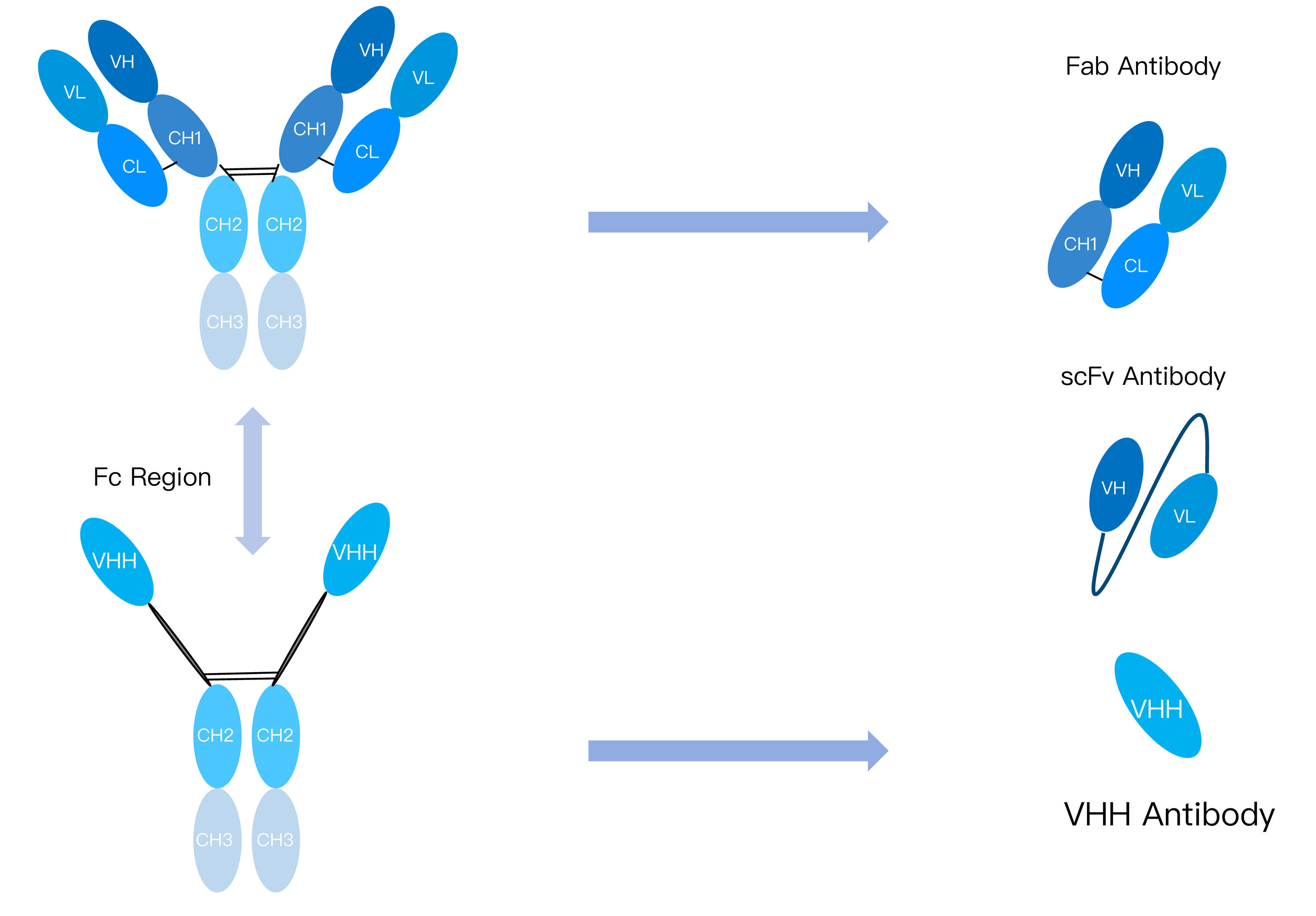
Nanobodies are antibody-derived binding domains based on the variable domain of heavy-chain-only antibodies, commonly called VHH domains. Heavy-chain-only antibodies occur naturally in camelids, including camels and llamas. Unlike conventional antibodies, which use paired heavy and light chains to form their antigen-binding sites, a VHH domain can function as an independent antigen-binding unit.
That distinction is central to the discovery strategy. Researchers are not simply producing a smaller version of a conventional antibody. They are identifying and characterizing a different molecular format with its own structural properties, screening requirements, and engineering opportunities.
A typical VHH discovery workflow may include antigen design and preparation, camelid immunization or another library-generation route, immune library construction, phage display, iterative panning, sequence analysis, recombinant expression, and functional validation. The best workflow depends on the target and the intended application—not on a fixed checklist applied to every project.
For a practical overview of the service stages, see KMD Bioscience's VHH antibody platform.
How Does a Nanobody Discovery Strategy Work?
Most discovery programs begin by defining what a successful binder must do. Binding to a purified antigen is only one possible endpoint. A useful research nanobody may need to recognize a native cell-surface protein, distinguish a target from a homolog, block a protein interaction, detect a biomarker, or retain activity after recombinant production.
Define the target and application. Specify the target species, domain, conformation, post-translational modifications, and biological context. Decide whether the goal is simple binding, functional modulation, detection, or another measurable outcome.
Prepare and assess the antigen. Antigen quality has a direct effect on the usefulness of the resulting library. Confirm identity, purity, structural relevance, and suitability for the planned immunization and screening methods.
Generate a VHH repertoire. An immune library can be built after camelid immunization. Other routes, including synthetic or naïve libraries, may be appropriate depending on project objectives and constraints.
Screen and enrich candidate binders. Display-based selection, including phage display, can enrich VHH sequences that interact with the target. Selection conditions should reduce enrichment of nonspecific or assay-format-dependent binders.
Express and characterize candidates. Selected sequences are produced recombinantly and tested for identity, purity, binding, specificity, and functional performance.
Advance only validated candidates. A sequence that binds in one screening assay is a lead, not a finished research reagent or therapeutic candidate. Additional testing is needed in the intended application.
In our view, the most important quality decision is to define functional success before library screening begins. Otherwise, a project can produce many attractive binding signals without identifying a molecule that solves the research problem.
9 Reasons Researchers Choose Nanobody-Based Discovery Strategies
1. A compact single-domain structure
The VHH format is based on one variable domain rather than the paired variable heavy- and light-chain architecture used by conventional antibodies. This compact format can simplify certain construct designs and make VHHs attractive when molecular size is an important design consideration.
That does not mean smaller is automatically better. A compact binder may be advantageous in a fusion construct or a sterically constrained assay, but the actual benefit depends on the target geometry, linker, expression system, and intended use. Researchers should compare functional performance rather than choose a format based on molecular size alone.
2. Potential access to recessed or sterically restricted epitopes
Some VHHs can recognize epitopes that are less accessible to conventional antibodies. Their elongated antigen-binding loops and single-domain architecture can create binding solutions suited to certain recessed or narrow target surfaces.
This is a useful reason to include VHH discovery when a conventional antibody campaign repeatedly misses a biologically relevant region. It is not a guarantee that every nanobody will penetrate a difficult epitope. Structural accessibility must be tested using the native or application-relevant form of the target.
3. Flexible engineering for research applications
A VHH domain can be incorporated into different molecular designs, including tagged proteins, fusion proteins, and multispecific constructs. This flexibility can be valuable when a research team needs to combine target recognition with a reporter, purification handle, effector domain, or second binding specificity.
For example, a laboratory developing a dual-target research reagent may investigate linked VHH domains rather than a conventional antibody format. The construct still requires careful assessment: adding domains or linkers can affect folding, expression, aggregation, and binding activity.
4. An additional route for challenging targets
Some targets are difficult because they are structurally complex, have limited exposed surfaces, occur in multiple conformations, or share substantial sequence similarity with related proteins. A VHH library provides another discovery route rather than forcing every project through a conventional antibody workflow.
For commercial users, this can be a sensible diversification decision. If an established antibody approach has reached a technical limit, a well-designed VHH campaign may create new candidates worth evaluating. The key is to diagnose the original failure first. Poor antigen design or weak assay controls will not be fixed simply by switching antibody formats.
5. Potential for strong affinity and specificity
Nanobodies can be selected and optimized for strong binding, but high affinity and high specificity are not inherent guarantees of the format. Both depend on sequence, target presentation, selection pressure, and subsequent validation.
We recommend measuring binding with an orthogonal method where possible. A positive phage-display signal should be followed by tests that help distinguish genuine target recognition from nonspecific binding, avidity effects, or interactions caused by the screening format. Cross-reactivity testing is especially important when the target belongs to a protein family with close homologs.
6. Recombinant production and construct flexibility
Because VHHs are single-domain proteins, they can be compatible with recombinant expression strategies that differ from those used for full-length antibodies. Depending on the sequence and application, researchers may evaluate bacterial, yeast, or mammalian expression routes.
However, no expression system should be selected on format alone. Solubility, folding, disulfide-bond requirements, post-translational modifications, yield, and downstream purification all matter. For projects requiring additional protein components, KMD Bioscience also provides protein expression platform services and an overview of protein expression systems.
7. Potential advantages in specialized detection and functional assays
VHHs can be developed as research reagents for detection, capture, imaging-related workflows, or functional studies, provided that the selected candidate performs reliably in the intended assay. A compact binding domain may be useful in assay configurations where access to the target or construct architecture is limiting.
For example, a team studying a membrane protein may need a binder that recognizes an extracellular region under native conditions. The correct selection strategy should preserve the relevant conformation and include cell-based or other application-specific validation where appropriate. A result obtained only against a denatured protein fragment may not translate to the native target.
8. A complementary option for multispecific research designs
VHH domains can be linked in different combinations to create multispecific constructs. This gives researchers a modular way to explore recognition of two or more targets, or to combine target binding with a second functional component.
For early-stage research, this can make construct exploration more flexible. Yet multispecificity introduces additional development questions: domain orientation, linker length, steric interference, stability, aggregation, and the possibility that one binding domain compromises the other. Each domain should be tested independently and again in the final assembled construct.
9. A structured discovery and documentation workflow
A successful discovery project depends on more than finding a sequence. Researchers need traceability from antigen design through immunization, library construction, panning, sequence identification, expression, and functional validation. A documented workflow makes it easier to understand why a candidate was selected and whether the evidence supports its intended use.
This is particularly important when results will be transferred between research teams, used in regulated development environments, or compared across project stages. KMD Bioscience's Camel Immune VHH Antibody Library Construction Service describes an integrated approach covering antigen design, animal immunization, library construction and panning, and functional validation.
Camel immune VHH antibody library construction: an integrated discovery workflow from antigen preparation to candidate validation.
Key Benefits—and the Limitations Researchers Should Not Ignore
The strongest case for nanobody discovery is not that VHHs outperform conventional antibodies in every category. It is that they offer a different molecular format that can solve specific research constraints. The decision should be based on the requirements of the target and the evidence generated during characterization.
Pros and cons of nanobody-based discovery
| Potential advantages | Limitations and risks |
|---|---|
| Single-domain format can simplify some construct designs. | Small size does not guarantee better tissue access, delivery, or assay performance. |
| Some VHHs recognize recessed or sterically constrained epitopes. | Epitope access is candidate- and target-dependent and must be demonstrated. |
| Can be engineered into fusion and multispecific constructs. | Complex constructs may introduce folding, stability, and expression challenges. |
| Can be produced recombinantly in suitable expression systems. | Yield, solubility, purity, and activity vary by sequence and production conditions. |
| Provides an alternative discovery route for difficult targets. | Library quality and antigen design remain critical; the format cannot rescue a poor experimental design. |
| Can support specialized research detection and functional applications. | Binding in a screening assay does not establish performance in the final application. |
Nanobodies vs. Conventional Antibodies: Which Should You Choose?
The correct comparison is not simply small versus large. Researchers should compare the molecular format against the biological question, intended assay, production plan, and development stage. Conventional antibodies remain the better-established choice for many applications, while VHHs provide a useful alternative where their specific properties matter.
| Decision factor | VHH nanobody | Conventional antibody | Practical selection advice |
|---|---|---|---|
| Binding architecture | Single antibody-derived variable domain. | Typically paired heavy- and light-chain variable domains. | Choose based on target geometry and required construct format. |
| Molecular size | Generally much smaller than a full-length IgG. | Full-length IgG is a larger multidomain molecule. | Prioritize VHH when compact format is a real experimental advantage. |
| Epitope recognition | Some candidates can access recessed or constrained epitopes. | Recognizes a broad range of accessible epitopes. | Screen against the native target and map the epitope when it matters. |
| Engineering | Modular single-domain format can support linked or fusion designs. | Established Fc-containing and fragment-based formats. | Consider the downstream construct before selecting the discovery route. |
| Production | May be compatible with several recombinant expression platforms. | Full-length IgG commonly uses mammalian expression for appropriate assembly and processing. | Compare actual yield, quality, and cost for the candidate—not assumptions about the format. |
| Established applications | Useful in specialized research and emerging development formats. | Broadly established across research, diagnostics, and therapeutic development. | Use conventional antibodies when validated reagents and established workflows already meet the need. |
| Development risks | Sequence-specific stability, aggregation, immunogenicity, and functional risks remain. | Aggregation, stability, immunogenicity, and manufacturing risks also remain. | Apply developability testing to either format before committing to scale-up. |
For researchers comparing VHH discovery with broader antibody options, KMD Bioscience's antibody products provide a relevant starting point for reviewing antibody-related offerings. The choice should still be driven by the target and experimental endpoint rather than the supplier's catalog structure.
Best Use Cases: When Should Researchers Choose VHH Discovery?
Challenging protein targets
Consider VHH discovery when a target has a recessed binding surface, a difficult-to-access domain, or a history of unsuccessful conventional antibody screening. The antigen should represent the relevant native structure as closely as practical.
Compact research constructs
VHHs are worth evaluating when a project requires a smaller recognition domain or a modular fusion design. Examples may include research probes, tagged constructs, and experimental multispecific proteins. Test the complete construct, not just the isolated VHH.
Target-specific detection and functional research
For detection or functional assays, select against the biological form of the target that will be used in the final experiment. A candidate that binds a purified fragment may fail to recognize the same target on a cell, in a complex, or in a different conformational state.
Programs that need an alternative discovery route
For research groups whose existing antibody strategy has not delivered a suitable binder, a VHH campaign can diversify the discovery pipeline. Before commissioning the work, identify whether the limitation is the antibody format, the antigen, the assay, or the screening conditions. That diagnosis helps prevent spending on a new library that repeats the original problem.
Who Should Use Nanobody Discovery—and Who May Not Need It?
Nanobody discovery is worth considering for:
Research teams working with structurally challenging or sterically restricted targets.
Scientists developing compact, fusion, or multispecific research constructs.
Biotechnology companies seeking an additional route to target-specific binders.
Assay developers who need to explore alternative binding formats.
Projects with a defined validation plan and resources for recombinant expression and characterization.
It may not be necessary for:
Researchers whose existing conventional antibody already performs reliably in the required application.
Projects that only need a readily available, validated off-the-shelf antibody reagent.
Teams without a clear target definition or an assay capable of confirming functional performance.
Programs that assume a VHH will automatically solve delivery, stability, or immunogenicity challenges.
For beginners, the most sensible approach is to define the assay and compare available validated reagents before funding a custom discovery campaign. For commercial users, a custom VHH project is easier to justify when it addresses a measurable limitation or creates a differentiated research asset.
Common Mistakes in Nanobody Discovery Projects
Choosing an antigen that does not represent the real target
A purified fragment may expose surfaces that are hidden in the native protein, or it may lack a relevant modification or structural feature. Select antigen formats based on the biological application and use complementary validation methods when necessary.
Using binding as the only success criterion
Binding is an important first filter, but it is not the same as functional activity. Define whether the project needs blocking, agonism, detection, capture, or another specific outcome. Then include the appropriate functional assay in the selection and validation plan.
Overlooking cross-reactivity
A candidate may bind the intended protein and still recognize related proteins or unrelated assay components. Include relevant homologs, negative controls, and matrix controls in the specificity strategy.
Assuming every VHH is highly stable
Nanobodies are often discussed in connection with stability, but individual sequences differ. Evaluate thermal behavior, aggregation, solubility, storage conditions, and retained activity under the conditions relevant to the intended use.
Failing to plan for recombinant expression
A sequence that enriches well during display may not express efficiently as a soluble protein. Include expression and purification feasibility early enough to avoid advancing candidates that cannot be produced at useful quality or quantity.
Accepting incomplete project documentation
Without traceable antigen information, library records, selection history, sequence data, and validation results, it becomes difficult to reproduce or transfer the work. Documentation should be agreed before the project starts, not requested as an afterthought.
How to Choose a Nanobody Discovery Service Provider
Choosing a provider is a technical procurement decision. A low quoted price is not meaningful if the service produces a large list of unvalidated sequences, omits key experimental records, or leaves the customer to solve expression and functional testing independently.
1. Review the complete workflow
Ask whether the provider supports antigen design, camelid immunization where applicable, VHH library construction, display and panning, sequence identification, recombinant expression, and functional validation. Clarify which stages are included in the quotation and which are optional.
2. Examine antigen and library quality controls
Ask how antigen identity and quality are assessed, how library diversity is evaluated, and how the provider monitors enrichment and nonspecific binding. A credible workflow should explain the rationale behind selection conditions rather than promise a predetermined number of positive clones.
3. Require application-relevant validation
Agree on what constitutes a successful candidate. Depending on the project, this may include binding kinetics, specificity, cross-reactivity, cell-based recognition, blocking activity, or another functional endpoint. Do not accept a generic binding result as proof of suitability for every application.
4. Confirm deliverables and traceability
Before work begins, define the deliverables: sequence information, clone identifiers, screening data, expression and purification results, assay protocols, and relevant quality documentation. Confirm whether the provider supplies raw data and whether follow-up expression or characterization is available.
5. Evaluate communication and scientific judgment
A capable partner should be willing to challenge an unsuitable antigen, discuss alternative library strategies, and explain technical risks. Be cautious of providers that guarantee a fixed number of high-affinity functional binders before reviewing the target and project requirements.
6. Compare the total project cost
Compare the full cost of discovery, validation, expression, purification, and any required repeat work. A lower initial fee may become more expensive if essential characterization is excluded. Conversely, a highly comprehensive package may be unnecessary for a project that only needs preliminary research binders.
Cost-Benefit Analysis: Is a Custom VHH Campaign Worth the Investment?
A custom nanobody project is generally most defensible when the expected value of obtaining a differentiated binder exceeds the cost and time of discovery. That value may come from solving a difficult assay problem, enabling a new construct, creating a proprietary research reagent, or establishing a platform for follow-on studies.
For a small academic project, an available validated antibody may be more economical than custom discovery. For a biotechnology company building a longer-term pipeline, a custom VHH library and a documented selection process may create reusable knowledge and candidate options. The economic case changes with the number of targets, expected reuse, required validation depth, and downstream production scale.
| Project situation | Recommended route | Cost-benefit judgment |
|---|---|---|
| One routine assay with a validated antibody available | Purchase an established reagent first. | Custom discovery is usually difficult to justify unless the existing reagent has a defined limitation. |
| Repeated failure with conventional antibody discovery | Assess a VHH campaign after reviewing antigen and assay design. | Potentially worthwhile if the format addresses the identified technical barrier. |
| New compact or multispecific construct | Evaluate VHHs as modular building blocks. | Potentially valuable, but include construct optimization and functional testing in the budget. |
| Commercial research reagent development | Plan discovery, validation, production, and quality documentation together. | Higher initial investment may be justified by differentiation and repeatable supply. |
| Early feasibility study with uncertain target biology | Start with target characterization and a focused pilot. | A staged project reduces the risk of committing to a full campaign too early. |
KMD Bioscience: Camel Immune VHH Antibody Library Construction
KMD Bioscience provides antibody discovery services and offers Camel Immune VHH Antibody Library Construction Services for research clients. The described workflow covers antigen design, animal immunization, library construction and panning, and functional validation. The service emphasizes documentation and traceability across the major stages of discovery.
The company describes its approach as incorporating Quality by Design (QbD) principles and referring to relevant ICH guidance. These statements should be evaluated against the specific project protocol, quality system, and deliverables agreed with the client; they should not be interpreted as a blanket certification or regulatory approval of every project.
For a project involving a challenging protein target, the practical starting point is a technical discussion about antigen format, target species, desired epitope, screening method, and functional endpoint. KMD's Camel Immune VHH antibody library construction service provides further information about the service workflow.
Depending on the research program, related resources may also be relevant, including recombinant protein products for protein-related research and COA download for available certificate-of-analysis documentation. Researchers should confirm product-specific documentation and service scope directly before placing an order.
Expert Recommendation: Choose the Format That Solves the Actual Problem
We recommend choosing nanobody-based discovery when there is a clear technical reason to investigate VHHs: a difficult epitope, a need for a compact binding domain, a planned fusion or multispecific construct, or a conventional antibody strategy that has not met the project's requirements.
Do not commission a VHH campaign simply because nanobodies are smaller or increasingly discussed in biotechnology. Start by defining the target in its biologically relevant form, the function required, and the evidence that will qualify a candidate. Then select the library and screening strategy around those requirements.
For most professional situations, the best project plan includes antigen quality assessment, a documented library workflow, multiple rounds of controlled selection, sequence-level tracking, recombinant expression, orthogonal binding analysis, and application-specific functional validation. If a service provider cannot explain how these stages connect, the proposal is not ready for approval.
For commercial users, we would also insist on agreeing to deliverables, data ownership, sequence disclosure, confidentiality, repeat-work conditions, and post-discovery support before the project begins. Those details can matter as much as the initial screening result.
Frequently Asked Questions About Nanobody-Based Discovery
1. What is the main reason researchers choose nanobody-based discovery?
The main reason is access to a different antibody-derived binding format. VHHs offer a compact single-domain structure and can provide useful options for challenging epitopes, engineered constructs, and specialized research applications. Their value must be confirmed for each target.
2. Are nanobodies better than conventional antibodies?
Not universally. Nanobodies may be advantageous when a compact format or particular epitope access is important. Conventional antibodies remain highly suitable for many established research, diagnostic, and therapeutic applications. The best choice depends on target biology and intended use.
3. What does VHH stand for?
VHH refers to the variable domain of a heavy-chain-only antibody found naturally in camelids. It can function as an independent antigen-binding domain and is commonly referred to as a nanobody when used in this discovery context.
4. How are camel immune VHH libraries constructed?
A typical immune-library workflow begins with antigen preparation and camelid immunization. Antibody-derived genetic material is then used to construct a VHH library, which can be screened through display-based selection. Candidate sequences are subsequently expressed and characterized.
5. Can nanobodies bind difficult or hidden epitopes?
Some VHH candidates can recognize recessed or sterically restricted epitopes. This is one reason researchers consider the format for challenging targets. It is not guaranteed, so the native target and relevant epitope must be tested directly.
6. Are nanobodies easy to express in E. coli?
Some VHHs can be expressed successfully in E. coli, but expression performance is sequence-dependent. Solubility, folding, disulfide bonds, yield, and purification requirements should be evaluated. Bacterial expression should be selected only when it meets the quality requirements of the intended application.
7. What validation is needed after VHH screening?
At minimum, researchers should confirm sequence identity, recombinant expression, purity, target binding, and specificity. Depending on the application, validation may also require affinity measurements, cross-reactivity tests, cell-based recognition, blocking assays, or other functional studies.
8. Can VHHs be used in multispecific constructs?
Yes. VHH domains can be linked or combined in engineered constructs to recognize multiple targets or incorporate additional functional components. Each domain and the assembled construct should be evaluated for folding, expression, stability, and retained binding activity.
9. What should I ask a nanobody discovery service provider?
Ask about antigen quality control, library construction and diversity, selection methods, sequence identification, recombinant expression, functional validation, documentation, data ownership, and project deliverables. Also clarify what is included in the price and what requires a separate service.
10. When is a custom nanobody discovery project not worthwhile?
It may not be worthwhile when an existing validated antibody already meets the research requirement, when the target and assay are poorly defined, or when the project lacks resources for candidate validation. A focused feasibility assessment can help determine whether custom discovery is justified.
References
Hamers-Casterman, C. et al. “Naturally occurring antibodies devoid of light chains.” Nature (1993). Foundational description of heavy-chain-only antibodies in camelids. Read the original paper.
Muyldermans, S. “Nanobodies: Natural Single-Domain Antibodies.” Annual Review of Biochemistry (2013). Review of VHH structure, properties, and applications. Read the review.
International Council for Harmonisation (ICH). “ICH Q8(R2): Pharmaceutical Development.” Guidance relevant to Quality by Design concepts in pharmaceutical development. View ICH quality guidelines.





 0
