


VHH antibodies, often called nanobodies, have become valuable tools for researchers who need compact antigen-binding domains, flexible molecular engineering options and access to epitopes that can be difficult to target with conventional antibodies. Their small size and single-domain architecture make them particularly attractive for selected structural biology, imaging, protein interaction and therapeutic discovery workflows. However, a VHH is not automatically better than a conventional antibody: its value depends on the target, assay, required affinity, molecular format and intended biological function.
For research teams deciding whether to develop a VHH reagent, the most useful question is not simply whether nanobodies are innovative. It is whether their specific properties solve a technical problem that existing antibodies, peptides or other binding proteins do not solve efficiently.

Quick Answer: What are the main applications of VHH antibodies?
The major applications of VHH antibodies include protein detection, immunoassay development, live-cell and tissue imaging, structural biology, intracellular target modulation, protein interaction studies, targeted delivery research, infectious disease research, therapeutic candidate discovery and biosensor development. Their compact single-domain structure can support access to certain recessed epitopes and facilitate fusion-protein or multivalent designs.
For most research programs, we recommend starting with the biological question and assay requirements, then selecting the discovery, screening and validation strategy. VHH development is most worthwhile when the resulting binder has a clear advantage in specificity, epitope recognition, molecular engineering or experimental performance—not merely because it is smaller.
What Are VHH Antibodies?
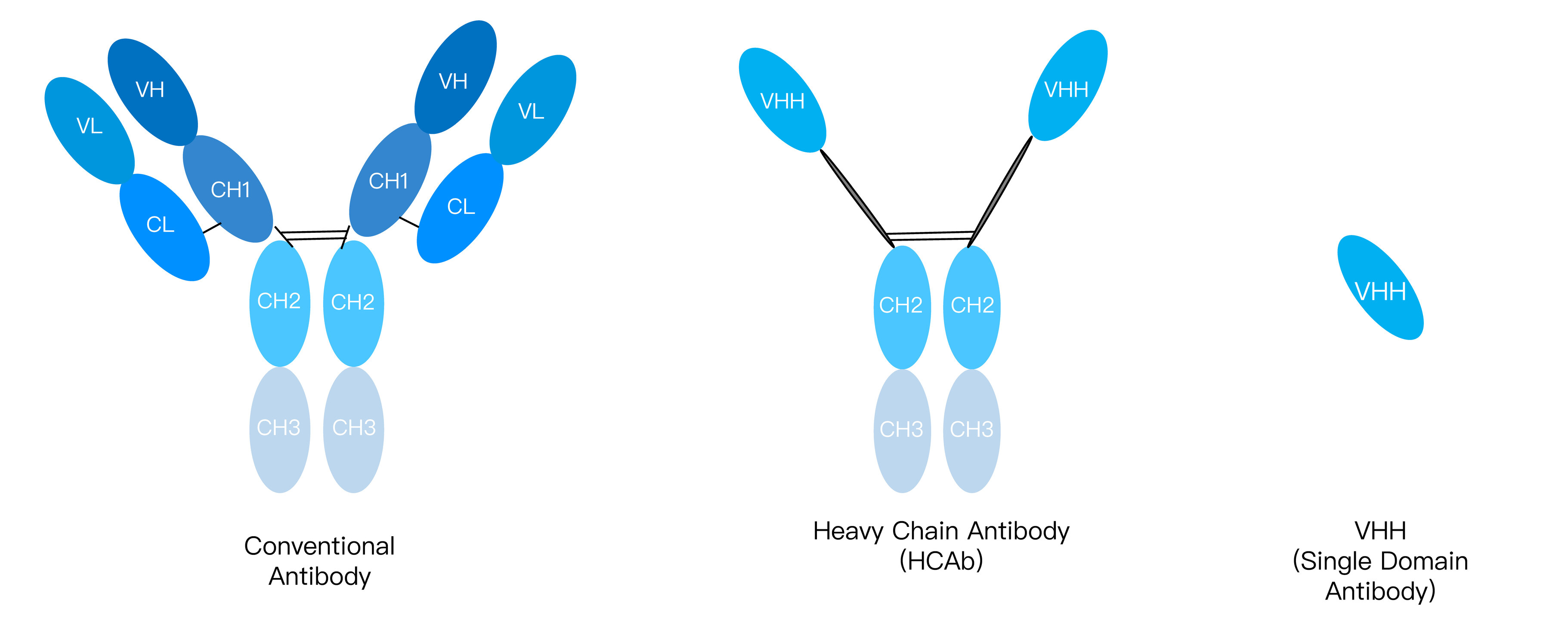
VHH antibodies are single-domain antigen-binding fragments derived from the heavy-chain-only antibodies naturally found in camelids, including alpacas and llamas. Unlike conventional immunoglobulin G (IgG), which uses paired heavy and light chains to form its antigen-binding sites, a VHH consists of one variable domain that can recognize an antigen independently.
The terms VHH, nanobody and single-domain antibody are often used in overlapping contexts, although terminology can vary by scientific and commercial setting. Strictly speaking, VHH refers to the variable domain of a camelid heavy-chain-only antibody. “Nanobody” is also used as a platform or product term in the research market.
The appeal of VHH molecules comes from their compact structure, potential stability, accessible engineering format and ability to recognize diverse epitopes. These characteristics can be useful when conventional antibodies are too large for a particular experimental design, when a binder must be fused to another protein, or when the research question requires a distinctive epitope-recognition profile.
These advantages are conditional. Not every VHH is highly stable, soluble, high-affinity or easy to express. Individual candidates must be screened and characterized for the intended application.
How VHH Antibodies Work in Biomedical Research
A VHH binds a target through its complementarity-determining regions (CDRs), which form much of the antigen-recognition surface. Sequence variation in these regions helps determine which antigen a VHH recognizes and how it interacts with that antigen. Binding performance depends on the specific sequence, antigen structure, experimental conditions and molecular format.
Researchers typically obtain candidate VHH sequences through an antibody discovery workflow. Depending on the project, this may involve immunizing an alpaca, isolating relevant B cells, constructing a VHH library, screening candidates by phage display or another display method, and evaluating binding and function. Candidate sequences can then be expressed, purified and validated using assays appropriate to the intended use.
Affinity is only one part of candidate quality. A strong discovery program also considers specificity, cross-reactivity, expression yield, solubility, aggregation, stability, epitope accessibility and performance in the final assay. A VHH with excellent binding in a purified-protein assay may perform poorly against a native membrane protein or in a complex biological sample.
Practical principle: Select and validate VHH candidates against the biological form of the target that matters for your experiment. Whenever possible, confirm that the target antigen used for discovery represents the conformation, modification state or cellular context present in the intended application.
1. Protein Detection and Immunoassay Development
One of the most direct applications of VHH antibodies is the detection of proteins in research assays. VHH binders can be used as affinity reagents in immunoassays, including selected ELISA formats, immunoblotting workflows, immunoprecipitation approaches and other protein detection methods. Whether a VHH performs well depends on the target, sample matrix, assay architecture and detection chemistry.
The single-domain format offers engineering flexibility. A VHH can be produced with a suitable tag, coupled to a detection system, or incorporated into a fusion construct. In some assay designs, a compact binder may improve access to an epitope that is sterically restricted when larger binding molecules are used.
When VHH is worth considering
Consider a VHH when a conventional antibody gives inconsistent performance, the target contains a difficult-to-access epitope, or the assay requires a compact binding module for a defined architecture. It is also worth exploring when a project needs a custom binder rather than a commercially available reagent that has already been validated for the exact application.
What to validate
Test signal-to-background ratio, detection limit, specificity, matrix interference and reproducibility using the actual sample type. For sandwich assays, verify that capture and detection binders recognize compatible epitopes. Two strong individual binders do not necessarily form a successful pair.
For teams planning a custom reagent program, KMD Bioscience's Antibody Expression & Validation Platform is a relevant starting point for discussing candidate production and experimental validation.
2. Live-Cell and Tissue Imaging
VHH antibodies are useful in selected imaging workflows because their small size can support rapid target engagement and, in some contexts, improved access to crowded molecular environments. When fused to fluorescent proteins or coupled to suitable labels, VHH-based probes can help researchers visualize proteins, track molecular localization or investigate target distribution.
For live-cell research, the distinction between extracellular and intracellular targets is critical. A VHH added to a culture medium does not automatically cross an intact cell membrane. Intracellular imaging may require genetic expression of a VHH fusion, a validated delivery approach or another method appropriate to the experimental system.
Applications in practice
Mapping the localization of a selected protein in cells or tissue sections.
Developing fluorescent probes for microscopy workflows.
Comparing target distribution across experimental conditions.
Investigating whether a target is accessible in a specific cellular compartment.
For imaging, prioritize low nonspecific background, reliable labeling, retained binding after conjugation and appropriate controls. A bright signal is not proof of target specificity. Include negative controls, target-negative samples where available, and independent confirmation of the observed localization.
3. Structural Biology and Protein Structure Research
VHH antibodies can help stabilize selected protein conformations for structural studies, including cryo-electron microscopy and other methods that benefit from a defined protein complex. A VHH may bind a particular conformation, reduce conformational heterogeneity or provide additional molecular mass that helps distinguish a target complex during image processing.
This application is particularly valuable when a target is flexible, exists in multiple conformations or is difficult to characterize in isolation. A conformation-selective VHH can act as a research tool for enriching or stabilizing a state of interest. However, its effect must be tested: a binder may stabilize the desired state, alter the equilibrium between states, or introduce a structural change that complicates interpretation.
What makes a structural biology VHH different?
The best candidate is not necessarily the one with the lowest measured dissociation constant. Researchers should consider epitope location, complex formation, conformational selectivity, sample homogeneity and compatibility with purification and structural workflows. A binder that produces a stable, monodisperse complex may be more useful than one with marginally stronger affinity but poor complex behavior.
For demanding structural projects, plan screening around the final complex and its intended use. Validate complex formation and sample quality before committing substantial time and resources to data collection.
4. Protein Interaction Studies
VHH antibodies can be used to investigate protein-protein interactions, distinguish molecular states and probe the function of selected binding interfaces. A VHH may bind near an interaction surface and disrupt a protein complex, or it may recognize a region that helps researchers capture and characterize a specific target.
These experiments can support research into signaling pathways, receptor-ligand interactions, protein complexes and molecular mechanisms. The interpretation requires care: an observed change in a pathway does not, by itself, prove that a VHH directly blocks a specific interaction. The result may reflect altered protein localization, stability, expression or another indirect effect.
Recommended experimental approach
Pair binding data with an interaction assay that directly addresses the biological hypothesis. Depending on the target, that may include biochemical binding measurements, pull-down assays, biophysical characterization or cell-based functional readouts. Use appropriate negative controls and, where possible, an independent method to confirm the result.
For projects focused on molecular binding mechanisms, KMD Bioscience offers a Protein Interaction Services resource that researchers can review when planning an appropriate study design.
5. Intracellular Target Modulation and Research Inhibitors
Intracellular VHH molecules, sometimes described as intrabodies, can be used to investigate the function of proteins inside cells. Depending on the binder and design, an intrabody may interfere with a protein interaction, alter localization, stabilize a particular conformation or help researchers test whether a target is required for a biological process.
This approach can be useful for targets that are difficult to study using extracellular antibodies. Researchers can express a VHH inside a model system and evaluate the resulting phenotype. The compact single-domain format can also make fusion with fluorescent proteins, localization signals or other functional elements more straightforward than some larger antibody formats.
Key limitation: intracellular access
VHH molecules generally do not enter intact cells simply because they are small. Intracellular studies require a delivery or expression strategy, and the chosen method can affect cell viability, localization and experimental interpretation. Researchers should also evaluate folding, solubility and target engagement in the cellular environment.
We recommend treating intrabodies as research tools that need direct functional validation. Confirm that the VHH reaches the intended compartment, interacts with the target and produces a reproducible effect distinct from nonspecific expression or delivery-related effects.
6. Infectious Disease Research
VHH antibodies are being investigated as tools for studying viral and other pathogen-associated proteins. Researchers may use them to detect antigens, characterize epitopes, investigate host-pathogen interactions or identify candidate molecules that interfere with a pathogen's binding or entry mechanisms.
Because a VHH can recognize a compact epitope, it may be useful for probing particular surface regions or conserved structural features. Yet pathogen targets can vary substantially between strains, conformations and experimental contexts. Binding to a purified viral protein does not establish neutralization, protection or clinical effectiveness.
Separate binding from biological activity
For infectious disease research, the evidence should match the claim. Binding assays establish recognition under defined conditions; competition assays can test interference with a specific interaction; and appropriately designed functional studies are needed to evaluate biological effects. Cross-reactivity and variation across relevant target forms should also be assessed.
Researchers working with viral antigens may find KMD Bioscience's viral protein research products useful when identifying target materials for a discovery or characterization project. The antigen format and its relevance to the intended experiment should be confirmed before selecting a binder-development strategy.
7. Therapeutic Candidate Discovery
VHH antibodies are an important format in biologic discovery because they can serve as starting points for therapeutic research and molecular engineering. Depending on the target and mechanism, candidates may be investigated as single domains, linked into multivalent constructs, combined with other binding domains or fused to functional components.
Potential research directions include receptor modulation, ligand neutralization, pathway inhibition and other target-dependent mechanisms. The appropriate format depends on whether the desired effect requires blocking a ligand, cross-linking a receptor, extending circulation time or engaging multiple targets.
Why a good discovery binder is not automatically a therapeutic candidate
Therapeutic development requires much more than antigen binding. Researchers must investigate potency, specificity, stability, aggregation, expression, immunogenicity risk, pharmacokinetic behavior, tissue distribution and safety-related properties. A small molecular format may have advantages in tissue penetration in some settings, but it can also undergo rapid renal clearance depending on its size and molecular design.
For that reason, therapeutic discovery programs should define the required biological effect before screening. If the goal is receptor agonism, for example, a high-affinity binder that does not trigger the necessary receptor behavior may be the wrong candidate. Functional screening should be designed around the mechanism, not added as an afterthought.
KMD Bioscience's Innovative Drug Discovery Platform and Antibody Humanization Platform are relevant resources for teams evaluating discovery and subsequent antibody engineering options. Humanization and other developability work should be guided by the molecule, intended application and development stage.
8. Targeted Delivery Research
VHH domains can be incorporated into experimental targeting constructs intended to bind selected cells, tissues or molecular targets. A VHH may be fused to a payload, reporter, enzyme, nanoparticle-binding component or another functional molecule, depending on the research objective. The binding domain provides target recognition; the attached component provides the additional function.
Potential applications include investigating target-directed delivery, studying receptor-mediated uptake and comparing the distribution of different molecular formats. A compact binder may help create a smaller construct, but overall size, charge, linker design, target accessibility and payload properties all affect behavior.
What determines whether a targeting construct works?
Specificity is only the first requirement. Researchers should measure binding to target-positive and target-negative cells, internalization where relevant, payload stability, nonspecific uptake and the effect of the complete construct. A VHH that binds strongly to a purified target may not recognize that target when it is embedded in a membrane or surrounded by other molecules.
Do not equate cell binding with successful delivery. The payload may fail to enter the intended compartment, detach prematurely or cause off-target effects. Build the validation plan around the entire construct rather than evaluating the VHH domain in isolation.
9. Biosensors and Point-of-Use Detection Research
VHH antibodies can serve as recognition elements in biosensor development. Researchers may immobilize a VHH on a surface or integrate it into a detection architecture to capture a target and generate a measurable signal. The readout can depend on the chosen sensor platform, labeling method and assay design.
The compact size of VHH molecules may be advantageous when surface geometry and access to a target influence sensor performance. In some configurations, the binder can be oriented or engineered to improve its presentation on the sensing surface. However, immobilization chemistry can reduce binding activity, and the performance of a purified assay does not necessarily translate into a complex sample.
What to measure during development
Limit of detection and useful dynamic range.
Specificity and cross-reactivity against related analytes.
Response time, repeatability and stability of the immobilized binder.
Matrix effects from the intended sample type.
Storage, regeneration and shelf-life requirements for the complete sensor.
For commercial or point-of-use development, reproducibility and manufacturing consistency matter as much as initial sensitivity. A sensor that produces a strong signal in a clean buffer but fails in the intended sample matrix is not ready for practical deployment.
10. Reagent Engineering and Functional Studies
Another major application of VHH antibodies is their use as modular building blocks for engineered research reagents. Because a VHH is a single binding domain, it can be combined with tags, reporter proteins, localization sequences or other domains to create constructs suited to specific experiments.
Researchers can use these designs to compare binding formats, investigate molecular localization, create affinity reagents for specialized assays or test how changes in valency influence target engagement. Multivalent designs may improve apparent avidity, but they can also alter specificity, aggregation, steric accessibility and biological activity. The result should therefore be evaluated as a new molecule rather than assumed to behave like the original monomeric VHH.
Custom reagent design is particularly useful when off-the-shelf antibodies do not meet the project's needs. Still, custom engineering is worth the investment only when the proposed modification addresses a defined experimental limitation. Begin with the smallest construct that can answer the question, then add complexity when the data justify it.
For projects that require a broader custom binder strategy, KMD Bioscience's Custom Antibody Platform and Protein Expression Services are relevant starting points for discussing construct design and production requirements.
VHH Antibodies vs. Conventional Antibodies: Which Should You Choose?
VHH antibodies are not a universal replacement for conventional IgG. The correct choice depends on the assay, target structure, required molecular format and the evidence available for each candidate. Use the following comparison as a project-planning guide rather than an assumption that one format always performs better.
| Decision Factor | VHH Antibody | Conventional IgG | Practical Recommendation |
|---|---|---|---|
| Molecular format | Single antigen-binding domain | Typically two heavy and two light chains with paired antigen-binding sites | Choose VHH when a compact, modular binder is advantageous. |
| Epitope access | Small size may help access some recessed or crowded epitopes | Larger overall structure may limit access in certain contexts | Compare candidates experimentally against the native target. |
| Engineering | Single-domain format can simplify selected fusion designs | Established formats with extensive engineering options | Choose based on construct complexity and desired function. |
| Effector functions | No conventional IgG Fc domain unless engineered or fused | Fc can support selected immune effector and Fc-receptor functions | Use IgG or an engineered VHH format according to the biological mechanism. |
| Circulation time | Small domains may clear rapidly unless format or design changes this behavior | Fc and size generally support longer systemic persistence | Consider pharmacokinetics early in therapeutic research. |
| Reagent availability | Availability varies by target and application | Many targets have established commercial antibody options | Compare custom development time and validation evidence with off-the-shelf reagents. |
| Best fit | Compact probes, selected structural studies, engineered constructs and specialized binders | Established assays and applications requiring conventional antibody properties | Start with the biological question, not the novelty of the format. |
Benefits and Limitations of VHH Antibodies
Main benefits
Compact molecular size: Can support access to selected epitopes and facilitate certain engineered constructs.
Single-domain architecture: Can simplify some cloning, fusion and format-development workflows.
Broad engineering flexibility: VHH domains can be linked or fused to other components when the application requires it.
Potential stability advantages: Some VHH candidates tolerate conditions that challenge other binders, although this must be measured for each sequence.
Alternative epitope recognition: VHH discovery may identify binding sites not adequately covered by existing conventional antibodies.
Main limitations
Candidate variability: Solubility, expression, affinity, specificity and stability differ between sequences.
Fast systemic clearance in some formats: Small size can be a disadvantage for applications that require prolonged circulation.
Limited inherent Fc functions: A standalone VHH does not automatically reproduce the functions of an intact IgG.
Application-specific validation: A positive binding result does not guarantee imaging, inhibition, detection or therapeutic performance.
Custom discovery costs and timelines: Generating and validating a new binder requires project planning, experimental resources and defined acceptance criteria.
VHH Antibody Research: Pros and Cons Table
| Pros | Cons |
|---|---|
| Compact single-domain format can suit specialized molecular designs. | Small size alone does not guarantee better performance or tissue penetration. |
| Can recognize useful epitopes for which existing reagents are inadequate. | Discovery success and epitope quality depend on target design and screening strategy. |
| Can be fused to reporters or other domains for custom research tools. | Fusion partners may change folding, binding, solubility or biological activity. |
| May be suitable for selected structural biology and imaging workflows. | Native-target binding and final-assay performance still require validation. |
| Offers an alternative format for therapeutic discovery. | Developability, pharmacokinetics, immunogenicity and safety remain substantial considerations. |
How to Choose a VHH Discovery and Validation Workflow
For a new project, the discovery method should be selected around the target and the intended application. A technically successful library screen is only an intermediate milestone; the final goal is a binder that works in the experiment that matters.
Step 1: Define the target and the required function
Document the target species, sequence, structure, post-translational modifications and relevant biological form. Decide whether you need binding, inhibition, activation, neutralization, imaging, capture or another defined function. This decision determines how candidates should be screened and evaluated.
Step 2: Select the discovery strategy
Different approaches suit different projects. Alpaca immunization followed by VHH library construction and display-based screening can be appropriate when an immune repertoire is part of the strategy. Phage display can enable selection and enrichment of candidate binders. Single B-cell approaches may be useful where the project benefits from recovering sequences from selected antibody-producing cells. Each approach has trade-offs in target suitability, screening design, time and resource requirements.
KMD Bioscience provides a VHH Antibody Platform and a Phage Display Platform for teams assessing discovery options. For project-specific decisions, ask how the proposed method addresses your antigen, required epitope and final functional assay.
Step 3: Plan library construction and screening around the antigen
Antigen quality can strongly influence discovery outcomes. Recombinant proteins may differ from native targets in folding, oligomeric state, glycosylation or membrane context. If the final application involves a cell-surface target, screening only against a short peptide or an isolated domain may fail to capture important native epitopes.
Define screening criteria before starting. These may include binding strength, specificity, competition behavior, cross-reactivity and recognition of the relevant target form. The exact criteria should match the scientific question rather than use affinity as the sole ranking measure.
Step 4: Express and characterize selected candidates
After screening, candidates should be expressed and purified in a format suitable for characterization. Evaluate identity, purity, yield, solubility and aggregation, then test binding with an appropriate assay. Where the project requires a functional effect, include a relevant functional assay rather than inferring activity from binding alone.
KMD Bioscience's Single B Cell Screening Platform may be relevant to projects evaluating B-cell-based discovery strategies. The Antibody Expression & Validation Platform can also be reviewed when planning downstream candidate characterization.
Step 5: Establish acceptance criteria before scaling up
Before committing to larger-scale production or downstream engineering, define what success means. Establish measurable requirements for binding, purity, concentration, storage stability, assay performance and batch consistency. For therapeutic discovery, add the developability and biological evaluation appropriate to the stage of research.
This is where a cost-benefit decision becomes important. A low-cost binder that fails in the intended assay is not a bargain. A more expensive discovery route may be justified when it provides a credible path to the required target conformation, function or reagent format. Conversely, if a well-validated commercial antibody already answers the question, custom VHH discovery may not be necessary.
Common Mistakes in VHH Antibody Research
Choosing by affinity alone: A high-affinity candidate may still have poor specificity, aggregation, low yield or unsuitable functional behavior.
Using an irrelevant antigen format: A peptide or isolated domain may not represent the native target encountered in the final assay.
Assuming small size guarantees cell entry: VHHs do not automatically cross intact cell membranes.
Confusing binding with function: Binding data alone do not prove inhibition, neutralization, internalization or therapeutic benefit.
Ignoring molecular format: Adding a tag, linker, label or fusion partner can change the behavior of the original binder.
Skipping negative controls: Nonspecific binding and assay artifacts can create misleading signals.
Starting without defined acceptance criteria: Projects can waste time on candidates that are technically interesting but unsuitable for the final application.
Underestimating downstream development: A successful screen is not the end of expression, purification, characterization or functional validation.
How KMD Bioscience Supports VHH Antibody Research
For research teams that need a custom VHH rather than an off-the-shelf antibody, the discovery workflow can be as important as the final sequence. KMD Bioscience describes a VHH library construction and screening service based on alpaca immunization and phage display, with service stages that can include antigen design, immunization, library construction, screening and functional validation.
Alpaca VHH Antibody Library Construction
KMD Bioscience reports more than nine years of experience in VHH library construction and screening, with a technical team and an integrated discovery workflow. Researchers should confirm the scope, deliverables, project timelines and validation criteria for their particular target before engaging a service provider.
Explore the Alpaca VHH Library Construction service.
When evaluating a service provider, we recommend discussing the following points before requesting a quote:
Antigen feasibility: Can the provider support the relevant protein format, membrane target or other challenging antigen?
Screening design: Will candidate selection address the intended application and required biological function?
Deliverables: Will the project provide sequence information, purified candidates, binding data and functional validation results as agreed?
Quality criteria: How are specificity, purity, expression and reproducibility assessed?
Project ownership and confidentiality: Clarify sequence ownership, intellectual property, sample handling and confidentiality terms in writing.
Downstream support: Can the team support expression, engineering or additional validation if the initial candidates need optimization?
For a research group that needs a complete path from discovery to usable reagents, an integrated workflow can reduce coordination between separate vendors. However, service breadth alone does not guarantee a successful outcome. Compare providers based on the proposed scientific plan, relevant experience, transparent deliverables and evidence that the final assays will address the project's objective.
Expert Recommendation: When Should You Choose a VHH Antibody?
From our perspective, VHH antibodies are most valuable when the project has a clear reason to use a single-domain binder. Examples include a structurally challenging epitope, a compact imaging probe, a conformation-selective research tool, a custom fusion construct or a discovery program where existing antibodies do not deliver the required specificity or function.
For routine protein detection, start by checking whether a validated commercial antibody already meets the assay's needs. If it does, developing a new VHH may add cost and delay without a meaningful gain. If existing reagents fail because of epitope access, specificity or engineering constraints, a custom VHH program becomes more compelling.
For therapeutic discovery, do not stop at binding. Plan for functional activity, developability, pharmacokinetics and the other requirements relevant to the intended development stage. For structural biology, prioritize the quality and relevance of the target complex. For imaging and biosensors, validate signal specificity and performance in the actual sample context.
Our recommendation is to define the target, desired function, sample context and measurable acceptance criteria before choosing the discovery platform. Then select the workflow that offers the most credible route to those outcomes. That approach is more likely to produce a useful research reagent than selecting a technology first and searching for an application afterward.
Frequently Asked Questions About Applications of VHH Antibodies
1. What are the main applications of VHH antibodies?
The main applications include protein detection, immunoassay development, imaging, structural biology, protein interaction studies, intracellular target modulation, infectious disease research, therapeutic candidate discovery, targeted delivery research and biosensor development. The best application depends on the individual VHH's binding properties and the required experimental function.
2. What is the difference between a VHH antibody and a nanobody?
VHH refers to the variable antigen-binding domain of a camelid heavy-chain-only antibody. Nanobody is commonly used to describe this type of single-domain binder, although it can also be used as a commercial or platform term. The exact terminology can vary by supplier and scientific context.
3. Are VHH antibodies better than conventional antibodies?
Not in every situation. VHH molecules have a compact single-domain structure and can be useful for selected epitopes and engineered constructs. Conventional IgG antibodies may be preferable when established reagents, Fc-mediated functions or longer systemic persistence are required. Choose based on experimental evidence and the intended use.
4. Can VHH antibodies enter living cells?
Not automatically. Their small size does not mean they freely cross intact cell membranes. Intracellular applications generally require an expression, delivery or other validated strategy. Researchers should confirm cellular localization, target engagement and functional activity in the chosen model.
5. Can VHH antibodies be used for therapeutic research?
Yes. VHH domains can serve as starting points for therapeutic discovery and can be engineered into different molecular formats. A promising binder still requires appropriate functional, specificity, stability, developability, pharmacokinetic and safety-related evaluation before any therapeutic conclusions can be drawn.
6. Why is VHH library construction important?
A library provides a collection of candidate VHH sequences that can be screened for recognition of the target. Library quality, antigen design, selection conditions and screening criteria influence the candidates recovered. A successful library screen is an intermediate step, not proof that a candidate will work in the final assay.
7. What is phage display in VHH discovery?
Phage display is a selection method in which candidate binding molecules are displayed on bacteriophages and enriched through binding-based screening. It can help identify VHH sequences that recognize a target under defined conditions. Additional characterization is required to assess specificity, expression, stability and functional performance.
8. How should researchers validate a VHH antibody?
Validation should match the intended application. Typical considerations include sequence identity, purity, binding strength, specificity, cross-reactivity, solubility, aggregation and stability. Functional studies are also necessary when the intended use involves inhibition, neutralization, target modulation, imaging or another biological effect.
9. When is custom VHH antibody discovery worth the investment?
Custom discovery is most worthwhile when existing reagents do not meet the project's requirements, when a specific epitope or function is needed, or when the intended construct requires a specialized binding domain. If an established commercial antibody already performs reliably in the required assay, purchasing that reagent may be more cost-effective.
10. What should I ask a VHH antibody service provider before starting a project?
Ask about antigen suitability, discovery strategy, screening and validation assays, candidate deliverables, project timelines, quality criteria, sequence ownership, confidentiality, pricing and downstream support. Agree on measurable acceptance criteria before the project begins so that success is defined by the research need rather than by the number of candidates delivered.
References
Muyldermans, S. “Nanobodies: Natural Single-Domain Antibodies.” Annual Review of Biochemistry. A foundational review of single-domain antibody structure, properties and applications. https://doi.org/10.1146/annurev-biochem-063011-092449
Hamers-Casterman, C. et al. “Naturally occurring antibodies devoid of light chains.” Nature. Foundational research describing heavy-chain-only antibodies in camelids. https://doi.org/10.1038/363446a0
U.S. National Library of Medicine, PubMed. Biomedical literature database for research on VHH antibodies, nanobodies, structural biology and therapeutic discovery. https://pubmed.ncbi.nlm.nih.gov/
Research note: VHH performance is sequence-, target- and application-dependent. The applications discussed here describe research uses and development opportunities; they do not establish that a particular candidate is clinically effective or suitable for every assay. Confirm claims against primary literature and validate each binder in the intended experimental system.





 0
