


7 Key Factors That Affect Gene Editing Efficiency: An Expert Guide
- 2026-09-13
- 36
In the rapidly accelerating field of biotechnology, CRISPR-Cas9 and other nucleases have revolutionized how we approach cellular engineering. Yet, a harsh commercial reality plagues academic and industrial laboratories alike: theoretical design rarely matches physical execution. You can design a brilliant Single Guide RNA (sgRNA) on your computer, but if you fail to account for the physical variables that Affect Gene Editing Efficiency, your experiment will yield a disastrous 2% knockout rate. Time and capital are wasted.

From our experience engineering complex cell lines and managing extensive plant and mammalian genetic modifications, we know that successful gene editing is not a single protocol but a delicate orchestration of variables. In most professional situations, the difference between a stalled project and a patentable breakthrough comes down to optimizing delivery mechanisms, nuclease formats, and cellular repair pathways. In this comprehensive guide, we will dissect the seven pivotal variables that Affect Gene Editing Efficiency, providing commercial and practical judgment to help you make informed decisions for your next molecular endeavor.
Quick Answer: What Controls Editing Success?
If you are struggling with low knockout or knock-in rates, several distinct variables directly Affect Gene Editing Efficiency. The 7 key factors are:
sgRNA Specificity and Design: The thermodynamic stability and targeting precision of your guide RNA.
Delivery Methods: Whether you use electroporation, lipofection, or viral vectors.
Nuclease Format: Utilizing Ribonucleoprotein (RNP) complexes versus standard plasmid DNA.
Target Cell Type and State: Primary cells versus dividing immortalized cell lines.
DNA Repair Pathways: Balancing Non-Homologous End Joining (NHEJ) against Homology-Directed Repair (HDR).
Chromatin Accessibility: The physical state of the target DNA (euchromatin vs. heterochromatin).
Validation and Detection: The sensitivity of the assays used to confirm the edits.
We recommend transitioning away from plasmid-based delivery to RNP complexes for immediate, massive boosts in efficiency, especially in hard-to-transfect primary cells.
Table of Contents
What is Gene Editing Efficiency?
Gene editing efficiency refers to the percentage of target cells within a given population that successfully acquire and maintain the desired genetic modification (e.g., insertion, deletion, or substitution) after treatment with editing tools like CRISPR-Cas9, TALENs, or ZFNs. In a perfectly efficient system, 100% of the cells exposed to the editing machinery would exhibit the exact intended mutation on both alleles without any off-target effects.
In reality, baseline efficiency can be as low as 1% to 5% in difficult primary cells. Identifying the exact bottlenecks that Affect Gene Editing Efficiency is the primary job of a molecular biologist. If efficiency is too low, isolating a successfully edited monoclonal cell line becomes statistically impossible, bringing your entire downstream assay pipeline to a halt.
How These 7 Factors Work Together
To successfully navigate a genetic engineering project, you must optimize each of these seven pillars. A failure in just one will drastically Affect Gene Editing Efficiency.
1. sgRNA Design and Specificity
The guide RNA is the GPS of your Cas9 nuclease. If the sgRNA targets a sequence with high secondary structure or poor GC content, the Cas9 will fail to bind effectively. Furthermore, off-target effects drain the concentration of active Cas9 complexes away from your primary target. In our testing, utilizing chemically synthesized, modified sgRNAs (with 2'-O-methyl analogs) prevents rapid degradation inside the cell, dramatically increasing the window of editing opportunity.
2. Delivery Methods (Viral vs. Non-Viral)
How you get the machinery into the cell is arguably the most critical variable. Traditional lipid-based transfection (lipofection) is cheap but highly toxic and inefficient for primary cells or stem cells. Electroporation physically shocks the cell membrane open, which is harsh but highly effective. Viral vectors (like Lentivirus or AAV) offer superb delivery efficiency but require extensive safety protocols and complex Molecular Platform expertise to engineer.
3. Cas9 Nuclease Format (Plasmid vs. RNP)
Historically, researchers delivered Cas9 and sgRNA encoded on a DNA plasmid. This means the cell must first transcribe and translate the plasmid before editing can begin—a slow, inefficient process. Today, we recommend utilizing Ribonucleoprotein (RNP) complexes. This involves delivering a pre-assembled, active Cas9 protein directly bound to the sgRNA. It acts immediately and degrades quickly, preventing long-term off-target editing.
4. Target Cell Type and State
An immortalized HEK293 cell line is eager to divide and highly receptive to transfection. A primary T-cell or a mature plant protoplast is incredibly resistant. The cell cycle state matters immensely; cells must typically be actively dividing for high-efficiency editing to occur. For agricultural biotechnology, navigating the tough plant cell wall is a unique challenge that requires a dedicated Plant Genetic Transformation Platform to master via Agrobacterium or biolistics.
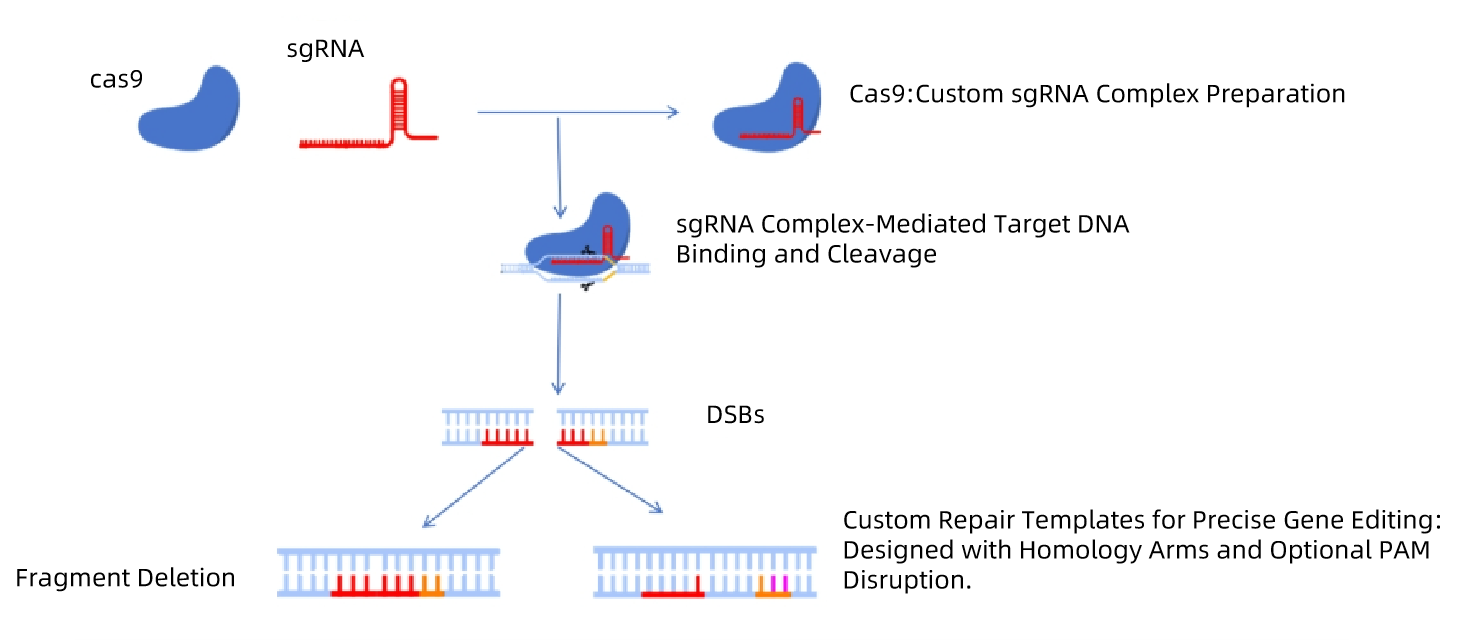
Plant Gene Knockout (KO) Service Introduction
Gene knockout (KO) technology is a method that enables specific genes in the organism’s genome to lose their function. This technique introduces mutations into the DNA sequence of the target gene, preventing it from encoding normal proteins and thus resulting in gene function loss. In the field of plant genetics and crop improvement, specific genes can be knocked out to observe changes in plant phenotypes, thereby studying gene function.
At KMD Bioscience, our Plant Gene Knockout (KO) Service leverages optimized CRISPR-Cas9 protocols specifically tailored to overcome the rigid plant cell wall, maximizing transformation rates in both model and crop species.
5. DNA Repair Mechanisms (NHEJ vs. HDR)
Once Cas9 cuts the DNA, the cell repairs it. Non-Homologous End Joining (NHEJ) is the cell's default, error-prone repair pathway, which is excellent for creating gene knockouts via frameshift mutations. However, if you are attempting to insert a specific sequence (Knock-in), you must rely on Homology-Directed Repair (HDR). HDR is notoriously inefficient (often less than 5%). Providing an optimized, single-stranded DNA repair template and using small molecule inhibitors to block NHEJ can force the cell into the HDR pathway.
6. Chromatin Accessibility
Cas9 cannot cut what it cannot reach. If your target gene is locked away in tightly wound heterochromatin, the sgRNA will bounce off. You must profile the epigenetic state of your target cells. Sometimes, pre-treating cells with chromatin-relaxing agents (like HDAC inhibitors) can temporarily open the DNA architecture and positively Affect Gene Editing Efficiency.
7. Validation and Detection Methods
You might have successfully edited your cells, but if your detection assay is poor, you will mistakenly assume failure. Standard Surveyor or T7E1 mismatch cleavage assays often lack the sensitivity to detect low-frequency edits. You must employ Next-Generation Sequencing (NGS) or utilize a robust Detection Platform to accurately quantify your indel frequencies.
The Commercial Benefits of Optimization
For commercial users, pharmaceutical developers, and agricultural biotech firms, low editing efficiency translates directly to massive capital burn. If your team spends six months trying to isolate a homozygous knockout clone from a pool with a 1% editing efficiency, you are wasting labor, expensive cell culture media, and critical time-to-market.
By heavily investing upfront in optimizing the factors that Affect Gene Editing Efficiency—such as purchasing high-quality recombinant protein products for RNP delivery rather than cheap plasmids—you compress your project timeline. A highly efficient edit allows for rapid phenotypic screening, faster transition to Protein Modification & Detection Services, and expedited patent filings.
Limitations and Hard Biological Truths
We must apply practical judgment here. You cannot overcome biology with sheer force. For heavy-duty applications involving primary human stem cells or polyploid plant species, achieving greater than 20% HDR knock-in efficiency without lethal toxicity is currently a barrier of modern science. Aggressive electroporation to force RNPs into primary cells will result in massive cell death. You must always balance editing efficiency against cell viability. A 90% editing rate is useless if 99% of your cells die from the delivery method.
Who Should Optimize (And Who Does Not Need To)
Who Should Hyper-Optimize: We strongly advise researchers working with induced pluripotent stem cells (iPSCs), primary immune cells (CAR-T therapy), or complex agricultural crops to ruthlessly optimize every parameter. For these applications, utilizing a specialized Gene Editing Platform is critical.
Who Does Not Need To: If you are a beginner simply performing a routine gene knockout in a robust, immortalized cancer line (like HeLa or HEK293) just to perform a basic western blot, you do not need to spend thousands of dollars on custom RNP complexes. A basic, off-the-shelf lipofection plasmid kit will suffice for these highly forgiving scenarios.
Common Mistakes in the Laboratory
Expert Insight: The most catastrophic mistake we see researchers make is failing to validate their Cas9 protein activity in vitro before attempting to edit complex cell lines.
Never blindly trust that your synthesized plasmid or purchased protein is active. Always perform an in vitro cleavage assay. Furthermore, researchers frequently fail to account for the protein expression systems overview when synthesizing their own nucleases. If you use a standard E. coli protein expression system to generate Cas9 without proper purification, the retained endotoxins will immediately kill your mammalian cells upon delivery.
Expert Buying Considerations for CROs
If you choose to outsource this complex work to a Contract Research Organization (CRO), you must ask hard questions. Do not accept a generic guarantee. Ask the CRO what specific strategies they use to positively Affect Gene Editing Efficiency in your specific cell line.
Do they guarantee a homozygous knockout, or just a heterozygous mixed pool?
Do they utilize RNP electroporation as their standard?
Can they seamlessly transition the edited cell line into downstream Protein Interaction Services to validate the functional outcome of the genetic change?
Pros and Cons of In-House vs Outsourced Editing
| Strategy | Pros (Advantages) | Cons (Disadvantages) |
|---|---|---|
| In-House Gene Editing | Complete control over intellectual property; excellent learning opportunity for laboratory staff. | Massive upfront cost for electroporators, NGS sequencing, and media. High risk of project delays due to optimization failures. |
| Outsourcing to a CRO | Guaranteed deliverables; leverages industrial-scale optimization and expertise; rapid turnaround times. | Higher initial cash outlay per project; requires strict material transfer agreements (MTAs). |
Comparison Table: Delivery Methods
Understanding delivery is the primary bottleneck. Review this comparison to choose your approach.
| Delivery Method | Efficiency (Hard Cells) | Toxicity Level | Best Use Case |
|---|---|---|---|
| Lipid Transfection (Plasmids) | Low to Moderate | High | Standard immortalized cell lines (HEK293, HeLa). |
| Electroporation (RNPs) | Very High | Moderate | Primary cells, stem cells, and rapid knockout screens. |
| Lentivirus / AAV | Extremely High | Low | In vivo therapies, stable integration, hard-to-reach tissues. |
KMD Bioscience Expert Recommendation
From our experience engineering thousands of custom cell lines and agricultural variants, the days of struggling for months with inefficient plasmid transfections should be over. We strongly recommend that commercial users and serious academic labs stop viewing gene editing as a DIY endeavor when dealing with non-standard cells.
By leveraging KMD Bioscience's integrated platforms, you bypass the painful optimization phase. Whether you require a robust protein expression platform services for downstream validation, or a highly specific plant transformation, outsourcing the complex variables that Affect Gene Editing Efficiency to our dedicated scientific teams ensures your project transitions from theory to tangible results on time and on budget.
Frequently Asked Questions (FAQ)
Why is my CRISPR knockout efficiency so low?
Low efficiency is typically caused by poor sgRNA design (targeting inaccessible chromatin), using an inefficient delivery method (like lipofection in primary cells), or low expression of the Cas9 nuclease. Switching to an RNP-based electroporation method usually resolves this immediately.
What is the difference between NHEJ and HDR?
NHEJ (Non-Homologous End Joining) is an error-prone repair pathway that randomly inserts or deletes bases, making it perfect for destroying (knocking out) a gene. HDR (Homology-Directed Repair) uses a provided DNA template to precisely insert a new sequence, but it is highly inefficient and only occurs during cell division.
Are RNP complexes better than Cas9 plasmids?
In most professional situations, yes. RNP (Ribonucleoprotein) complexes consist of the Cas9 protein pre-bound to the guide RNA. Because they do not require transcription or translation by the cell, they edit immediately and degrade rapidly, which massively reduces toxic off-target effects compared to long-lasting plasmids.
Can I use standard E. coli to express my own Cas9 protein?
Yes, but with extreme caution. While Cas9 can be expressed using an recombinant protein expression service in E. coli, you must rigorously purify the protein to remove bacterial endotoxins. If you introduce endotoxins into mammalian cells during electroporation, you will cause mass cell death.
Authoritative References & Scientific Standards
To ensure our methodologies align with global biological standards, we reference the following authoritative organizations:
National Center for Biotechnology Information (NCBI): Guidelines on gene annotation, chromatin states, and genomic mapping critical for accurate sgRNA design. Visit NCBI
Addgene: The global non-profit plasmid repository, providing standardized protocols for CRISPR-Cas9 assembly, validation, and delivery. Visit Addgene CRISPR Guide
Nature Protocols: Peer-reviewed, standardized methodologies for measuring, tracking, and improving genome editing efficiency via HDR and NHEJ pathways. Visit Nature Protocols

- Protein Platform
- Protein Expression Services
- Protein Modification & Detection Services
- Protein Interaction Services
- Protein Purification Service
- Antibody Discovery Platform
- VHH Antibody Platform
- Phage Display Platform
- Antibody Humanization Platform
- Single B Cell Screening Platform
- Antibody Expression & Validation Platform
- Peptide Library Platform
- Custom Antibody Platform
- Innovative Drug Discovery Platform
- Product Center
- Proteins
- Antibodies
- Raw Materials Reagents
- Small Molecule Reagents
- Peptide Products
- Nanoparticle Products
- Contact Us
- Phone:400-621-6806
- Mobile:13110936064(WeC
- E-mail:[email protected]
- Address:Room 108, Building 10, No. 6 Hechang Road, Wuqing Development Zone, Tianjin City
-

WeChat
-

Service Account
-
 400-621-6806
 -
 3599163699
 -
 Monday to Friday 9:00-18:00
 -

-
 0
0
-
