


7 Advantages of VHH Antibodies for Modern Drug Discovery
- 2026-09-07
- 56
Conventional monoclonal antibodies (mAbs) are physically massive, structurally complex, and remarkably expensive to manufacture. At 150 kDa, full-length IgGs routinely fail to penetrate dense tumor microenvironments and are completely excluded by the blood-brain barrier. The biopharmaceutical industry has aggressively pivoted toward heavy-chain-only antibodies derived from Camelidae, commonly known as VHH antibodies or nanobodies. If your pipeline relies exclusively on traditional hybridoma technology, you are operating at a severe commercial and clinical disadvantage.
From our experience engineering targeted therapeutics and diagnostic reagents at KMD Bioscience, the structural simplicity of a 15 kDa VHH domain bypasses the inherent roadblocks of conventional antibodies. We consistently observe that VHH candidates clear preclinical validation faster, cost significantly less to scale, and bind to cryptic epitopes that conventional IgGs simply cannot reach. Understanding the precise Advantages of VHH Antibodies is mandatory for any commercial laboratory looking to build next-generation bispecifics, CAR-T therapies, or inhalable biologics.
Quick Answer: Core Advantages of VHH Antibodies
The primary Advantages of VHH Antibodies stem from their minimal size (15 kDa) and unique single-domain structure. They offer: 1) Superior tissue and solid tumor penetration. 2) The ability to bind hidden or cryptic epitopes due to extended CDR3 loops. 3) Extreme thermal and chemical stability, enabling novel delivery routes like inhalation. 4) Cost-effective microbial manufacturing (E. coli or yeast) rather than expensive mammalian cell culture. 5) High solubility and minimal aggregation. 6) Exceptional modularity for creating multispecific formatting. 7) High sequence homology to human VH domains, making humanization highly efficient and low-risk. In most professional situations, VHH domains are the superior choice for targeting complex membrane proteins or developing modular bispecifics.
Table of Contents
What It Is: The Anatomy of a VHH Antibody
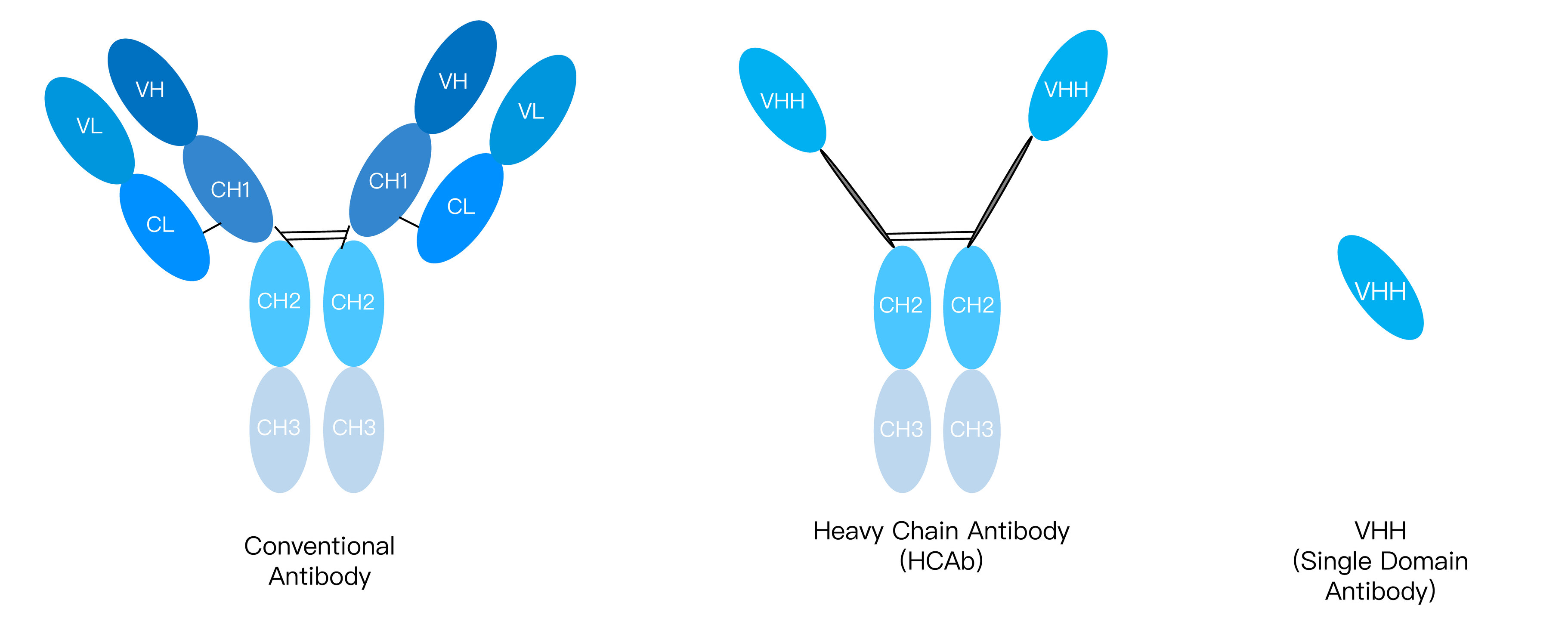
A VHH antibody is the recombinant, single-domain variable region derived from heavy-chain-only antibodies naturally found in camelids (alpacas, llamas, camels). Unlike conventional human IgGs, which consist of two heavy chains and two light chains requiring precise pairing, camelid heavy-chain antibodies lack the light chain and the CH1 domain entirely. The remaining antigen-binding fragment—the VHH domain—is roughly one-tenth the size of a standard IgG molecule, typically measuring 2.5 nm by 4 nm and weighing just 15 kDa.
This structural independence means a VHH does not suffer from the heavy/light chain mispairing issues that plague traditional bispecific antibody engineering. To explore the foundational architecture of these molecules, professionals rely heavily on a robust VHH Antibody Platform to sequence and isolate the specific binding domains.
How It Works: Antigen Recognition
A conventional IgG uses a flat or concave binding interface created by the pairing of VH and VL domains. VHH antibodies operate differently. They possess a remarkably long Complementarity Determining Region 3 (CDR3). This extended loop protrudes from the molecule like a finger, allowing it to reach into deep enzymatic clefts, viral crevices, and active receptor sites that are physically inaccessible to the bulky, flat surface of a traditional IgG.
Furthermore, because the hydrophobic interface normally used to bind the VL domain in a human antibody is replaced by hydrophilic amino acid substitutions in a camelid VHH, these molecules are highly soluble in aqueous environments, preventing the aggregation that often ruins antibody yields during scale-up.
The 7 Advantages of VHH Antibodies
1. Superior Tissue and Tumor Penetration
The 15 kDa molecular weight allows VHH antibodies to rapidly extravasate from blood vessels and deeply penetrate dense solid tumor microenvironments. Traditional IgGs often bind only to the outer periphery of a tumor (the "binding site barrier" effect). VHHs diffuse rapidly, making them exceptional targeting moieties for antibody-drug conjugates (ADCs) or CAR-T cell therapies.
2. Access to Cryptic Epitopes
As mentioned, the extended CDR3 loop of a VHH allows it to bind to concave epitopes, such as the active sites of enzymes, GPCRs, and ion channels. This unlocks an entirely new class of undruggable targets that conventional monoclonals and even a standard Peptide Library Platform struggle to inhibit effectively.
3. Extreme Thermal and Chemical Stability
VHH antibodies can withstand extreme temperatures, prolonged storage at room temperature, and harsh pH environments without losing their binding affinity. They can even refold into their active conformation after thermal denaturation. This extreme stability makes them ideal candidates for alternative administration routes, including oral gastrointestinal delivery or nebulized inhalation for respiratory viruses.
4. Cost-Effective Microbial Manufacturing
Traditional IgGs require expensive, low-yield mammalian cell culture systems (like CHO cells) to ensure proper glycosylation and folding. Because VHHs are single-domain proteins without glycosylation requirements, they can be expressed in high yields using economical microbial systems such as Escherichia coli or Pichia pastoris. Utilizing a streamlined Antibody Expression & Validation Platform drastically reduces the Cost of Goods Sold (COGS) for commercial scale-up.
5. Highly Modular Formatting
The single-gene nature of VHH domains makes them incredibly easy to engineer into multivalent or multispecific constructs. You can string two or three VHHs together on a single polypeptide chain using flexible linkers to create biparatopic antibodies (binding two different epitopes on the same antigen) or bispecifics (binding two different antigens, such as CD3 and a tumor marker) without any chain mispairing issues.
6. Streamlined Humanization Process
Camelid VHH sequences share approximately 80% sequence homology with human VH3 family domains. This high baseline similarity means that converting an alpaca VHH into a human therapeutic carries a very low risk of immunogenicity. A sophisticated Antibody Humanization Platform only needs to mutate a few specific framework residues to create a fully humanized therapeutic profile without sacrificing binding affinity.
7. Rapid Discovery via Phage Display
Because the binding domain is encoded by a single gene, constructing massive, highly diverse VHH libraries from immunized alpacas is highly efficient. By deploying a rigorous Phage Display Platform, scientists can pan these libraries against complex antigens to isolate high-affinity binders in a matter of weeks, drastically shortening the early drug discovery timeline.
Commercial Pipeline Benefits
For commercial users, the Advantages of VHH Antibodies directly impact the bottom line. Reducing discovery time through targeted immunization and bypassing mammalian cell culture in manufacturing accelerates the IND-enabling phase. Additionally, the unique patent landscape of VHH domains allows biotech companies to develop novel therapeutics that bypass existing intellectual property blockades held by legacy IgG therapies. This is a core strategy implemented within any Innovative Drug Discovery Platform.
Limitations and Mitigation Strategies
We must use commercial and practical judgment: VHH antibodies are not flawless. Their greatest advantage—small size—is also their primary limitation in vivo. A 15 kDa protein is well below the renal filtration threshold (~60 kDa), meaning naked VHHs are rapidly cleared from the bloodstream through the kidneys, resulting in a half-life of hours rather than weeks.
To mitigate this in therapeutic applications, engineers must format the VHH. This is routinely solved by fusing the therapeutic VHH to an anti-human serum albumin (HSA) VHH, or by appending an Fc domain to leverage neonatal Fc receptor (FcRn) recycling. Furthermore, naked VHHs lack native effector functions (ADCC and CDC). If your mechanism of action requires immune cell recruitment, you must engineer an Fc domain onto your VHH construct.
Who Should Use It
We recommend VHH discovery pipelines for biopharmaceutical companies developing targeted radioligand therapies, bispecific T-cell engagers, CAR-T scFv replacements, and therapies targeting solid tumors or central nervous system (CNS) diseases. If you require deep tissue penetration or need to target a complex membrane protein (like a GPCR), VHH is the definitive choice.
Who Does Not Need It
If you are an academic researcher requiring standard reagents for routine Western blotting, flow cytometry, or ELISA assays where deep tissue penetration is irrelevant, you do not need to invest in custom VHH discovery. Standard murine monoclonal antibodies generated via a Custom Antibody Platform are more than sufficient and highly cost-effective for basic in vitro laboratory applications.
Common Mistakes in VHH Discovery
In our testing and client consulting, the most catastrophic mistake made during VHH discovery is poor antigen design prior to alpaca immunization. If you immunize an alpaca with an improperly folded recombinant protein, the resulting VHH library will yield binders that fail to recognize the native protein on a cell surface.
Another major error is relying exclusively on naive synthetic libraries. While synthetic libraries are fast, an immunized alpaca library harnesses the animal's natural in vivo affinity maturation, consistently yielding VHHs with significantly higher binding affinities (picomolar range). Alternatively, advanced teams are now successfully utilizing a Single B Cell Screening Platform directly on alpaca PBMCs to isolate rare, ultra-high-affinity clones without relying on phage display.
Buying Considerations for Library Construction
When selecting a contract research organization (CRO) for VHH discovery, you must evaluate their library capacity. A functional immunized library must possess a diversity of at least 10^8 to 10^9 independent transformants. You must also verify that the partner possesses downstream validation capabilities, including Surface Plasmon Resonance (SPR) or Bio-Layer Interferometry (BLI) for accurate affinity ranking.
Summary and Comparison Tables
| Parameter | VHH Antibody (Nanobody) |
|---|---|
| Molecular Weight | ~15 kDa |
| Structure | Single monomeric variable domain |
| Tissue Penetration | Excellent (High diffusion into solid tumors) |
| Epitope Recognition | Binds hidden/cryptic clefts via long CDR3 |
| Manufacturing Host | E. coli, Yeast (Cost-effective) |
| Feature | Conventional IgG | VHH Antibody |
|---|---|---|
| Size | 150 kDa | 15 kDa |
| Stability | Moderate (Susceptible to heat/pH) | Extreme (Resistant to heat/pH) |
| Half-life (Unmodified) | 21 Days (FcRn recycling) | ~2 Hours (Renal clearance) |
| Effector Function | Native ADCC / CDC | None (Requires engineering) |
| Bispecific Engineering | Complex (Chain mispairing risks) | Simple (Direct genetic fusion) |
| Pros (Advantages) | Cons (Limitations) |
|---|---|
| Superior solid tumor penetration. | Rapid renal clearance without half-life extension. |
| Cost-effective microbial production. | Lacks native immune effector functions. |
| Easy to humanize due to high VH homology. | Requires camelid immunization for optimal affinity. |
| Binds previously undruggable cryptic targets. | Small size can hinder target cross-linking if required. |
Expert Recommendation
In most professional situations, launching a biologic targeting a complex microenvironment with a conventional IgG is no longer the optimal path. We recommend transitioning your discovery pipeline to a VHH architecture, specifically leveraging immunized alpaca libraries to secure picomolar affinity candidates. The reduction in downstream manufacturing costs and the unparalleled formatting flexibility of VHH domains provide a massive strategic advantage. To stay updated on the shifting paradigms in this field, we highly recommend following recent antibody development news and broader biotech industry trends blog publications.
KMD Bioscience Alpaca VHH Antibody Library Construction Introduction
KMD Bioscience brings over nine years of expertise in VHH Library Construction and Screening, backed by a seasoned technical team. Leveraging our robust Antibody Discovery Platform, we deliver hundreds of successful Alpaca VHH Library Construction projects annually.
We have established a comprehensive VHH Display Technology platform. Utilizing phage display technology, we offer One-Stop services encompassing Antigen Design, Alpaca Immunization, VHH Library Construction and Screening, and Functional Validation. KMD empowers scientists worldwide with high-specificity, high-affinity Alpaca VHH library construction services.
Learn more about our Alpaca VHH Antibody Library Construction Service
Frequently Asked Questions
Are VHH antibodies safe for human use?
Yes. Because camelid VHH domains share high sequence homology with human VH3 domains, they exhibit very low native immunogenicity. Furthermore, standard humanization protocols can easily alter the remaining divergent framework residues to match human sequences, making them highly safe for clinical therapeutics.
How do you increase the half-life of a VHH antibody?
To prevent rapid renal clearance, researchers use several strategies. The most common methods involve genetically fusing the therapeutic VHH to an anti-human serum albumin (HSA) VHH, fusing it to an IgG Fc domain, or utilizing PEGylation. These modifications dramatically increase the molecular weight and leverage natural recycling mechanisms to extend serum half-life from hours to weeks.
Why are alpacas used to generate VHH libraries?
Alpacas, llamas, and camels naturally produce a unique class of antibodies devoid of light chains. Immunizing an alpaca allows the animal's immune system to undergo natural somatic hypermutation and affinity maturation against the target antigen. The RNA from their B-cells is then extracted to amplify the VHH genes, resulting in a library of highly specific, high-affinity single-domain antibodies.
Authoritative Industry References
To ensure rigorous clinical and scientific accuracy regarding structural biology and therapeutic approvals, our analysis is grounded in standards from the following authorities:
National Center for Biotechnology Information (NCBI) - Peer-reviewed literature detailing the structural biology, pharmacokinetics, and therapeutic applications of camelid single-domain antibodies.
U.S. Food and Drug Administration (FDA) - Regulatory guidance and approval pathways for novel biologic therapies, including the first approved VHH-based drug (Caplacizumab).
European Medicines Agency (EMA) - Scientific guidelines and regulatory frameworks for the development of advanced therapy medicinal products (ATMPs) and recombinant single-domain proteins.
For continuing education on the evolving landscape of biologic therapies, explore the antibody research news and updates or dive deep into the latest protein research insights.

- Protein Platform
- Protein Expression Services
- Protein Modification & Detection Services
- Protein Interaction Services
- Protein Purification Service
- Antibody Discovery Platform
- VHH Antibody Platform
- Phage Display Platform
- Antibody Humanization Platform
- Single B Cell Screening Platform
- Antibody Expression & Validation Platform
- Peptide Library Platform
- Custom Antibody Platform
- Innovative Drug Discovery Platform
- Product Center
- Proteins
- Antibodies
- Raw Materials Reagents
- Small Molecule Reagents
- Peptide Products
- Nanoparticle Products
- Contact Us
- Phone:400-621-6806
- Mobile:13110936064(WeC
- E-mail:[email protected]
- Address:Room 108, Building 10, No. 6 Hechang Road, Wuqing Development Zone, Tianjin City
-

WeChat
-

Service Account
-
 400-621-6806
 -
 3599163699
 -
 Monday to Friday 9:00-18:00
 -

-
 0
0
-
