


CRISPR/Cas9 Technology: A Popular Science Guide
- 2026-07-10
- 383
On October 7, 2020, the Royal Swedish Academy of Sciences decided to award the 2020 Nobel Prize in Chemistry to Dr. Emmanuelle Charpentier of the Max Planck Institute for Pathogen Research in Germany and Dr. Jennifer A. Doudna of the University of California, Berkeley, in recognition of their contributions to the field of genome editing. They “developed a method for gene editing” that rewrote “the code of life.” This technological tool is known as CRISPR-Cas9. CRISPR-Cas9 gene-editing technology has long been a key focus and hot topic in research; it has established a powerful RNA-guided DNA-targeting platform that is widely applied in various fields, including genome editing, transcriptional disruption, and epigenetic regulation.
Introduction to CRISPR/Cas Technology:
Clustered regularly interspaced short palindromic repeats (CRISPR)— —Clustered regularly interspaced short palindromic repeats and CRISPR-associated protein 9 (Cas9)—together form a system known as the CRISPR/Cas system. It is a biological tool capable of editing the genome with unprecedented precision; much like a text editor, it edits the genome through a mechanism of “cutting and pasting” deoxyribonucleic acid (DNA) sequences.
CRISPR/Cas9 is an immune system developed by bacteria and archaea over a long evolutionary process to defend against the invasion of exogenous genetic material, providing them with acquired immunity. The CRISPR/Cas system can recognize exogenous DNA, cut it, and silence the expression of exogenous genes. It is precisely because of this precise targeting capability that the CRISPR/Cas system has been developed into a highly efficient genome editing tool.
In nature, there are various types of CRISPR/Cas systems, and the CRISPR/Cas9 system is the most extensively studied and maturely applied among them. Thanks to its low cost, ease of use, and high efficiency, CRISPR/Cas9 has rapidly gained popularity in laboratories worldwide, becoming a powerful aid in biological research and a robust tool for gene editing.
Principles of CRISPR/Cas Technology:
CRISPR sequences consist of numerous short, conserved repeat regions and spacer regions. The repeat regions contain palindromic sequences that can form hairpin structures. The spacer regions are unique in that they consist of exogenous DNA sequences captured by bacteria. These act as a “blacklist” for the bacterial immune system; when this exogenous genetic material invades again, the CRISPR/Cas system delivers a precise strike. The upstream leader region is considered the promoter of the CRISPR sequence. Additionally, there is a polymorphic family of genes upstream; the proteins encoded by these genes all interact with the CRISPR sequence region. Therefore, these genes are named CRISPR-associated genes (Cas). Cas genes have co-evolved with the CRISPR sequence, forming the highly conserved CRISPR/Cas system found in bacteria.
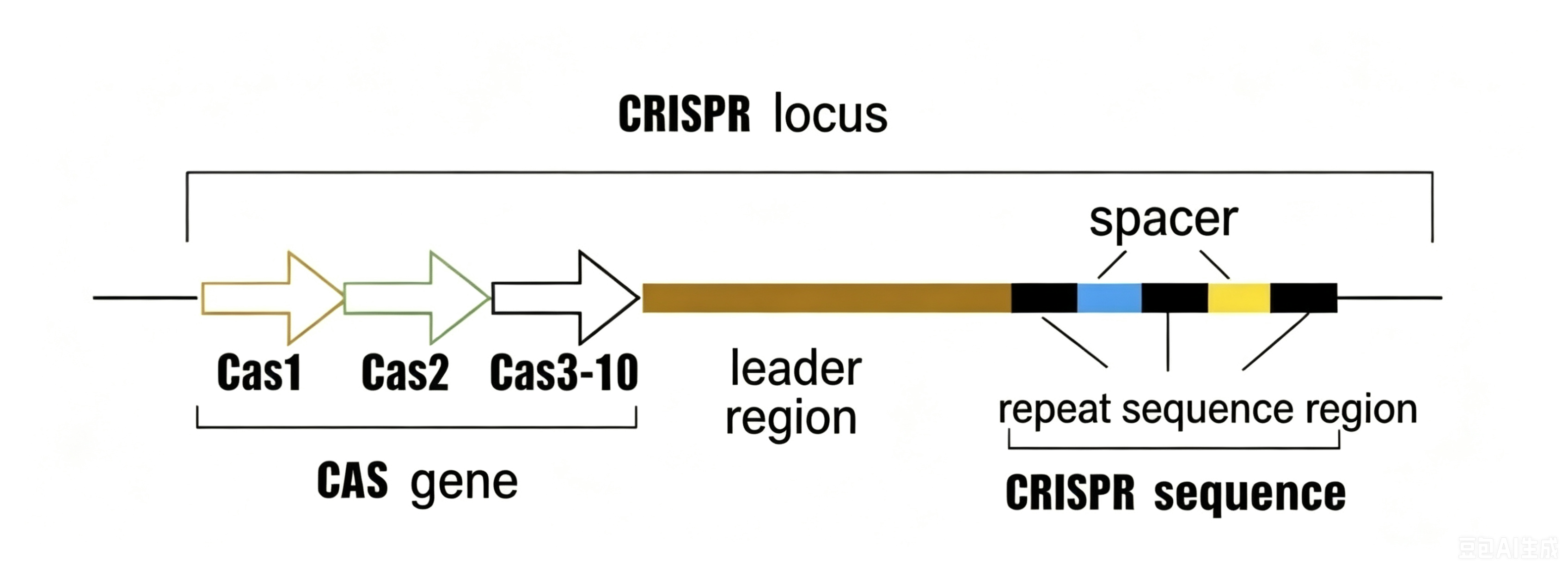
Figure 1: Schematic diagram of CRISPR
Applications of CRISPR/Cas Technology:
CRISPR/Cas9 genome editing technology has opened the door to a wide range of applications in nearly all organisms. Since its development by Charpentier and Doudna in 2012, CRISPR/Cas9 has been used to identify new therapies for various diseases—including cancer and HIV/AIDS—as well as to develop new plant varieties. Compared to siRNA and shRNA library-based knockdown methods, CRISPR-Cas9 libraries induce phenotypic changes through targeted gene knockout, allowing for the use of more stringent screening criteria and more effective elimination of false positives; they also offer advantages such as low cost, simple construction, and ease of use.
Based on the principle that CRISPR/Cas9 precisely targets exogenous DNA, gene knockout can be achieved. If a repair template plasmid (donor DNA molecule) is introduced into the cells on this basis, site-specific gene mutations can be achieved.
By editing the genes of fertilized eggs and implanting them into a surrogate mother, gene-edited animal models can be created, which can then be used for gene activation or inactivation, disease modeling, and even gene therapy.
Furthermore, one of the key applications of CRISPR-Cas9 is the treatment of genetic diseases. In 2014, U.S. scientists led by Long used CRISPR-Cas9 technology to cure Duchenne muscular dystrophy in mice. The safe and efficient CRISPR-Cas9 technology has opened up new avenues for the treatment of human genetic diseases.
Leveraging advanced technology and an experienced research team, KMD Bioscience provides clients with comprehensive CRISPR/Cas9 knockout cell line construction services. In collaboration with renowned domestic R&D institutions, we have developed a comprehensive CRISPR/Cas9 vector system, including single-knockout, double-knockout, endonuclease, lentiviral knockout vectors, and knockout vector libraries. Each vector system offers a choice of different markers (EGFP/RFP/Puro/Neo), enabling us to provide clients with fast and accurate gene knockout project services.
- CRISPR/Cas9
- gene editing
- epigenetic regulation
- generation of target-gene-knockout cell lines

- Protein Platform
- Protein Expression Services
- Protein Modification & Detection Services
- Protein Interaction Services
- Protein Purification Service
- Antibody Discovery Platform
- VHH Antibody Platform
- Phage Display Platform
- Antibody Humanization Platform
- Single B Cell Screening Platform
- Antibody Expression & Validation Platform
- Peptide Library Platform
- Custom Antibody Platform
- Innovative Drug Discovery Platform
- Product Center
- Proteins
- Antibodies
- Raw Materials Reagents
- Small Molecule Reagents
- Peptide Products
- Nanoparticle Products
- Contact Us
- Phone:400-621-6806
- Mobile:13110936064(WeC
- E-mail:[email protected]
- Address:Room 108, Building 10, No. 6 Hechang Road, Wuqing Development Zone, Tianjin City
-

WeChat
-

Service Account
-
 400-621-6806
 -
 3599163699
 -
 Monday to Friday 9:00-18:00
 -

-
 0
0
-
