


A Brief Discussion of Gene Knockout
- 2026-07-10
- 426
I. Principles of Gene Knockout
Gene knockout involves removing, replacing, or inactivating a specific gene in the genome, followed by observation of that gene’s function in cells or in the organism as a whole. By selecting an appropriate plasmid, homologous sequences flanking the target gene are cloned onto the vector; after transformation into the host bacterium, homologous recombination is used to achieve the replacement and knockout of the target gene. A relatively specific gene knockout system must be constructed based on the characteristics of the host bacterium.
II. Mechanism of Target Gene Knockout via Homologous Recombination (Using Bacteria as an Example)
Homologous sequences (homologous arms A and B) flanking the target gene (the gene to be knocked out) are cloned into a plasmid lacking a replication origin; typically, a resistance gene is inserted between the two homologous arms (Figure 1-A). The plasmid integrates into the bacterial genome via homologous recombination (Figure 1-B). Under permissive conditions, single and double exchanges occur through ring-mediated replication of the plasmid. During single-exchange recombination, partially diploid cells containing both wild-type and mutant homologous sequences are formed, and the target gene knockout fails. During double-exchange recombination, as the plasmid is excised, either the mutant homologous sequence remains in the bacterial genome while the plasmid carrying the wild-type sequence is excised, resulting in successful target gene knockout (Figure 1C-1); or the wild-type sequence remains in the bacterial genome, and because the plasmid is excised via homologous recombination, target gene knockout fails (Figure 1C-2). In most strains, homologous recombination is a low-probability event, so insertion of a resistance marker is necessary to aid in the screening of mutant strains. Unless the recombinant plasmid carries a negative selection marker, the probability of plasmid excision or loss is very low, requiring significant effort to screen for mutant strains.
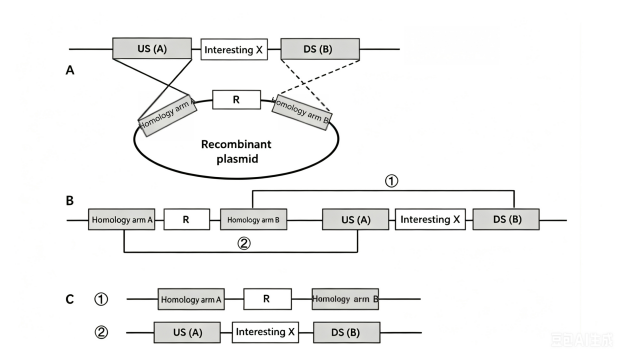
Figure 1: Schematic Diagram of Homologous Recombination
III. CRISPR/Cas9 Gene Knockout Technology
The CRISPR/Cas system is primarily inspired by bacteria that contain CRISPR sequences. When a pathogen first infects a bacterium, the Cas protein complex (Cas1 and Cas2 proteins) extract prototype spacer sequences from the invading pathogen’s DNA based on candidate recognition sites and the adjacent PAM motif. This sequence is then inserted into the non-repeated spacer sequence starting from the 5’ end (i.e., near the leader sequence), thereby forming an invasion memory. When the pathogen reinfects the bacterium, CRISPR first transcribes the long-chain CRISPR sequence precursor (pre-crRNA) and tracrRNA. Subsequently, the tracrRNA forms a palindromic structure by complementary pairing with the repetitive sequences of the pre-crRNA. Through processing by RNase III, this is converted into a mature, short CRISPR RNA (crRNA) and tracrRNA complex. The Cas9 protein specifically binds to the crRNA and tracrRNA complex due to the palindromic structure, thereby pairing with the prototypical spacer sequence of the invading pathogen. With technological advancements and applications, scientists have combined the crRNA and tracrRNA complex to form gRNA. Guided by gRNA, the Cas9 protein localizes to the vicinity of the PAM sequence, recognizes and cleaves exogenous double-stranded DNA. In this process, the HNH domain of Cas9 cleaves the complementary strand of the crRNA, while the RuvC domain cleaves the non-complementary strand, resulting in a double-strand break in the DNA. To survive, invading pathogens repair the broken DNA strands through homologous or non-homologous recombination, thereby inactivating the pathogen.
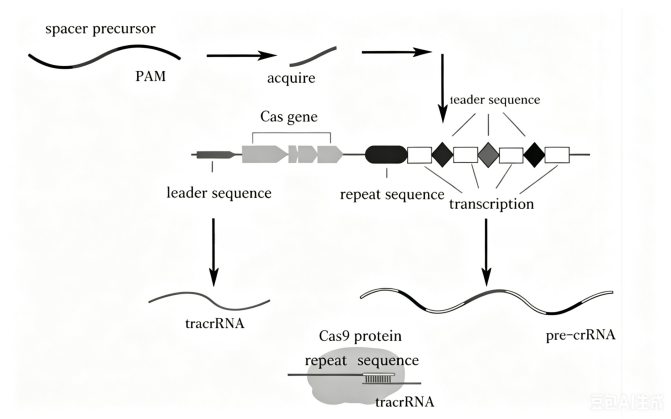
Figure 2: How CRISPR/Cas9 Works
IV. Comparison of the Advantages and Disadvantages of Homologous Recombination and CRISPR/Cas9 Technologies
Red Homologous Recombination Technology | CRISPR/Cas9 | |
Advantages | The procedure is relatively simple; it requires a shorter homologous arm and does not require enzyme digestion. The recombination efficiency is higher than that of suicide plasmids, and the targeting is more precise. It can be used to knock out both small and large gene fragments. | It is capable of knocking out larger gene segments, and there are no restrictions on the number or length of genes. |
Disadvantages | After gene knockout, an FRT site remains in the bacterial genome. | Due to the drawbacks associated with off-target effects, gRNA exhibits a high degree of mismatch tolerance when recognizing target genes distant from the PAM site; even the deletion or addition of a single base, or mismatches of 3 to 5 bases, can cause the gRNA to direct Cas9 to cleave the target, resulting in cuts at off-target sites. |
KMD Bioscience has been dedicated to microbial genome editing services for many years, primarily offering highly accurate and effective trace-free genome editing using both the traditional λRed homologous recombination method and CRISPR/Cas9 technology. The microbial genome editing systems we offer primarily include Escherichia coli, Bacillus subtilis, Salmonella, Pichia pastoris, Saccharomyces cerevisiae, Candida albicans, Staphylococcus aureus, Pseudomonas aeruginosa, and Lactobacillus, among others. You may also specify other microbial genera based on your specific needs; please contact our technical specialists for further details.
- CRISPR/Cas9 technology
- λRed homologous recombination

- Protein Platform
- Protein Expression Services
- Protein Modification & Detection Services
- Protein Interaction Services
- Protein Purification Service
- Antibody Discovery Platform
- VHH Antibody Platform
- Phage Display Platform
- Antibody Humanization Platform
- Single B Cell Screening Platform
- Antibody Expression & Validation Platform
- Peptide Library Platform
- Custom Antibody Platform
- Innovative Drug Discovery Platform
- Product Center
- Proteins
- Antibodies
- Raw Materials Reagents
- Small Molecule Reagents
- Peptide Products
- Nanoparticle Products
- Contact Us
- Phone:400-621-6806
- Mobile:13110936064(WeC
- E-mail:[email protected]
- Address:Room 108, Building 10, No. 6 Hechang Road, Wuqing Development Zone, Tianjin City
-

WeChat
-

Service Account
-
 400-621-6806
 -
 3599163699
 -
 Monday to Friday 9:00-18:00
 -

-
 0
0
-
