


Highly active human-derived SNAP25 recombinant protein, empowering synaptic and neurosecretory research!
- 2026-08-21
- 41
1. Basic Information
Full Name: Synaptosomal-Associated Protein 25 kDa (SNAP-25). The protein was originally designated "SUP" in early studies and is now referred to uniformly as SNAP-25.
Human Gene: SNAP25 · NCBI Gene ID: 6616 · UniProt ID: P60880
Classification: Q-type t-SNARE protein. SNAP-25 lacks a transmembrane helix and is anchored to the cytoplasmic face of the plasma membrane through palmitoylation of its central cysteine-rich region.
Discovery: SNAP-25 was first isolated and characterized by Oyler et al. in 1989 from rat brain synaptic fractions, and was named for its apparent molecular weight of 25 kDa. Its early laboratory designation was SUP.
2. Protein Structure
N-terminal SNARE coiled-coil domain
Central cysteine-rich palmitoylation region (membrane-anchoring site)
C-terminal SNARE coiled-coil domain
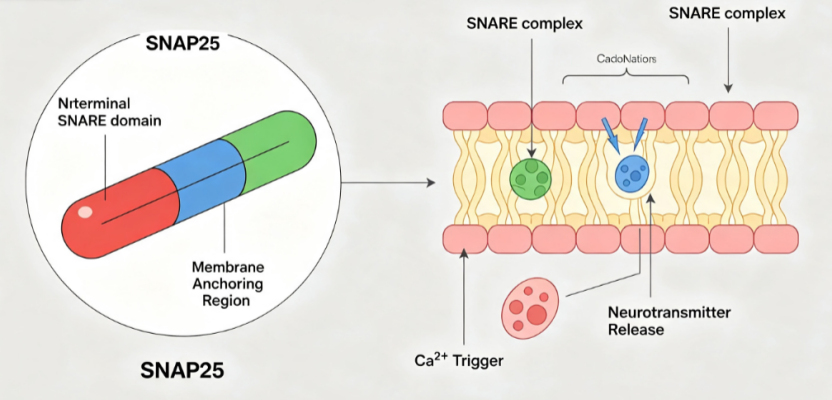
Figure 1. Domain architecture of SNAP-25 and its role in SNARE complex–mediated synaptic vesicle fusion and neurotransmitter release.
3. Core Biological Functions
3.1 Synaptic Vesicle Exocytosis (the Canonical Function)
An action potential arriving at the presynaptic terminal opens voltage-gated Ca²⁺ channels, producing a localized Ca²⁺ influx that activates the Ca²⁺ sensor synaptotagmin. SNAP-25, together with syntaxin-1 and VAMP2 (synaptobrevin), then assembles into a stable four-helix SNARE complex that drives fusion of the synaptic vesicle with the presynaptic plasma membrane, releasing neurotransmitter into the synaptic cleft.
3.2 Ion Channel Modulation (Independent of Membrane Fusion)
Beyond its role in fusion, SNAP-25 directly interacts with P/Q-type and L-type voltage-gated Ca²⁺ channels, providing negative feedback that limits Ca²⁺ influx and prevents excessive synaptic excitation. The protein also modulates voltage-gated K⁺ channels, contributing to the fine-tuning of presynaptic excitability.
3.3 Functions in Non-Neuronal Cells
Pancreatic β cells: mediates the exocytosis of insulin-containing secretory granules.
Endocrine cells: supports Ca²⁺-triggered release of catecholamines and peptide hormones.
3.4 Emerging Functions (Recent Studies)
SNAP-25 has been shown to undergo liquid–liquid phase separation (LLPS), forming biomolecular condensates that locally concentrate SNARE components at the plasma membrane and enhance the efficiency of vesicle fusion. More recent work has also implicated SNAP-25 in postsynaptic receptor trafficking and in the regulation of dendritic spine plasticity.
4. Toxin Target (Key Experimental Context)
Botulinum neurotoxins BoNT/A and BoNT/E cleave the C-terminal region of SNAP-25 with high specificity. The resulting C-terminally truncated SNAP-25 cannot assemble a functional SNARE complex, blocking neurotransmitter release and producing flaccid paralysis. This cleavage is the molecular basis of botulinum toxin pharmacology and a widely used experimental tool for dissecting SNARE-dependent membrane trafficking.
5. Disease Associations (Synaptopathies)
Congenital Myasthenic Syndrome type 18 (CMS18): heterozygous loss-of-function mutations in SNAP25 disrupt neuromuscular junction transmission.
Developmental and Epileptic Encephalopathy 117 (DEE117): de novo mutations cause severe epilepsy and intellectual disability.
Psychiatric disorders: SNAP25 polymorphisms have been linked to schizophrenia, attention-deficit/hyperactivity disorder (ADHD), and bipolar disorder.
Metabolic disease: impaired SNAP-25 function contributes to β-cell insulin secretory defects and has been associated with type 2 diabetes.
6. Key Product Advantages — Engineered for a Wide Range of Research Applications
6.1 Full-Length, Domain-Intact Sequence
The recombinant protein retains both SNARE coiled-coil domains together with the central cysteine-rich membrane-anchoring region, faithfully recapitulating in vivo SNARE ternary complex assembly and supporting in vitro reconstitution of membrane fusion. This eliminates the loss of binding activity commonly observed with truncated constructs.
6.2 His-Tag Purification Workflow
An N-terminal His tag enables rapid, single-step purification on Ni-NTA affinity resin, with no need for elaborate refolding or multi-step chromatographic polishing. The product is immediately suitable for pull-down assays, co-immunoprecipitation, and in vitro binding studies, allowing straightforward capture of Syntaxin-1 and VAMP2 interaction complexes.
6.3 High Purity, Low Background
Each lot is QC-verified to >90% purity by SDS-PAGE, with endotoxin and host-cell protein levels tightly controlled. The product is validated for cell-based incubation assays, in vitro membrane fusion reconstitution, enzymatic activity assays, and toxin cleavage assays, minimizing non-specific background and improving data reproducibility across experiments.
6.4 Lyophilized Format for Long-Term Stability
The lyophilized formulation significantly extends shelf life and shows markedly superior tolerance to repeated freeze–thaw cycles compared with liquid preparations. Single-use aliquoting upon first reconstitution preserves full activity for long-term storage, reducing overall reagent cost.
6.5 Flexible Custom Services
In addition to off-the-shelf 50 µg and 100 µg pack sizes, we offer bulk production, custom tag design (placement and identity), expression-system optimization, and tailored reconstitution protocols to support high-throughput screening campaigns, ex vivo animal dosing studies, and structural biology / crystallization projects.
7. Related Products
Product Number | Catalog Number | Application | Size |
PA4590 |
WB, IHC, IF |
50ul, 100ul
| |
|
MA748 |
WB |
50ul, 100ul |
Human SUPSNAP25 Protein, His Tag
|
KMPH3270 |
/ |
50ul, 100ul |
- SNAP-25 protein
- recombinant SNAP25 protein

- Protein Platform
- Protein Expression Services
- Protein Modification & Detection Services
- Protein Interaction Services
- Protein Purification Service
- Antibody Discovery Platform
- VHH Antibody Platform
- Phage Display Platform
- Antibody Humanization Platform
- Single B Cell Screening Platform
- Antibody Expression & Validation Platform
- Peptide Library Platform
- Custom Antibody Platform
- Innovative Drug Discovery Platform
- Product Center
- Proteins
- Antibodies
- Raw Materials Reagents
- Small Molecule Reagents
- Peptide Products
- Nanoparticle Products
- Contact Us
- Phone:400-621-6806
- Mobile:13110936064(WeC
- E-mail:[email protected]
- Address:Room 108, Building 10, No. 6 Hechang Road, Wuqing Development Zone, Tianjin City
-

WeChat
-

Service Account
-
 400-621-6806
 -
 3599163699
 -
 Monday to Friday 9:00-18:00
 -

-
 0
0
-
