


Enhancing Recombinant Protein Expression: Optimization of Codon Usage and mRNA Structure
- 2026-02-24
- 283
I. Key Bottlenecks in Recombinant Protein Expression
Currently, the critical bottleneck in recombinant protein expression lies in the inherent differences in translation machinery across different organisms. Directly using gene sequences from natural hosts leads to a "language barrier" with the host cell, often making efficient expression in heterologous expression systems difficult to achieve, which fails to meet the demands of both research and industrial applications. This is primarily manifested in two aspects:
1) Translation Efficiency and Accuracy: The high frequency of rare codons in the host cell can cause ribosome stalling or even premature termination, significantly reducing protein yield and potentially introducing translation errors.
2) mRNA Stability and Translatability: Potential regulatory elements within the natural gene sequence—such as suboptimal GC content and complex secondary structures—can severely impact mRNA stability and translation initiation efficiency, ultimately leading to expression failure or the inability of the target protein to fold correctly.
II. Codon Optimization
To achieve maximal translation efficiency and fidelity, it is often necessary to perform codon optimization on the coding sequence of the exogenous gene, enabling it to adapt to the expression environment of the host species. Typically, this involves referencing the host's "codon usage bias table" to replace rare codons within the coding sequence with high-frequency preferred codons. This strategy prevents issues such as ribosome stalling, translation errors, or premature termination during recombinant protein expression, thereby ensuring the correct folding and full functionality of the expressed protein.
Furthermore, GC content is a core factor influencing the translation efficiency of recombinant proteins. Its level directly affects mRNA thermostability and secondary structure formation, which can subsequently impede ribosome binding and movement. Complex structures near the translation initiation site are particularly detrimental, exerting the most significant inhibitory effect on translation efficiency.
III. Detailed Explanation of SnapGene Optimization Functionality
Utilizing a professional codon optimization tool like SnapGene, precise host selection coupled with coordinated parameter configuration allows for the direct transformation of theoretical design into highly efficient and feasible sequences, achieving optimal results from sequence optimization.
1) Host Selection and Parameter Configuration: Within the SnapGene interface, select the target expression system—such as E. coli, yeast, or mammalian cells—and then configure key parameters. This process enhances the Codon Adaptation Index (CAI), controls GC content within an optimal range, and thereby mitigates potential negative effects from mRNA secondary structures.
2) Synergistic Optimization Algorithm: SnapGene employs an algorithm that integrates multiple considerations: the distribution of codon usage frequency, reduction of free energy in the translation initiation region, and avoidance of consecutive repetitive sequences. This synergistic approach facilitates efficient ribosome binding, generating an optimal sequence characterized by stability and high translatability.
3) Result Verification: Review the SnapGene report to confirm that the Codon Adaptation Index (CAI) and GC content meet the predefined standards. Additionally, verify that the translation initiation region does not form stable secondary structures. The optimized DNA sequence that passes these checks is ready for direct use in gene synthesis, enabling the subsequent construction of highly efficient recombinant expression vectors.
IV. Coordinated Optimization of mRNA Secondary Structure
To significantly enhance protein expression levels, the coordinated optimization of codon preference and mRNA secondary structure has become a core strategy. This strategy aims to resolve unfavorable spatial folding conformations of the mRNA molecule, thereby ensuring smooth and efficient translation elongation by the ribosome.
1) Translation Initiation Region: Reduce the free energy around the start codon AUG in key regions—such as the Ribosome Binding Site (RBS) in prokaryotic expression systems or the Kozak sequence in eukaryotic systems—to ensure the ribosome binding site maintains an open conformation.
2) Open Reading Frame (ORF): It is necessary to scrutinize the entire coding sequence to avoid the formation of global, highly stable secondary structures that could cause ribosome stalling during the elongation process.
3) Regulation of GC Content: Balancing GC content is crucial for maintaining mRNA stability. It is essential to avoid excessively high GC levels, which can lead to the formation of unfavorable, stable secondary structures.
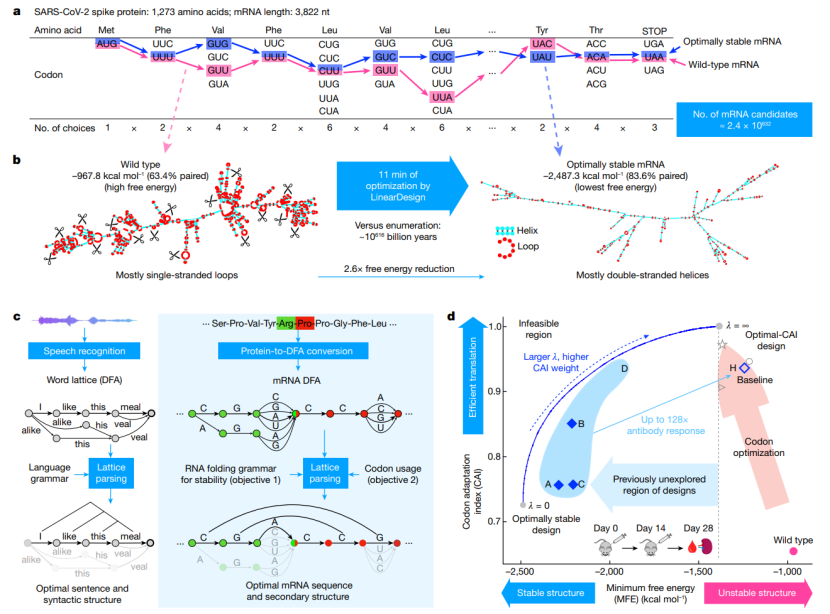
Fig 1. Design schematic of the SARS-CoV-2 spike protein mRNA coding region, illustrating the integration of stability and codon optimization considerations (Adapted from [1]).
V. Optimization Verification Strategy
The critical design phase for recombinant protein expression involves codon and mRNA structure optimization, with the verification strategy following a stepwise pathway from gene to protein:
1) Primary Verification: Perform full gene synthesis and sequencing of the optimized DNA sequence to ensure it is completely consistent with the design and free of synthesis errors.
2) Secondary Verification: Construct the recombinant expression vector containing the target sequence, transform it into the target host for induced expression, and perform quantitative analysis of protein expression levels using techniques such as SDS-PAGE and Western Blot.
3) Functional Verification: Conduct activity assays or structural analysis to confirm the correct folding and biological function of the recombinant protein, thereby achieving closed-loop verification from design to successful functional expression.
VI. Common Misconceptions
1) Over-pursuit of High-Frequency Codons: Indiscriminately replacing all codons with the most frequently used types may lead to excessively rapid translation rates, potentially interfering with co-translational protein folding and resulting in inclusion body formation or loss of activity.
2) Neglecting Overall Regulatory Balance: Focusing narrowly on a single metric, such as the Codon Adaptation Index (CAI) or GC content, while overlooking global factors like mRNA secondary structure and cryptic splice sites.
3) Overlooking Host Specificity: Different expression systems (e.g., E. coli, yeast, mammalian cells) possess distinct codon preferences, tRNA pools, and cellular environments. It is essential to apply corresponding optimization parameters tailored to the specific host.
A successful optimization typically follows an iterative process of "design-verification-analysis-redesign." By rationally refining the sequence based on experimental data, an optimal balance between protein yield and functional quality can ultimately be achieved.
Leveraging a mature protein research and preparation platform, KMD Bioscience integrates systematic codon optimization, coordinated mRNA structure design, and rigorous verification methods to provide services for achieving high-yield soluble expression and high-purity preparation of target proteins. The high-quality proteins prepared by KMD Bioscience are suitable for direct use in downstream applications, such as phage display peptide library screening, nucleic acid aptamer (SELEX) screening, and intermolecular affinity measurement, providing a solid and reliable foundation for your life science research.
[1] Zhang H, Zhang L, Lin A, et al. Algorithm for optimized mRNA design improves stability and immunogenicity. Nature. 2023;621(7978):396-403.
[2] Ward M, Richardson M, Metkar M. mRNA folding algorithms for structure and codon optimization. Brief Bioinform. 2025;26(4):bbaf386.
[3] Jin L, Zhou Y, Zhang S, Chen SJ. mRNA vaccine sequence and structure design and optimization: Advances and challenges. J Biol Chem. 2025;301(1):108015.
- Codon Optimization
- Codon Optimization SnapGene
- Codon Optimization Tools
- Recombinant Protein Expression

- Protein Platform
- Protein Expression Services
- Protein Modification & Detection Services
- Protein Interaction Services
- Protein Purification Service
- Antibody Discovery Platform
- VHH Antibody Platform
- Phage Display Platform
- Antibody Humanization Platform
- Single B Cell Screening Platform
- Antibody Expression & Validation Platform
- Peptide Library Platform
- Custom Antibody Platform
- Innovative Drug Discovery Platform
- Product Center
- Proteins
- Antibodies
- Raw Materials Reagents
- Small Molecule Reagents
- Peptide Products
- Nanoparticle Products
- Contact Us
- Phone:400-621-6806
- Mobile:13110936064(WeC
- E-mail:[email protected]
- Address:Room 108, Building 10, No. 6 Hechang Road, Wuqing Development Zone, Tianjin City
-

WeChat
-

Service Account
-
 400-621-6806
 -
 3599163699
 -
 Monday to Friday 9:00-18:00
 -

-
 0
0
-
