


Plasmid Extraction Experimental Protocol
- 2026-07-10
- 499
1. Bacterial Cell Harvesting
* Pick a single colony from the selective medium and inoculate it into 2–5 mL of LB broth containing the appropriate antibiotic. Incubate at 37°C with vigorous shaking (300 rpm) for 8 hours.
* Dilute the cultured bacterial suspension at a ratio of 1:500 to 1:1000 into 3 mL of selective LB medium. Incubate at 37°C with vigorous shaking (300 rpm) for 12–16 hours.
* Centrifuge at 6,000 × g for 15 minutes to pellet the bacterial cells, removing as much supernatant as possible. Resuspend the bacterial pellet in 0.1–0.5 mL of suspension buffer (50 mM Tris-Cl, 10 mM EDTA, 100 μg/mL RNase A, pH 8.0) until no cell clumps remain.
2. Cell Lysis
* Add 0.25 mL of lysis buffer to the sealed tube and invert vigorously 4–6 times to ensure thorough mixing. Incubate at room temperature (15–25°C) for 5 minutes. Do not vortex, as this may shear genomic DNA. The lysate should appear viscous after lysis. Note: The lysis reaction should be completed within 5 minutes.
3. Neutralization Reaction
* Add 0.3 mL of neutralization buffer and invert vigorously 4–6 times. Incubate on ice for 5 minutes. A white flocculent precipitate will form upon neutralization, reducing the viscosity of the mixture. The precipitate contains genomic DNA, proteins, and cell debris. Ensure thorough mixing to allow uniform precipitation of potassium dodecyl sulfate (SDS). If the mixture remains viscous, additional neutralization may be required for complete reaction. A homogeneous, colorless suspension indicates effective SDS precipitation.
4. Column Purification
* Carefully transfer the supernatant to the spin column assembled in a collection tube and centrifuge at 13,000 rpm for 1 minute.
* If the supernatant remains turbid, perform a second, shorter centrifugation to avoid retaining suspended particles on the column. These particles (causing turbidity) may clog the column, reducing or blocking flow.
5. Column Equilibration
* Add 0.7 mL of wash buffer to the spin column placed in the collection tube and centrifuge at 13,000 rpm for 10 minutes.Equilibrate the column with 1 mL of equilibration buffer (750 mM NaCl, 50 mM KCl, pH 7.0, 15% isopropanol).
6. Elution
* Elute the DNA with 0.8 mL of elution buffer (1.23 M NaCl, 50 mM Tris-Cl, pH 8.5, 15% v/v isopropanol) and collect the eluate in a 1.5 mL or 2 mL microcentrifuge tube.
* Precipitate the DNA by adding 0.7 volumes (0.56 mL per 0.8 mL elution volume) of room-temperature isopropanol to the eluted DNA. Centrifuge at ≥10,000 rpm for 30 minutes and discard the supernatant.
* Wash the DNA pellet with 1 mL of 70% ethanol, centrifuge at 10,000 rpm for 10 minutes, and discard the supernatant. The 70% ethanol step removes residual salts and replaces isopropanol with the more volatile ethanol, facilitating easier DNA redissolution.
* Air-dry the silica membrane containing the plasmid DNA for 5–10 minutes, then resuspend the DNA in an appropriate buffer (e.g., TE buffer, pH 8.0, or 10 mM Tris-HCl, pH 8.5).
7. Yield Quantification
* To determine nucleic acid concentration, dilute the plasmid DNA 1:100 or 1:50 (depending on plasmid copy number) in TE buffer and measure the absorbance (optical density) at 260 nm (A260) and 280 nm (A280), using TE buffer as a blank. The nucleic acid concentration can be directly calculated using the formula:
[DNA] (μg/mL) = A260 × Dilution factor × 50
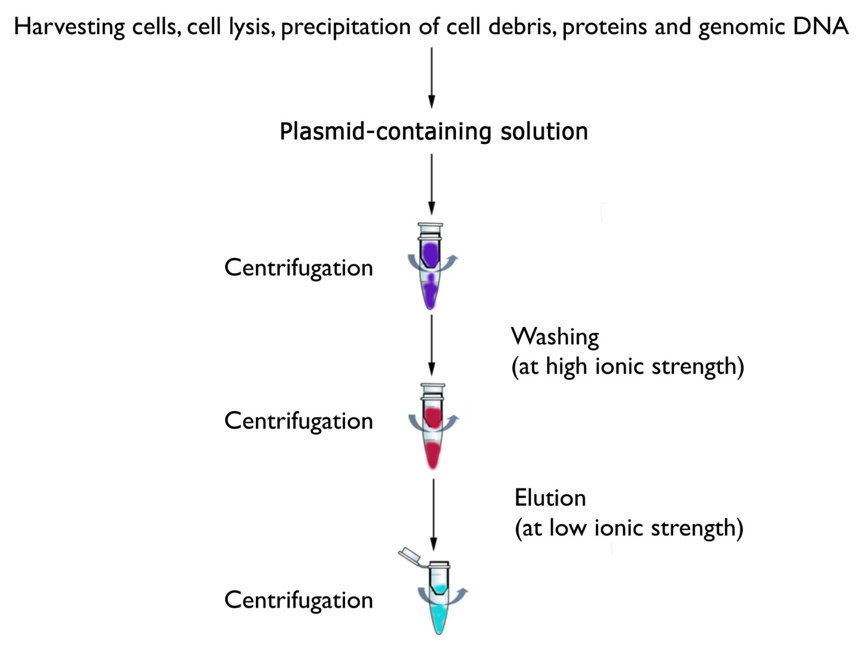
Plasmid Extraction Experimental Procedure
KMD Bioscience is committed to providing comprehensive one-stop services spanning from plasmid DNA extraction to protein expression, meeting the demands of biotechnology and scientific research for high-quality protein products. Our services encompass plasmid construction and optimization, efficient DNA extraction, as well as protein expression in various host systems, including prokaryotic, yeast, insect, and mammalian cells.By employing cutting-edge biotechnology and stringent quality control processes, we ensure that the proteins we deliver exhibit high purity and excellent biological activity, while optimized expression conditions guarantee high yields. KMD Bioscience not only offers standardized services but also tailors customized solutions to meet specific client requirements.Our goal is to accelerate scientific research and biopharmaceutical development through efficient and reliable services, providing robust support for drug discovery, functional studies, diagnostic development, and beyond.
- Plasmid extraction
- protein expression
- plasmid extraction experimental protocol
- protein expression services

- Protein Platform
- Protein Expression Services
- Protein Modification & Detection Services
- Protein Interaction Services
- Protein Purification Service
- Antibody Discovery Platform
- VHH Antibody Platform
- Phage Display Platform
- Antibody Humanization Platform
- Single B Cell Screening Platform
- Antibody Expression & Validation Platform
- Peptide Library Platform
- Custom Antibody Platform
- Innovative Drug Discovery Platform
- Product Center
- Proteins
- Antibodies
- Raw Materials Reagents
- Small Molecule Reagents
- Peptide Products
- Nanoparticle Products
- Contact Us
- Phone:400-621-6806
- Mobile:13110936064(WeC
- E-mail:[email protected]
- Address:Room 108, Building 10, No. 6 Hechang Road, Wuqing Development Zone, Tianjin City
-

WeChat
-

Service Account
-
 400-621-6806
 -
 3599163699
 -
 Monday to Friday 9:00-18:00
 -

-
 0
0
-
