


Yeast Two-Hybrid Assay
- 2026-07-09
- 301
Living organisms possess complex molecular regulatory mechanisms that respond to external changes, and protein-protein interactions have become a hot topic in the study of gene function. Uncovering the complexity of gene regulatory networks at the protein level is an effective approach. The yeast two-hybrid assay is a powerful method for validating protein-protein interactions; it can confirm interactions between known proteins, screen for unknown proteins that interact with known proteins, and identify binding sites for these interactions.
The yeast two-hybrid system is based on an understanding of the yeast transcriptional activator GAL4, a transcription factor that activates the expression of downstream genes. This process relies on the N-terminal BD (DNA-binding domain) and C-terminal AD (activation domain) of GAL4. The BD domain primarily recognizes and binds to the upstream activation sequence (USA) of a gene promoter, while the AD domain serves as the transcriptional activation domain. The BD and AD can function independently, but they can only act as a transcription factor—initiating the expression of downstream genes—when they are sufficiently close to each other in space. Therefore, taking advantage of this structural feature of GAL4, we construct vectors that fuse the two proteins of interest with the BD and AD domains of GAL4, respectively, for co-expression. If the two proteins interact, the AD and BD will come sufficiently close to each other, thereby exerting transcriptional activation activity and initiating the expression of the downstream reporter gene.
Using the GAL4 system as an example, the experimental workflow for verifying whether two proteins interact is as follows:
1. Vector Selection
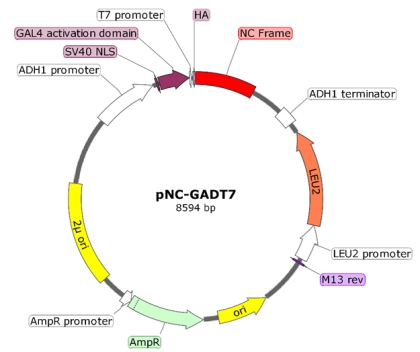
2. Host: AH109/Y2HGold
3. Medium: Double-deficient plates (SD/-Leu/-Trp), Quadruple-deficient plates (SD/-Leu/-Trp/-His/-Ade)
4. Experimental Procedure:
(1) Clone the two protein genes into the vectors pGADT7 and pGBKT7, respectively, and name them AD-Protein 1 and BD-Protein 2
(2) Co-transform the two constructed plasmids into AH109 or Y2HGold competent cells, plate them onto SD/-Leu/-Trp plates, incubate at 28°C for 2–3 days, and pick positive clones. (Simultaneously, set up BKT7-53 + ADT7-T as the positive control group and BKT7-LAM + ADT7-T as the negative control group for co-transformation in yeast)
(3) Transfer a single colony (1–2 mm in diameter) from the dual-deficient plate to a quadruple-deficient plate and incubate at 28°C for 2–3 days. Once a 1–2 mm colony has formed, add 2–3 μL of X-α-gal; if the colony turns blue, this indicates an interaction between the two proteins.
(4) To rule out the possibility of self-activation of BD-protein 2, BD-Protein 2 and an empty pGADT7 vector should be co-transformed into AH109 or Y2HGold yeast competent cells. After they have grown on a two-deficient plate, transfer them to a four-deficient plate to observe whether the yeast grows. If growth occurs and the colonies turn blue after adding X-α-gal, this indicates that BD-Protein 2 exhibits self-activation; if no growth is observed on the four-deficient plate, this indicates that self-activation does not occur.
Yeast two-hybrid can also be used to screen for unknown proteins that interact with known proteins. A known protein is cloned into a BD vector, and a yeast two-hybrid library is constructed. The known protein is then hybridized with the library, and the proteins interacting with the known protein are identified by sequencing the growing yeast colonies.
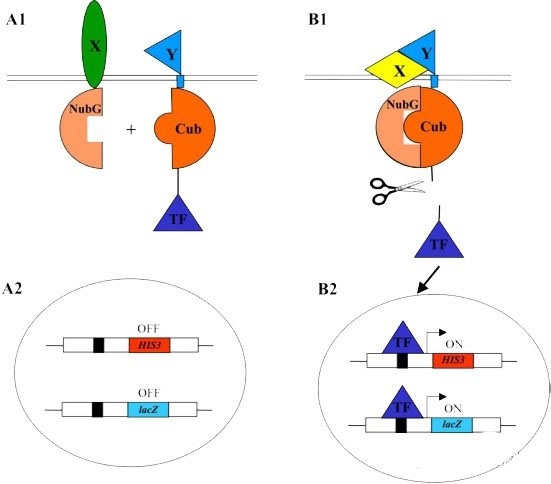
Yeast two-hybrid is suitable for validating interactions among nuclear proteins, whereas for validating interactions involving membrane proteins, a new membrane-based two-hybrid system—the cleaved ubiquitin system—has been developed. The cleaved ubiquitin system is primarily based on modifications to cleaved ubiquitin. Ubiquitin possesses two relatively independent domains: Nub at the N-terminus and Cub at the C-terminus. Only when both parts are co-expressed in the same cell do they refold through their affinity-mediated binding, forming a complete ubiquitin protein that is subsequently recognized and cleaved by the ubiquitin-specific protease USPS. However, when the two parts are expressed separately in the cell, they undergo partial folding and cannot be recognized by USPS. Therefore, we can exploit this property of ubiquitin. We mutate the N-terminal NubI of ubiquitin to NubG; the affinity between the mutated NubG and Cub is significantly reduced. We then fuse protein Y to the Cub terminus and protein X to the NubG terminus of ubiquitin. If protein Y and protein X interact, NubG and Cub will come into close proximity, refold to form a complete ubiquitin molecule, and be recognized and cleaved by USPS. By fusing the transcription factor PLv (por-LeAx-VP16) to the CUB domain, this transcription factor is released along with the ubiquitin protein and subsequently transported into the nucleus to activate the expression of the reporter gene.
KMD Bioscience offers protein interaction analysis services, including yeast hybrid, immunoprecipitation (Co-IP), and pull-down assays, to enable qualitative and quantitative analysis of interactions between proteins, small molecules, and antibodies; it also performs common immunological assays such as ELISA and Western blot.
- Yeast double-hybrid
- yeast hybrid
- interaction validation

- Protein Platform
- Protein Expression Services
- Protein Modification & Detection Services
- Protein Interaction Services
- Protein Purification Service
- Antibody Discovery Platform
- VHH Antibody Platform
- Phage Display Platform
- Antibody Humanization Platform
- Single B Cell Screening Platform
- Antibody Expression & Validation Platform
- Peptide Library Platform
- Custom Antibody Platform
- Innovative Drug Discovery Platform
- Product Center
- Proteins
- Antibodies
- Raw Materials Reagents
- Small Molecule Reagents
- Peptide Products
- Nanoparticle Products
- Contact Us
- Phone:400-621-6806
- Mobile:13110936064(WeC
- E-mail:[email protected]
- Address:Room 108, Building 10, No. 6 Hechang Road, Wuqing Development Zone, Tianjin City
-

WeChat
-

Service Account
-
 400-621-6806
 -
 3599163699
 -
 Monday to Friday 9:00-18:00
 -

-
 0
0
-
