


Large-Scale Freeze-Drying Technology for Proteins
- 2026-07-10
- 401
Because freeze-dried pharmaceuticals are porous, can be stored stably for long periods, and can easily be rehydrated to restore their activity, freeze-drying technology is widely used in the preparation of solid protein drugs, rapidly dissolving oral medications, and drug-encapsulated liposomes. Currently, China has a variety of freeze-dried pharmaceuticals, including recombinant human granulocyte-macrophage colony-stimulating factor for injection and recombinant human interferon α2b for injection.
Recombinant proteins are inherently less stable, which to some extent limits their development and application; however, freeze-drying provides an effective solution to this problem.
1. Principles of Freeze-Drying
The basic principle of freeze-drying technology involves first freezing a recombinant protein solution at low temperatures and then drying it under vacuum conditions to form a solid recombinant protein formulation. The drying process can be further divided into preliminary drying, which removes crystalline water, and secondary drying, which removes bound water. However, since the freeze-drying process is essentially a conversion of matter and energy, freeze-drying itself can also have adverse effects on recombinant proteins, leading to their denaturation.
1.1 Denaturation Mechanisms During Freezing
The denaturation mechanisms during freezing primarily include low-temperature denaturation and freeze denaturation. Freeze denaturation involves various factors, such as the formation of dendritic ice crystals, increased ionic strength, changes in pH, and phase separation.
1.2 Denaturation Mechanisms During Drying
Denaturation during the drying process primarily occurs during the secondary drying stage, when bound water is removed. Recombinant proteins are hydrated in aqueous solutions; the surface of a hydrated recombinant protein is enveloped by a layer of water molecules, forming a monolayer known as the hydration layer. This layer of water molecules interacts with the protein via hydrogen bonds. The drying process inevitably removes some of the water from the hydration layer, and this removal disrupts the hydrogen bond structure on the protein surface, which may cause denaturation of the recombinant protein’s native structure.
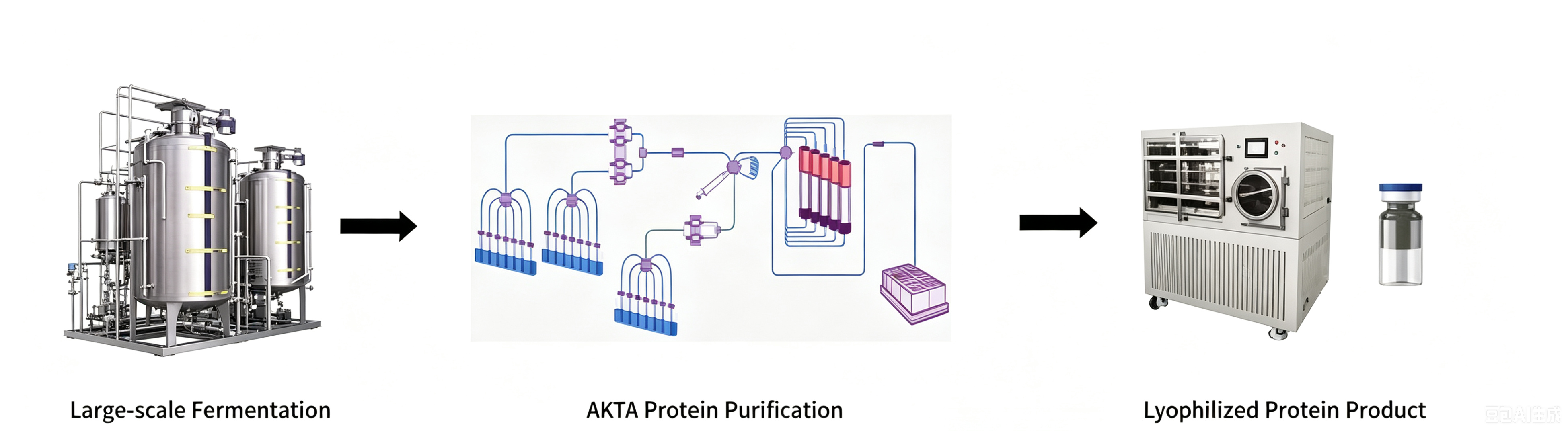
2. Main Process Flow of Freeze-Drying Technology:
3. Protective Agents
The addition of additives can effectively reduce or prevent the denaturing effects of freeze-drying on proteins. These additives are also known as protective agents; therefore, to preserve the bioactivity of pharmaceuticals, protective agents for the active ingredients are typically added to drug formulations. They must possess four characteristics: a high glass transition temperature, low water absorption, low crystallinity, and the absence of reducing groups.
Commonly used protectants include the following categories of substances:
1) Sugars/polyols: sucrose, trehalose, mannitol, lactose, glucose, maltose, etc.;
2) Polymers: HES, PVP, PEG, dextran, albumin, etc.;
3) Anhydrous solvents: ethylene glycol, glycerol, DMSO, DMF, etc.;
4) Surfactants: Tween 80, etc.;
5) Amino acids: L-serine, sodium glutamate, alanine, glycine, creatine, etc.;
6) Salts and amines: phosphates, acetates, citrates, etc.
KMD Bioscience has established a comprehensive antibody and protein platform. We operate a GMP-compliant freeze-drying production line and possess a full range of large-scale freeze-drying equipment, enabling us to provide clients with large-scale protein packaging and freeze-drying services in a single process. Our protein preparation technicians have accumulated extensive experience in recombinant protein expression, fermentation, and purification, allowing us to offer clients a full one-stop service covering everything from protein expression and preparation to large-scale fermentation production, protein purification, freeze-drying, and subsequent characterization.
- Protein freeze-drying process
- protein freeze-drying technology
- large-scale protein freeze-drying

- Protein Platform
- Protein Expression Services
- Protein Modification & Detection Services
- Protein Interaction Services
- Protein Purification Service
- Antibody Discovery Platform
- VHH Antibody Platform
- Phage Display Platform
- Antibody Humanization Platform
- Single B Cell Screening Platform
- Antibody Expression & Validation Platform
- Peptide Library Platform
- Custom Antibody Platform
- Innovative Drug Discovery Platform
- Product Center
- Proteins
- Antibodies
- Raw Materials Reagents
- Small Molecule Reagents
- Peptide Products
- Nanoparticle Products
- Contact Us
- Phone:400-621-6806
- Mobile:13110936064(WeC
- E-mail:[email protected]
- Address:Room 108, Building 10, No. 6 Hechang Road, Wuqing Development Zone, Tianjin City
-

WeChat
-

Service Account
-
 400-621-6806
 -
 3599163699
 -
 Monday to Friday 9:00-18:00
 -

-
 0
0
-
