


Understanding Large-Scale Protein Fermentation Technology
- 2026-07-10
- 398
Recombinant protein products are biotechnology products based on genetic engineering and cell engineering as key technologies. They are characterized by high specificity, good uniformity, and well-defined targets, and are widely used in the treatment of various diseases, particularly cancer. Currently, among the 32 categories of antibody drugs approved by the FDA for treating diseases, oncological diseases account for 32%, immune-related diseases for 37%, organ transplant-related diseases for 11%, infectious diseases for 8%, cardiovascular diseases for 4%, and other diseases for 6%. With the rapid development of the protein drug market and in-depth research in proteomics, the demand for large-scale protein production is growing. Large-scale fermentation technology is widely used in the production of recombinant therapeutic proteins and antibodies, and the industrial production levels of these products are gradually improving. High-throughput cultivation processes have optimized cell culture conditions suitable for exogenous protein expression, while the use of single-use bioreactors has simplified large-scale fermentation processes, saving both production time and costs. The application of large-scale protein fermentation technology has accelerated the industrialization of recombinant therapeutic proteins.
1. Large-Scale Fermentation Technology Workflow
Large-scale protein fermentation technology primarily includes the following steps: gene optimization, expression condition optimization, large-scale fermentation, and protein purification:
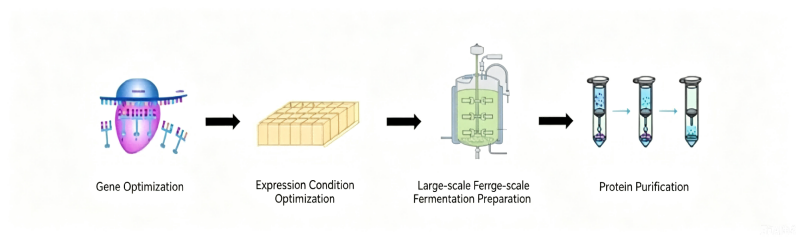
● Genetic Optimization: The gene sequence is a key factor determining the success or failure of protein expression. Optimization areas include: mRNA structure, rare codons, and ribosome binding sites.
● Optimization of Expression Conditions: Optimization of protein expression conditions, including factors affecting protein yield such as temperature, inducers, and OD, has resulted in higher cell culture density and protein yield during subsequent fermentation.
● Large-Scale Fermentation: This is divided into standard protein fermentation and high-density fermentation, and involves optimizing the fermentation process—including temperature, pH, dissolved oxygen, and feed addition methods.
● Protein Purification: After obtaining a large amount of protein-expressing bacterial slurry, protein purification is required to ultimately obtain the protein at the desired purity.
2. High-Density Fermentation Technology
Large-scale fermentation for the production of recombinant proteins can generally be divided into conventional protein fermentation and high-density fermentation, with high-density fermentation being the most effective method for increasing recombinant protein yield. High-density fermentation, also known as high-cell-density fermentation, refers to a fermentation technique that maximizes biomass accumulation under specific culture conditions and systems without compromising the accumulation of intracellular products, thereby enabling the production of greater quantities or higher-purity target products. High-density fermentation technology increases the concentration of cells per unit volume of culture medium, thereby improving volumetric yield; correspondingly, it reduces reactor volume while also shortening the production cycle, enabling the production of large quantities of protein in a relatively short time to meet customer needs.
There are many factors that influence high-density fermentation, such as the accumulation of nutrients and inhibitory substances, dissolved oxygen concentration, culture temperature, pH, and feed addition methods. To establish high-density fermentation technology, it is necessary to optimize and select the host strain type, culture environment, and cultivation methods based on traditional fermentation techniques.
Host Strain Type:
Different strains vary significantly in terms of growth conditions, ability to express exogenous genes, production of metabolic byproducts, and tolerance to inhibitory metabolic byproducts. Therefore, the host strain is a key factor in determining whether a genetically engineered product can be produced on an industrial scale.
Optimization of the Culture Environment:
Dissolved oxygen, temperature, and pH are all important factors affecting the growth of recombinant bacteria. In addition, appropriate concentrations and ratios of culture medium components can make it easier for recombinant bacteria to achieve high cell density and efficient expression of exogenous proteins. Therefore, during high-density fermentation, the physiological characteristics of recombinant bacteria should be fully considered to create culture conditions suitable for their growth and metabolism, thereby ensuring high cell density and high productivity.
Selection of Cultivation Methods:
Compared to dialysis cultivation, fixed-bed cultivation, and recirculating cultivation, the feed-batch strategy is an effective method for achieving high yields of recombinant proteins in high-density fermentation. By adopting the feed-batch strategy and adjusting cultivation conditions—including temperature, pH, and the feed rates of culture medium and substrates—cell quality and production efficiency can be improved.
KMD Bioscience has been dedicated to protein expression and purification research for many years. We possess a variety of recombinant protein expression systems, including prokaryotic and eukaryotic systems, and have established a comprehensive platform for large-scale protein fermentation and purification. We are able to provide clients with industrial-scale fermentation technical services. With our proven high-density fermentation technology and a wide range of fermenters and bioreactors, combined with various protein purification techniques, we offer large-scale purification services capable of producing recombinant proteins in quantities ranging from milligrams to grams.
- Protein Expression and Preparation
- Large-Scale Fermentation for Protein Production
- Protein Expression
- Protein Purification Services

- Protein Platform
- Protein Expression Services
- Protein Modification & Detection Services
- Protein Interaction Services
- Protein Purification Service
- Antibody Discovery Platform
- VHH Antibody Platform
- Phage Display Platform
- Antibody Humanization Platform
- Single B Cell Screening Platform
- Antibody Expression & Validation Platform
- Peptide Library Platform
- Custom Antibody Platform
- Innovative Drug Discovery Platform
- Product Center
- Proteins
- Antibodies
- Raw Materials Reagents
- Small Molecule Reagents
- Peptide Products
- Nanoparticle Products
- Contact Us
- Phone:400-621-6806
- Mobile:13110936064(WeC
- E-mail:[email protected]
- Address:Room 108, Building 10, No. 6 Hechang Road, Wuqing Development Zone, Tianjin City
-

WeChat
-

Service Account
-
 400-621-6806
 -
 3599163699
 -
 Monday to Friday 9:00-18:00
 -

-
 0
0
-
