


Antibody humanization is often described as replacing non-human antibody sequences with human counterparts. That description is technically incomplete and can lead to expensive design mistakes. A successful humanized antibody must become more compatible with the human immune system without losing the antigen recognition, molecular stability, expression behavior, or biological activity that made the original antibody worth developing.
For research teams developing therapeutic monoclonal antibodies, the central challenge is not maximizing human sequence content at any cost. It is finding the right balance between human framework compatibility, preserved paratope structure, binding performance, and developability. The seven mistakes below explain where humanization projects commonly go wrong and how a more disciplined design-and-validation strategy can reduce avoidable rework.

The most common mistakes in antibody humanization are using inaccurate CDR definitions, selecting a human framework based only on sequence similarity, overlooking Vernier-zone residues, removing important non-human residues through excessive back-mutation or sequence replacement, treating humanization as a guarantee of low immunogenicity, ignoring antibody developability, and relying on insufficient experimental validation.
Our recommendation: Treat humanization as a multi-parameter engineering and validation process, not a one-step sequence conversion. Use consistent antibody numbering, compare more than one framework strategy where justified, preserve residues that support antigen binding, evaluate sequence and structural liabilities, and experimentally confirm affinity, specificity, expression, stability, and relevant biological function.
How to Avoid the Most Common Antibody Humanization Mistakes
Antibody humanization aims to reduce the non-human sequence content of an antibody while retaining its desired antigen-binding properties. Conventional approaches include chimerization, complementarity-determining region (CDR) grafting, resurfacing, framework-based approaches, and more recent computational or library-guided strategies. Each method has a different balance of sequence modification, structural assumptions, experimental workload, and potential performance trade-offs.
In most professional situations, the best strategy begins with a well-characterized parental antibody. Before changing the sequence, the development team should understand its binding profile, specificity, functional mechanism, sequence liabilities, expression behavior, and relevant structural features. Without this baseline, it is difficult to determine whether a humanized candidate has genuinely preserved the properties of the original molecule.
We recommend using a staged workflow: sequence annotation, framework selection, structure-informed design, candidate generation, expression, binding assessment, functional testing, and developability evaluation. Computational tools can help prioritize designs, but they do not replace experimental confirmation.
What Is Antibody Humanization and How Does It Work?
Antibody humanization is an antibody engineering process that modifies a non-human antibody sequence to make it more human-like while attempting to preserve antigen specificity and biological activity. It is commonly used when an antibody discovered from a mouse or another non-human source is being considered for therapeutic development.
A conventional monoclonal antibody contains variable heavy-chain (VH) and variable light-chain (VL) domains that form the antigen-binding site, as well as constant regions that contribute to antibody class and effector functions. Within each variable domain, CDR loops are central to antigen recognition. Framework regions provide the structural scaffold that supports the variable-domain fold and helps position the CDR loops.
In CDR grafting, selected CDR sequences from the original antibody are transferred into human variable-region frameworks. However, framework residues can influence CDR geometry, antigen access, and binding energetics. A direct transfer may therefore reduce affinity or alter specificity. Selected original residues may need to be retained or restored through back-mutation.
Humanization is not the same as simply changing a mouse antibody's constant region. That process produces a chimeric antibody, which retains the original non-human variable domains. Humanized antibodies generally involve additional modification of the variable-region sequence.
What Does a Successful Humanization Project Need to Achieve?
Preserve the parental antibody's intended antigen specificity.
Maintain acceptable binding affinity and relevant biological activity.
Reduce unnecessary non-human sequence content without damaging structure.
Support suitable expression, folding, assembly, and molecular stability.
Identify potential immunogenicity and developability risks for further assessment.
Generate reproducible experimental evidence that supports candidate selection.
Importantly, a humanized sequence is not automatically non-immunogenic, clinically safe, or suitable for therapeutic use. Immunogenicity depends on multiple molecular, product-related, and patient-related factors. Humanization is one risk-reduction strategy within a much broader development program.
7 Common Mistakes in Antibody Humanization and How to Avoid Them
1. Using Inaccurate CDR Definitions or Antibody Numbering
One of the earliest and most consequential mistakes is defining CDR boundaries incorrectly. Antibody variable regions contain highly variable loops, insertions, and sequence patterns. Different numbering and CDR-definition systems do not always assign identical boundaries to the same antibody sequence.
Common schemes include Kabat, Chothia, IMGT, and AHo. They were developed with different structural or sequence-based considerations. As a result, the residues classified as CDRs or framework positions can differ depending on the selected convention.
If the design team transfers the wrong residues during CDR grafting, it may unintentionally remove antigen-contacting residues or leave important loop residues behind. This can change the shape and chemical properties of the paratope, leading to weaker binding, altered specificity, or an unexpected functional profile.
How to avoid it: Select and document a consistent numbering and annotation method before designing the humanized sequence. Review the VH and VL domains separately, compare relevant CDR definitions, and use structural information where available. For antibodies with unusual loop lengths or atypical sequence features, do not rely on a single automated annotation result without expert review.
From our experience with antibody development workflows, sequence annotation should be treated as a design-control step. It is much cheaper to resolve a boundary disagreement before synthesis than to explain an unexpected loss of binding after expression.
2. Choosing a Human Framework Based Only on Sequence Similarity
A common assumption is that the human germline framework with the highest sequence identity to the parental antibody will automatically provide the best humanization result. Sequence similarity is useful, but it is not sufficient to predict framework compatibility.
Two frameworks with similar sequence identity can differ in their effects on CDR loop conformation, packing interactions, domain stability, and antigen accessibility. A framework that looks attractive in an alignment may not support the original antibody's binding geometry.
This is especially important when the parental antibody has unusual CDR lengths, distinctive loop conformations, or framework residues that contribute indirectly to antigen recognition.
How to avoid it: Compare several plausible human acceptor frameworks rather than selecting a single candidate based only on percentage identity. Consider framework homology, germline usage, canonical loop compatibility, structural modeling, sequence liabilities, and experimental binding data. Where the project risk justifies it, generate a focused panel of framework variants and compare their performance.
Recent work on matrixed CDR grafting illustrates why framework choice should be evaluated as a compatibility problem rather than a simple sequence-matching exercise. A broader framework comparison can reveal trade-offs among expression, affinity, and biophysical properties.
3. Ignoring Vernier-Zone Residues and Other Important Framework Positions
CDRs are not isolated loops that function independently of the rest of the variable domain. Certain framework residues located beneath or around the CDR loops can influence their conformation. These positions are commonly discussed as Vernier-zone residues.
During CDR grafting, replacing too many parental framework residues with human residues may disrupt the local structural environment that supports antigen binding. The result can be a humanized antibody with an apparently correct CDR sequence but reduced affinity or altered functional activity.
Not every non-human framework residue needs to be retained. The challenge is identifying which positions contribute meaningfully to structure or binding and which can be changed without compromising the molecule.
How to avoid it: Use structural analysis, sequence comparison, known antibody residue relationships, and targeted mutagenesis to identify framework positions that may require retention. Evaluate back-mutations individually or in rational combinations. Avoid restoring residues simply because they are non-human; each retained position should have a design rationale and be tested against the humanization objective.
For a difficult antibody, a small, well-designed set of variants is often more informative than one highly modified sequence selected from an alignment alone.
4. Over-Humanizing the Antibody and Removing Critical Parental Residues
Maximizing the percentage of human sequence can become a misleading project target. Excessive replacement of parental residues may improve a sequence-level human similarity score while damaging the antibody's binding behavior or structural integrity.
Some original non-human residues contribute directly to antigen contact. Others support CDR orientation, VH-VL packing, local hydrogen-bond networks, or domain stability. Removing them without evaluating their role can produce a candidate that is more human-like on paper but less useful in practice.
This does not mean that non-human residues should be retained indiscriminately. Unnecessary parental residues may contribute to potential immunogenicity concerns, so the development team must balance sequence humanization against preservation of function.
How to avoid it: Define functional acceptance criteria before optimizing sequence human content. Use a rational back-mutation strategy, compare multiple variants, and measure affinity and specificity after each meaningful design stage. If a retained residue is suspected to be important, document the structural or experimental reason rather than treating it as an unexplained exception.
We recommend optimizing for a balanced candidate, not the highest possible human identity percentage. A humanized antibody that cannot maintain the required biological activity is not a successful development outcome.
5. Assuming Humanization Automatically Eliminates Immunogenicity
Humanization can reduce non-human sequence content, but it cannot guarantee that a therapeutic antibody will avoid anti-drug antibody (ADA) responses. This misconception can lead development teams to underestimate immunogenicity assessment and risk management.
Potential immune responses can be influenced by sequence-derived T-cell epitopes, aggregation, product impurities, post-translational modifications, formulation, route of administration, treatment duration, patient characteristics, and disease context. The clinical relevance of an immune response also varies. Some ADA responses may have limited apparent impact, while others can alter pharmacokinetics, reduce efficacy, or contribute to safety concerns.
In addition, humanization itself introduces new sequence junctions and mutations. A human framework does not mean every resulting peptide will be immunologically indistinguishable from endogenous human proteins.
How to avoid it: Treat immunogenicity as a separate risk-assessment workstream. Review potential T-cell epitopes and sequence liabilities using appropriate computational tools, but interpret predictions as prioritization evidence rather than definitive clinical outcomes. Consider product quality, aggregation, impurities, and formulation during development. For therapeutic programs, follow a risk-based immunogenicity strategy aligned with the product's intended use and regulatory expectations.
The FDA's guidance on immunogenicity assessment emphasizes a product-specific, risk-based approach. Humanization should therefore be one component of the overall strategy, not a substitute for immunogenicity testing and clinical evaluation.
6. Focusing on Binding Affinity While Ignoring Antibody Developability
A humanized antibody can retain strong antigen binding and still be a poor development candidate. This happens when teams use affinity as the primary selection criterion and postpone developability assessment until late in the project.
Developability describes the molecular properties that influence whether an antibody can be expressed, purified, formulated, stored, and manufactured consistently. Relevant concerns may include aggregation, solubility, self-interaction, thermal stability, viscosity, chemical degradation, charge heterogeneity, and expression yield.
Sequence changes introduced during humanization can affect these properties. A substitution that improves binding may also expose a hydrophobic patch, create an unfavorable charge distribution, or increase the risk of aggregation. Conversely, a candidate with slightly lower affinity may have a more favorable overall profile and be easier to develop.
How to avoid it: Build developability checks into candidate selection instead of waiting until the lead sequence is finalized. Evaluate expression and purification behavior, monomer content, aggregation tendency, thermal stability, solubility, and other attributes appropriate to the intended format and application. Investigate chemical liabilities such as deamidation, oxidation, or sequence motifs that may require additional characterization.
For therapeutic development, the best candidate is rarely the antibody with the strongest result in a single assay. It is the candidate that offers an acceptable balance of potency, specificity, stability, manufacturability, and risk.
7. Relying on Computational Predictions Without Sufficient Experimental Validation
Computational tools can accelerate humanization by helping teams annotate sequences, compare frameworks, model structures, estimate potential liabilities, and prioritize mutations. The mistake is treating predicted performance as proof of experimental performance.
Antibody structure and binding are influenced by complex interactions that may not be fully captured by a model. Small sequence changes can affect loop flexibility, domain orientation, conformational populations, and interactions with the antigen. A predicted structure that appears reasonable does not establish that the expressed antibody will retain the original binding profile.
Another frequent problem is using a single binding assay as the only validation endpoint. Binding to purified antigen does not necessarily demonstrate the required cellular activity, neutralization, receptor modulation, or other mechanism-specific function.
How to avoid it: Use a staged experimental validation plan. Compare parental and humanized candidates under consistent assay conditions. Confirm identity and purity, measure binding kinetics where appropriate, assess specificity and cross-reactivity, and perform functional assays that reflect the intended mechanism of action. Add stability and developability tests before selecting a lead candidate.
For a therapeutic program, validation should be designed around the intended biological and clinical use. A research reagent may need a different validation package from a candidate intended for preclinical development.
Antibody Humanization Methods: Comparison of Common Strategies
Not every antibody should be humanized using the same method. The best strategy depends on the parental sequence, CDR structure, target-binding requirements, available structural information, development stage, and acceptable experimental workload.
| Humanization Strategy | Basic Approach | Potential Advantage | Main Limitation | When to Consider It |
|---|---|---|---|---|
| Chimerization | Replace non-human constant regions with human constant regions while retaining parental variable domains. | Relatively direct route to a chimeric antibody format. | Retains substantial non-human variable-region sequence. | As an intermediate engineering or development step when appropriate. |
| CDR grafting | Transfer selected parental CDRs into human variable-region frameworks. | Established strategy for reducing non-human variable-region content. | Framework incompatibility can reduce affinity or alter function. | When CDR boundaries and suitable human acceptor frameworks can be identified. |
| CDR grafting with back-mutations | Graft CDRs and retain selected parental framework residues. | Can help restore structural support and binding performance. | Requires careful residue selection and experimental comparison. | When framework changes compromise binding or structure. |
| Resurfacing or veneering | Modify selected exposed framework residues while preserving much of the original variable-domain structure. | Can preserve structural features that are difficult to reconstruct by direct grafting. | May retain more non-human sequence than some alternative approaches. | When maintaining the original variable-domain architecture is a priority. |
| Structure-guided or computational design | Use sequence, structural, and computational analyses to guide substitutions and candidate ranking. | Supports rational design and prioritization of variants. | Predictions require experimental confirmation. | When structural information and suitable computational expertise are available. |
| Library-based or display-guided optimization | Generate variant libraries and select candidates using display or screening technologies. | Can explore combinations that are difficult to predict individually. | Library design, screening quality, and selection bias influence outcomes. | When a focused rational design does not provide a satisfactory candidate. |
Practical recommendation: Do not choose a method simply because it is familiar or computationally convenient. Start with the parental antibody's sequence and functional evidence. If a conventional CDR-grafting design produces a clear loss of affinity, investigate framework compatibility and back-mutations before assuming that the parental antibody cannot be humanized successfully.
Pros and Cons of Antibody Humanization
Humanization can be a valuable step in therapeutic antibody development, but its benefits depend on the quality of the design and the evidence supporting the resulting molecule.
| Potential Benefits | Limitations and Risks |
|---|---|
| Reduces non-human sequence content in the antibody. | Does not guarantee the absence of immunogenicity or ADA responses. |
| Can preserve the specificity of a valuable parental antibody. | CDR grafting and framework changes can reduce affinity or alter specificity. |
| Provides a route for advancing non-human discovery antibodies. | Requires sequence analysis, design expertise, and experimental screening. |
| Allows rational optimization of framework and variable-region properties. | Sequence changes can introduce or expose developability liabilities. |
| Can be integrated with display technologies and computational design. | Predictions and screening results do not replace later-stage characterization. |
Humanization is worth considering when the parental antibody has a valuable and reproducible binding profile and the project has a clear reason to reduce non-human sequence content. It is not a shortcut around poor parental-antibody quality. If the original molecule has weak specificity, unstable expression, or an unclear mechanism of action, those issues should be addressed before investing heavily in humanization.
A More Reliable Antibody Humanization Workflow
Professional antibody engineering teams do not treat humanization as an isolated sequence-editing task. They use a staged process that links design decisions to measurable experimental outcomes.
Step 1: Characterize the Parental Antibody
Confirm the VH and VL sequences, antibody format, antigen-binding profile, specificity, and relevant biological activity. Establish baseline expression and basic quality data where possible. These results provide the reference needed to evaluate the humanized candidates.
Step 2: Annotate CDRs and Framework Regions
Apply a consistent numbering convention and document the selected CDR definitions. Review unusual loop lengths, insertions, sequence features, and possible structural concerns. This step reduces the risk of transferring the wrong residues.
Step 3: Select and Compare Human Frameworks
Identify suitable human acceptor frameworks using sequence homology, germline information, structural compatibility, and developability considerations. Where the antibody is high-value or structurally unusual, compare more than one framework candidate.
Step 4: Design Humanized Variants
Generate candidate sequences using an appropriate strategy, such as CDR grafting, selected back-mutations, resurfacing, or a structure-guided approach. Keep a record of each substitution and its design rationale. Avoid making many unrelated changes in a single variant when a smaller comparison panel can isolate their effects.
Step 5: Express and Screen Candidates
Express selected variants in a suitable system and confirm that the expected antibody product is obtained. Compare expression yield, purity, and basic quality attributes. Candidates that fail to express or assemble properly should not advance simply because their sequence looks favorable.
Step 6: Confirm Binding and Biological Function
Use binding assays appropriate to the target and intended application. Depending on the mechanism, this may include affinity or kinetic measurements, cell-based binding, competition assays, neutralization, receptor modulation, or another relevant functional readout. Compare the humanized candidates directly with the parental antibody.
Step 7: Evaluate Developability and Select the Lead
Assess the candidate's stability, aggregation, solubility, purity, and other relevant properties. Combine these results with binding and functional performance to select a balanced lead. A candidate should advance because it meets defined acceptance criteria, not because it has the highest human sequence identity.
Project-management advice: Set acceptance criteria before variant screening begins. Define the minimum acceptable binding performance, specificity, expression, purity, and developability profile for the intended application. This prevents teams from changing selection criteria after seeing the results.
How to Validate a Humanized Antibody Before Selecting a Lead
Validation should answer a practical question: does the humanized candidate retain the properties that matter for the intended application while improving the sequence profile in a meaningful way?
| Validation Area | What to Examine | Why It Matters |
|---|---|---|
| Sequence identity | VH/VL sequence, CDR boundaries, framework substitutions, and construct integrity. | Confirms that the intended design was produced. |
| Expression and assembly | Expression level, chain assembly, product integrity, and purification behavior. | Identifies candidates with poor production characteristics. |
| Binding performance | Affinity, association and dissociation behavior where relevant, and antigen-binding consistency. | Checks whether humanization has compromised target recognition. |
| Specificity | Target selectivity, non-specific binding, and relevant cross-reactivity. | Helps identify unintended binding behavior. |
| Biological function | Mechanism-specific activity such as neutralization, blocking, or receptor modulation. | Binding alone may not demonstrate the intended biological effect. |
| Developability | Aggregation, stability, solubility, purity, and selected chemical liabilities. | Supports selection of a molecule that can progress through development. |
| Immunogenicity risk | Sequence-based risk review and appropriate product-specific assessment. | Humanization does not eliminate the need for immunogenicity evaluation. |
Assay selection should reflect the antibody's target and intended use. For example, a blocking antibody may require a functional assay that demonstrates inhibition of the relevant interaction. A receptor agonist may require a different cellular readout. A research antibody intended for detection may instead require application-specific validation in methods such as ELISA, immunohistochemistry, flow cytometry, or Western blotting.
For teams sourcing supporting reagents, use appropriately characterized high quality primary antibodies and review the available antibody validation guidance when planning assay controls. A reagent's performance in one application should not be assumed to prove performance in another.
Antibody Humanization and Developability: Issues Beyond Sequence Identity
Humanization and developability should be considered together. A sequence can look more human-like while becoming less soluble, less stable, or harder to manufacture. Conversely, a carefully selected back-mutation may preserve binding or improve molecular behavior, even if it slightly reduces the overall human sequence percentage.
Aggregation and Self-Association
Aggregation can affect product quality, recovery, formulation, and potentially immunogenicity risk. Evaluate aggregation under relevant concentration, buffer, temperature, and handling conditions. A result from a single dilute sample should not be treated as a complete prediction of formulation behavior.
Solubility and Surface Properties
Changes in charge distribution and exposed hydrophobic regions can influence solubility and self-interaction. These features deserve attention when humanization introduces multiple framework substitutions or when a candidate has unusual CDR composition.
Chemical Stability
Sequence motifs associated with deamidation, oxidation, isomerization, or other chemical changes may require characterization. The significance of a potential liability depends on its local structural environment, exposure, formulation, and observed degradation behavior. A predicted motif is a reason to investigate, not proof that degradation will occur.
Expression and Manufacturing Consistency
Expression level is only one part of manufacturing suitability. Correct assembly, purification recovery, product homogeneity, and batch-to-batch consistency also matter. For commercial or therapeutic development, evaluate the entire production and quality profile rather than selecting candidates based on small-scale expression yield alone.
Teams seeking additional information about antibody expression and validation capabilities should consider how expression, purification, and characterization data will be connected to the humanization decision. This integration is more useful than treating each service as an independent activity.
How KMD Bioscience Supports Antibody Discovery and Engineering Projects
KMD Bioscience provides antibody-related research services and platforms covering antibody discovery, customization, expression, and validation. For teams evaluating a humanization project, the important question is whether the service provider can connect sequence design with the experimental work needed to confirm candidate performance.
A suitable project plan should define the starting antibody material, target information, required format, sequence analysis, design strategy, expression system, validation assays, deliverables, and decision criteria. The scope should be based on the project's scientific objectives rather than a fixed promise that one humanization method will work for every antibody.
Antibody Humanization Platform
For projects focused on converting non-human antibodies into more human-like candidates, review the KMD Bioscience Antibody Humanization Platform. When discussing a project, provide the available parental VH/VL sequences, antibody format, target details, known binding data, and any relevant structural information. These inputs help establish a realistic design and validation scope.
Custom Antibody Development and Validation
Some projects require more than humanization alone. They may need additional sequence optimization, expression support, assay development, or functional characterization. KMD Bioscience also provides custom antibody development services and broader antibody customization solutions for project-specific requirements.
For laboratories that need supporting reagents for assay development, KMD Bioscience offers a range of antibody products. The appropriate product should be selected according to the target, application, species reactivity, and validation evidence relevant to the experiment.
VHH Discovery and Alpaca Antibody Library Construction
Not every antibody discovery project begins with a conventional monoclonal antibody. Single-domain VHH antibodies, commonly known as nanobodies, have distinct structural characteristics and require format-appropriate discovery and engineering strategies. Their humanization or sequence optimization should not be treated as a direct copy of a conventional VH/VL CDR-grafting workflow.
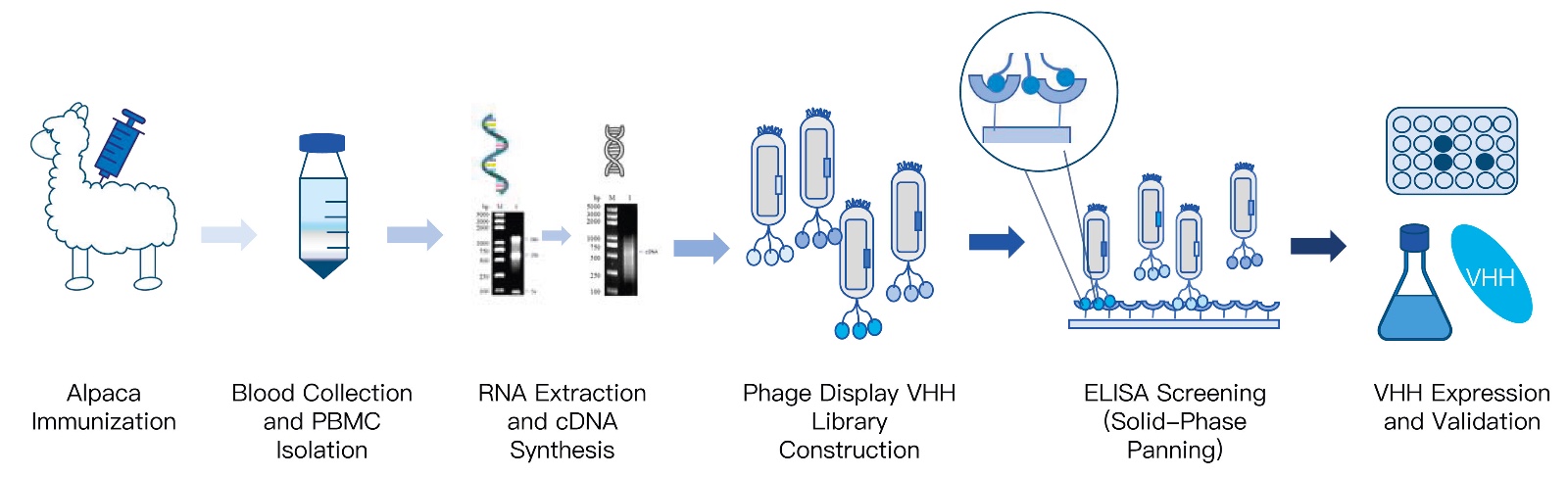
Alpaca VHH Antibody Library Construction Introduction
KMD Bioscience brings over nine years of expertise in VHH library construction and screening, supported by an established antibody discovery platform and an experienced technical team.
Its phage display-based service can cover antigen design, alpaca immunization, VHH library construction, screening, and functional validation. This integrated approach is relevant to research teams seeking high-specificity, high-affinity VHH candidates for further evaluation.
For projects where a VHH discovery route is more appropriate than conventional antibody humanization, explore the Alpaca VHH antibody library construction service and the broader VHH antibody platform.
What to Ask Before Selecting an Antibody Engineering Partner
Can the provider explain its sequence annotation and humanization design strategy?
Does the proposed work include framework comparison and a rationale for back-mutations?
Which expression, binding, specificity, and functional assays are included?
Are developability considerations included in candidate selection?
Will the project deliver complete sequences, construct information, assay data, and clear candidate-selection criteria?
Can the provider support additional optimization if the first humanized candidates lose affinity or show poor expression?
We recommend choosing a partner that can explain both the design logic and the experimental evidence. A sequence report without appropriate validation is not enough for a high-value therapeutic development decision.
Quick Summary: Seven Common Mistakes in Antibody Humanization
| Common Mistake | Potential Consequence | Recommended Solution |
|---|---|---|
| Incorrect CDR definitions or numbering | Loss of important antigen-binding residues | Use a consistent numbering scheme and review boundaries carefully. |
| Framework chosen only by sequence identity | Poor CDR-framework compatibility | Compare suitable frameworks using sequence, structural, and experimental evidence. |
| Ignoring Vernier-zone residues | Changes in CDR conformation and affinity | Identify and evaluate important framework positions. |
| Excessive humanization | Loss of binding or biological function | Balance human sequence content with functional preservation. |
| Assuming humanization eliminates immunogenicity | Underestimated ADA and immune-response risks | Use product-specific, risk-based immunogenicity assessment. |
| Ignoring developability | Aggregation, poor stability, or manufacturing difficulty | Assess expression, stability, solubility, and other relevant properties early. |
| Insufficient experimental validation | Unrecognized loss of specificity or function | Compare parental and humanized candidates using appropriate assays. |
Expert Recommendation: Optimize the Whole Antibody, Not Just Its Human Sequence Content
The most reliable antibody humanization projects begin with a strong parental molecule, accurate sequence annotation, and a clear understanding of the target-binding mechanism. Framework selection should consider structural compatibility rather than sequence identity alone. Back-mutations should be justified by evidence, and humanization should be evaluated alongside expression, stability, specificity, and biological activity.
For beginners, the most important lesson is to avoid treating CDR grafting as a guaranteed conversion method. For experienced antibody developers, the greater opportunity is to integrate rational design, focused variant screening, and developability assessment early enough to influence candidate selection.
Humanization is worth the investment when it advances a valuable antibody toward its intended application. It is not successful merely because the resulting sequence contains more human residues. A candidate should be selected because it retains the required function, has an acceptable molecular profile, and is supported by reproducible experimental evidence.
Frequently Asked Questions About Antibody Humanization
1. What is the most common mistake in antibody humanization?
A frequent mistake is selecting human frameworks based mainly on sequence similarity without evaluating how the framework supports the original CDR structure. This can reduce binding affinity or change antibody function. Accurate CDR annotation and framework compatibility assessment should be part of the initial design process.
2. Why can antibody humanization reduce binding affinity?
Humanization introduces sequence changes that can affect CDR loop conformation, framework packing, antigen-contact residues, or VH-VL domain interactions. CDR grafting may therefore reduce affinity if the selected human framework does not adequately support the parental antibody's binding structure.
3. What are Vernier-zone residues in antibody humanization?
Vernier-zone residues are framework positions that can influence the conformation and positioning of antibody CDR loops. Some parental residues at these positions may need to be retained or restored during humanization to preserve binding performance.
4. Does a humanized antibody have no immunogenicity risk?
No. Humanization reduces non-human sequence content but does not guarantee that an antibody will avoid immune responses. Sequence features, aggregation, product impurities, formulation, treatment conditions, and patient-related factors can all influence immunogenicity risk.
5. What is the difference between a chimeric and a humanized antibody?
A chimeric antibody generally combines non-human variable regions with human constant regions. A humanized antibody typically has additional modifications to its variable regions, often by transferring selected non-human CDRs into human frameworks while retaining residues needed for function.
6. Is CDR grafting always the best humanization method?
No. CDR grafting is an established method, but its success depends on CDR definitions, framework compatibility, and the structural role of parental residues. Other approaches, including resurfacing, structure-guided design, back-mutation strategies, and library-based optimization, may be appropriate for specific antibodies.
7. What tests should be performed after antibody humanization?
Testing should be tailored to the intended application. Common evaluation areas include sequence confirmation, expression, purity, binding affinity, specificity, biological function, aggregation, stability, solubility, and relevant immunogenicity risk assessment. A binding assay alone is not sufficient to establish overall candidate quality.
8. Can computational tools replace experimental antibody humanization validation?
No. Computational tools can support sequence annotation, framework selection, structural modeling, and candidate prioritization. However, experimental expression, binding, functional, and developability testing is needed to confirm the behavior of the resulting antibody.
9. How do I choose a reliable antibody humanization service provider?
Evaluate the provider's experience in antibody engineering, sequence analysis, framework selection, expression, and validation. Ask for a clear design strategy, defined deliverables, experimental acceptance criteria, and a plan for addressing candidates that lose affinity or show poor developability.
10. Is VHH or nanobody humanization the same as conventional IgG humanization?
No. VHH antibodies are single-domain antibody fragments with structural and sequence characteristics that differ from conventional VH/VL antibodies. Their engineering and humanization strategies should account for the VHH framework, CDR architecture, stability, and intended molecular format.
References
The following scientific and regulatory resources provide further background on antibody humanization, framework compatibility, and immunogenicity assessment.
Antibody humanization methods – a review and update. A review of framework-homology-based humanization, germline approaches, CDR-based strategies, and specificity-determining residue grafting.
Prospects for the computational humanization of antibodies and nanobodies. A review discussing computational approaches to antibody and nanobody humanization.
U.S. Food and Drug Administration – Immunogenicity Assessment for Therapeutic Protein Products. Regulatory guidance describing risk-based assessment of immune responses to therapeutic protein products.
Planning an Antibody Humanization or Discovery Project?
Share your antibody sequence, target information, intended format, and available experimental data with KMD Bioscience to discuss a project scope that connects design with expression and validation.
Explore the Antibody Humanization Platform or review Custom Antibody Platform services.





 0
