


Overview of Single-Chain Variable Fragment (scFv)
- 2026-07-10
- 375
With the development of genetically engineered antibodies, scFv (single-chain fragment variable) has attracted increasing attention in both theoretical and applied research. Compared to traditional antibody molecules, scFv has a smaller molecular weight (approximately 1/6 of a full antibody) and was first successfully expressed in yeast and plant cells. It can fold spontaneously into its native structure while retaining antigen-binding capabilities.ScFv holds broad application potential in areas such as antiviral therapy, cancer treatment, autoimmune disease management, and targeted drug delivery, making it a promising tool in biomedical research and therapeutic development.
1. Structure of scFv
scFv (single-chain variable fragment) is a small-molecule genetically engineered antibody composed of the variable regions of the antibody heavy chain (VH) and light chain (VL) connected by a short peptide linker of 15–20 amino acids, lacking the Fc fragment. A complete antibody consists of two heavy chains (H) and two light chains (L). Through genetic engineering, only the variable regions can be expressed, and the variable heavy chain (VH) and variable light chain (VL) are linked by a synthetic linker peptide gene to form a recombinant gene. The antibody expressed by this recombinant gene is called a single-chain antibody (scFv).Structurally, the N-terminus of the heavy chain can be connected to the C-terminus of the light chain, or the N-terminus of the light chain can be connected to the C-terminus of the heavy chain. The linker typically consists of 15–25 amino acids, often composed of glycine (Gly) and serine (Ser), providing flexibility and protease resistance. The linker serves to connect VH and VL while maintaining sufficient flexibility, allowing the functional domains of VH and VL to fold and pair properly, forming a monovalent antigen-binding site.
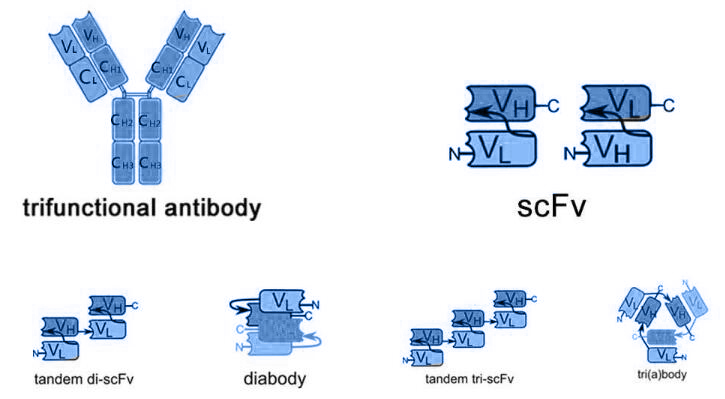
2. Preparation of scFv
scFv exhibits characteristics such as antigen-binding capability, strong tissue penetration, short in vivo half-life, low immunogenicity, expressibility in prokaryotic systems, and ease of genetic engineering manipulation. Currently, the most commonly used method for scFv preparation is phage display technology. Based on the source of antibody genes, antibody libraries are generally classified into several types, including naïve antibody libraries, immune antibody libraries, synthetic antibody libraries, and semi-synthetic antibody libraries.The prerequisite for screening an ideal scFv is whether the antibody library possesses sufficient size and diversity. A large and highly diverse antibody library increases the likelihood of obtaining high-affinity and specific scFv candidates.
The preparation process is as follows:
1)Cloning and recombination of antibody genes. Typically, degenerate primers specific to the framework regions of antibody variable region genes are used to amplify the heavy and light chain variable region genes via PCR. These genes are then connected by a linker to form a complete scFv gene.
2)Construction and expression of antibody gene expression vectors. The successfully amplified scFv gene is inserted into a phagemid vector and transformed into host cells to construct a phage-displayed single-chain antibody library.
3)Enrichment and screening of the phage-displayed single-chain antibody library. Generally, the immobilized antigen is incubated with the phage antibody library. Through multiple rounds of adsorption, washing, elution, and amplification, specific phages can be enriched up to 10^9-fold, with each phage representing a single antibody.
4)Soluble expression of scFv single-chain antibodies. During the construction of the single-chain antibody gene, tags such as c-Myc, histidine, GST, MBP, or lipid tags can be introduced at the C-terminus of the single-chain antibody gene to facilitate the detection and purification of the expressed product.
3. Applications of scFv
The specificity and low immunogenicity of scFv make them an excellent alternative to traditional therapeutic approaches, improving the accuracy of targeting specific molecules while avoiding adverse side effects.
The most prominent application of scFv is undoubtedly its role as a critical component in targeted drugs, particularly in chimeric antigen receptors (CARs) used in CAR-T cell therapy. As a star player in modern targeted therapies, CAR-T employs genetically engineered T cells to treat cancer. The premise of CAR-T immunotherapy is modifying T cells to recognize cancer cells, enabling more precise targeting and destruction—a function achieved by the scFv domain embedded in the CAR structure. CAR-T has already demonstrated significant efficacy in treating blood cancers, HIV, and herpes simplex virus (HSV) infections.
Additionally, scFv can be applied in disease diagnostics, such as the detection of rabies virus. In cases of rabies infection, treatment is only effective shortly after exposure, making accurate diagnosis crucial for patient survival. Compared to traditional monoclonal antibodies, scFv is more cost-effective, allowing for broader accessibility.
Furthermore, phage display libraries provide a versatile platform for subsequent antibody therapy experiments, including humanization and affinity maturation.
KMD Bioscience has been dedicated to the antibody field for many years. We have established a one-stop antibody service platform, offering a comprehensive suite of antibody solutions. Leveraging our proprietary phage display technology platform, we provide services such as human scFv antibody library construction, antibody humanization, and affinity maturation, among other technical services. Feel free to inquire!
- Single-chain antibody
- scFv
- phage display technology
- recombinant antibody construction

- Protein Platform
- Protein Expression Services
- Protein Modification & Detection Services
- Protein Interaction Services
- Protein Purification Service
- Antibody Discovery Platform
- VHH Antibody Platform
- Phage Display Platform
- Antibody Humanization Platform
- Single B Cell Screening Platform
- Antibody Expression & Validation Platform
- Peptide Library Platform
- Custom Antibody Platform
- Innovative Drug Discovery Platform
- Product Center
- Proteins
- Antibodies
- Raw Materials Reagents
- Small Molecule Reagents
- Peptide Products
- Nanoparticle Products
- Contact Us
- Phone:400-621-6806
- Mobile:13110936064(WeC
- E-mail:[email protected]
- Address:Room 108, Building 10, No. 6 Hechang Road, Wuqing Development Zone, Tianjin City
-

WeChat
-

Service Account
-
 400-621-6806
 -
 3599163699
 -
 Monday to Friday 9:00-18:00
 -

-
 0
0
-
