


A successful VHH antibody discovery workflow is not simply a sequence of immunization, phage display, and screening. It is a decision process designed to identify single-domain antibodies that bind the right target, perform in the intended assay, and remain practical to express, characterize, and develop. Skipping target validation or treating a positive screening signal as proof of a useful antibody can waste months of downstream work.
For research teams developing nanobodies for diagnostics, target biology, or early therapeutic research, we recommend planning the final validation criteria before the first library is built. KMD Bioscience provides an integrated VHH Antibody Platform covering antigen-related planning, alpaca VHH library construction and screening, and functional validation. The right scope depends on your target, available reagents, and intended application.
Quick Answer: What Are the 8 Steps in a VHH Antibody Discovery Workflow?
The typical workflow has eight stages: define the antibody's intended use, design and validate the antigen, select a discovery strategy, construct a VHH library, enrich target-binding clones, screen individual candidates, sequence and characterize hits, then validate function and developability.
For many projects using an alpaca immune library and phage display, the strongest approach is to treat each stage as a decision gate. Advance candidates only when the evidence supports the next investment. A large library or strong ELISA signal is not, by itself, evidence of specificity, functional activity, or suitability for downstream development.
Table of Contents
What Is a VHH Antibody Discovery Workflow?
VHH domains are the variable domains of heavy-chain-only antibodies naturally found in camelids, including alpacas, llamas, and camels. Recombinant VHH domains are commonly called nanobodies or single-domain antibodies. Compared with conventional antibody fragments that require paired heavy- and light-chain variable domains, a VHH can function as a single antigen-binding domain. This compact architecture makes VHHs attractive for research tools and for engineering into formats such as multivalent or multispecific constructs.
A VHH antibody discovery workflow is the coordinated process used to identify, isolate, and assess VHH sequences against a selected antigen. A common route uses alpaca immunization to generate an immune repertoire, followed by VHH gene amplification, phage display library construction, iterative selection, clone screening, sequencing, recombinant expression, and validation. Other routes use naïve or synthetic libraries, particularly when immunization is unsuitable or a defined sequence design strategy is preferred.
How does the workflow work?
At the discovery stage, researchers create or access a diverse collection of VHH sequences and present those sequences through a display system such as bacteriophage. The displayed VHHs are exposed to the target antigen under controlled selection conditions. Repeated selection and screening enrich candidates that bind the target, after which individual clones are evaluated using independent assays.
The workflow does not end when a clone binds in one assay. The selected VHH must be assessed for sequence identity, specificity, expression, purity, stability, and the intended biological or analytical function. The appropriate validation package depends on whether the final application is a research reagent, diagnostic component, imaging construct, or therapeutic discovery lead.
What are the main benefits and limitations?
VHHs can offer a compact format, access to epitopes that may be difficult for larger binders to reach, and flexibility for engineering. However, these properties are not guaranteed for every sequence. A VHH can show weak expression, aggregation, nonspecific binding, limited stability, or strong binding without the desired function. Candidate selection should therefore balance binding performance with practical developability.
Quick Summary Table: The Eight Steps
| Step | Main activity | Key decision or output | Common risk |
|---|---|---|---|
| 1. Define objectives | Specify target, application, assay, and success criteria | Agreed candidate profile | Optimizing for binding when function is required |
| 2. Validate antigen | Confirm identity, quality, format, and relevant conformation | Suitable target reagent and controls | Selecting against an irrelevant or misfolded form |
| 3. Choose strategy | Compare immune, naïve, and synthetic libraries | Discovery plan and feasibility assessment | Choosing a platform without considering target biology |
| 4. Build library | Recover VHH repertoire and construct display library | Quality-controlled library | Low diversity or biased sequence representation |
| 5. Enrich binders | Conduct display selection and appropriate counter-selection | Enriched candidate pool | Target-format artifacts or nonspecific enrichment |
| 6. Screen clones | Test individual candidates in primary and orthogonal assays | Ranked positive clones | False positives from a single assay |
| 7. Characterize hits | Sequence, express, purify, and measure binding | Confirmed unique candidates | Duplicate sequences or poor recombinant behavior |
| 8. Validate leads | Assess function, specificity, and developability | Evidence-based lead shortlist | Advancing binders with poor application fit |
Step 1: Define the VHH Antibody Discovery Objective
Before ordering antigen or commissioning a library, define what the VHH must do. “Bind protein X” is an incomplete project brief. A useful brief explains the target form, intended assay, species cross-reactivity needs, acceptable background, and whether binding alone is sufficient.
Specify the application before choosing the assay
For a Western blot reagent, recognition of a denatured epitope may be acceptable. For a cell-surface assay, the candidate may need to recognize an accessible epitope in the native cellular context. For a functional blocking study, binding must be connected to the relevant biological effect. A clone selected against a purified fragment may fail when tested against the full-length target on cells.
We recommend writing a candidate profile with measurable criteria, such as a defined positive signal, low background against relevant negative controls, a target-specificity panel, a preferred affinity range if justified, and minimum expression or stability expectations. Avoid arbitrary thresholds that are not connected to the assay or intended use.
Decision gate: Do not start discovery until the team agrees on the target form, the assay in which success will be judged, and the evidence required to advance a candidate.
Step 2: Design and Validate the Antigen
Antigen quality is one of the most consequential variables in the entire VHH antibody discovery workflow. A well-built library cannot compensate for a target reagent that is misfolded, impure, incorrectly tagged, or biologically irrelevant. The antigen should represent the molecular feature the final VHH is expected to recognize.
Match the antigen format to the final use
For soluble proteins, review construct boundaries, domain selection, oligomeric state, tags, purity, and available evidence of correct folding. For membrane proteins or complex targets, consider whether a purified domain adequately represents the native epitope. If the final application involves intact cells, include a plan to verify binding in a cell-based context.
Use suitable positive and negative controls where feasible. Depending on the target, controls may include an unrelated protein produced through a comparable process, tag-only material, target-negative cells, or a known reference binder. These controls help distinguish true target recognition from binding to tags, contaminants, plastic surfaces, or assay components.
For teams planning the upstream research package, KMD Bioscience provides protein products and raw materials and reagents as separate product categories. Confirm the precise target, format, specifications, and availability before selecting a reagent for a discovery campaign.
Practical recommendation: Validate the antigen with an appropriate analytical method before using it for selection. When target conformation is central to the application, build native-context confirmation into the plan from the beginning.
Step 3: Choose the Right VHH Discovery Strategy
The three common library sources are immune, naïve, and synthetic or semi-synthetic libraries. None is automatically the best choice for every target. The decision should reflect target biology, schedule, available antigen, desired sequence characteristics, and the team's downstream requirements.
Immune VHH library
An immune library is generated from a camelid that has been exposed to the target antigen through an immunization program. The resulting repertoire can contain VHH sequences shaped by an antigen-specific immune response and in vivo affinity maturation. This makes immune-library discovery an attractive option when immunization is feasible and the project benefits from a target-focused repertoire.
The trade-off is that immunization and subsequent library work require time, suitable antigen preparation, and a carefully managed program. An immune library also does not guarantee that every recovered binder will have the required specificity or function.
Naïve VHH library
A naïve library is derived from an un-immunized repertoire. It may be useful when immunization is not preferred or when a reusable source of sequence diversity is appropriate. Success depends on library diversity, quality, target properties, and the selection strategy. A naïve library should not be chosen simply because it appears faster on paper; the probability of finding suitable binders is target-dependent.
Synthetic or semi-synthetic library
Synthetic libraries use designed sequence diversity, often focused on complementarity-determining regions within selected frameworks. They can support deliberate control over library architecture and sequence design. However, design quality, library representation, selection conditions, and subsequent developability testing remain important. A synthetic library is not automatically more developable merely because its sequences were designed in advance.
For a deeper overview of the service options and platform scope, review KMD Bioscience's VHH antibody discovery platform. The choice should be made after considering the target and intended output, not by comparing platform labels alone.
Step 4: Construct a Quality-Controlled VHH Library
For an immune-library workflow, this stage typically involves collecting appropriate lymphocyte material after the immunization program, extracting RNA, synthesizing cDNA, amplifying VHH sequences, and cloning the repertoire into a suitable display vector. The resulting library is then evaluated for relevant quality attributes before selection.
Library size is often emphasized in marketing materials, but size alone does not establish quality. Diversity, sequence integrity, representation of functional VHH genes, display performance, and absence of problematic biases all matter. A very large nominal library with poor representation may perform worse than a smaller, well-characterized library in a particular selection campaign.
What should be documented?
Library source and construction approach.
Relevant quality-control methods and results.
Estimated library size and the method used to calculate it.
Evidence of sequence diversity and correct insert representation, where assessed.
Display system and relevant quality checks.
Known limitations or deviations that could affect selection.
Researchers should ask a service provider how library quality is measured rather than accepting a single size figure as a complete quality statement. KMD Bioscience describes its alpaca VHH library construction and screening service as part of an integrated platform. Project-specific deliverables and quality criteria should be confirmed in the scope of work.
Decision gate: Proceed to selection only when the library meets agreed quality criteria. If construction or diversity checks identify a significant issue, resolve it before spending resources on repeated screening.
Step 5: Enrich Target-Binding VHHs Through Display Selection
Phage display links a displayed VHH variant with the genetic information encoding it. During selection, the library is exposed to the target under defined conditions. Non-retained material is removed, target-associated phage is recovered, and enriched material can be used in subsequent rounds. The purpose is to increase the representation of candidate binders, not to establish final specificity or biological function.
Why selection design matters
Selection outcomes can be influenced by antigen immobilization, tag interactions, target density, washing stringency, nonspecific binding to assay surfaces, and the accessibility of the epitope. Excessively permissive conditions may enrich background binders; excessively stringent or poorly matched conditions may discard useful candidates. The appropriate strategy depends on target characteristics and the intended application.
Counter-selection can be useful when there are known sources of unwanted binding, such as a tag, related proteins, or negative-cell backgrounds. It should be designed around the project's real specificity risks. Adding every possible counter-target without a rationale can complicate interpretation or remove candidates that might otherwise be useful.
We recommend reviewing enrichment data alongside controls and maintaining traceability between selection conditions and downstream screening results. Strong enrichment is a useful signal, but it should not be reported as proof that the final VHH has high affinity, high specificity, or functional activity.
Step 6: Screen Individual VHH Clones With Orthogonal Assays
After selection, individual clones are screened to identify candidates that bind the target under a defined assay format. ELISA is often used for primary screening because it can assess many clones efficiently. It is useful for triage, but a positive ELISA signal alone is not enough to confirm a high-quality VHH.
Use screening assays that answer different questions
A primary binding assay identifies promising clones. A secondary assay should test an independent aspect of the interaction or remove a likely source of false positives. Depending on the project, this may involve a different antigen presentation format, binding to target-expressing versus target-negative cells, testing against related proteins, or a solution-phase or label-independent binding method.
For cell-surface targets, cell-based testing may be especially important because purified antigens can expose surfaces that are inaccessible in the native membrane context. For applications that depend on recognition of a specific protein domain, use controls that establish whether the VHH recognizes the intended target region rather than a fusion tag or unrelated construct feature.
Rank clones on evidence, not signal intensity alone
Very strong signals can arise from avidity effects, nonspecific interactions, high expression, or assay artifacts. Establish a ranking scheme that considers signal-to-background, reproducibility, specificity, sequence uniqueness, and compatibility with the intended application. Keep borderline candidates only when there is a clear reason to investigate them further.
For general background on assay quality and candidate assessment, consult the antibody validation guide. The most efficient screening program is not necessarily the one that produces the longest hit list; it is the one that reliably identifies candidates worth characterizing.
Step 7: Sequence, Express, and Characterize VHH Hits
Positive clones should be sequenced to confirm identity, detect duplicate sequences, and identify distinct candidate families. Sequence analysis can reveal whether many positive clones are closely related or whether the campaign has recovered multiple independent binders. The most abundant sequence is not automatically the best lead.
Selected VHH sequences are then subcloned into a suitable expression construct and produced for further testing. Expression host, construct design, tags, purification strategy, and final format should be chosen according to the intended research use. A clone that performs well as a displayed phage may behave differently as a soluble recombinant protein.
Characterize binding with a suitable quantitative method
Depending on the project, methods such as surface plasmon resonance (SPR) or biolayer interferometry (BLI) can provide quantitative binding kinetics and affinity estimates. Assay design matters: immobilization orientation, analyte concentration range, nonspecific interactions, mass-transport effects, and model fit can influence the interpretation. Use the method and controls appropriate to the target and expected binding behavior.
Also assess purity, identity, expression yield, solubility, and stability as relevant. If the candidate will be used in a cellular assay, confirm performance in that context rather than assuming purified-protein binding translates directly to cells. When planning additional experimental support, KMD Bioscience's protein product resources and antibody products may be relevant starting points; confirm specific product and service availability directly.
Practical recommendation: Sequence before investing heavily in expression and characterization. Confirm that the candidate is unique and that the soluble recombinant molecule retains the binding behavior observed during primary screening.
Step 8: Validate Function, Specificity, and Developability
The final stage is where a promising binder becomes a credible research candidate—or is removed from consideration. Validation should reflect the use case. A VHH intended as a detection reagent may need reproducible recognition, low background, and performance across relevant samples. A VHH intended to block a protein interaction needs a functional assay that measures that mechanism. A therapeutic discovery lead requires a substantially broader evaluation than a research-use binder.
Specificity and functional validation
Test the VHH against relevant off-targets and negative controls. For functional projects, use an assay linked to the proposed mechanism and include controls that help distinguish target-dependent activity from nonspecific effects. Binding and function are related but different properties: a VHH may bind strongly without blocking, activating, neutralizing, or otherwise changing target biology.
Developability is not an optional afterthought
For candidates intended for further development, assess expression, solubility, aggregation tendency, thermal or other relevant stability, sequence liabilities, and compatibility with the intended molecular format. The required package depends on the project stage and use. A research reagent may need a narrower assessment than a molecule being considered for therapeutic development, but neither should be advanced on binding data alone.
Humanization, affinity maturation, multimerization, or fusion to another domain may be considered when justified by the intended use. These changes can improve one attribute while negatively affecting another. For example, a sequence change intended to increase affinity may also alter solubility or aggregation behavior. Evaluate engineered variants experimentally instead of assuming that computational predictions or sequence similarity guarantee improvement.
For practical support around related experimental workflows, see KMD Bioscience's protein expression troubleshooting tips and biotech lab techniques guide. The objective is a candidate supported by reproducible evidence, not simply a binder with the most impressive primary-screening result.
Comparison Table: Immune, Naïve, and Synthetic VHH Discovery
Choose a library strategy according to the project requirements. Timelines, hit rates, and candidate quality vary with the target, library, selection design, and validation criteria, so a fixed performance ranking would be misleading.
| Strategy | How it is sourced | Best-fit scenarios | Main advantages | Important limitations |
|---|---|---|---|---|
| Immune library | VHH repertoire from an immunized camelid | Targets suitable for immunization when an antigen-focused response is desirable | Can include in vivo matured, target-responsive sequences | Requires an immunization program and suitable antigen; outcome is not guaranteed |
| Naïve library | Repertoire from non-immunized animals | Projects where immunization is not preferred and a reusable repertoire is appropriate | Can support discovery across multiple targets without target-specific immunization | Success depends on repertoire diversity, target properties, and selection quality |
| Synthetic or semi-synthetic library | Designed sequence diversity introduced into selected frameworks | Projects needing controlled library design or defined sequence architecture | Allows deliberate design of frameworks and diversified regions | Design and representation quality matter; developability still requires experimental assessment |
Is an alpaca immune library worth choosing?
It can be a strong choice when immunization is appropriate and the project benefits from a target-focused repertoire. However, it is not automatically superior to naïve or synthetic discovery. The right choice depends on antigen quality, target biology, the desired VHH characteristics, and whether the project can support the associated schedule and experimental requirements.
Pros and Cons of a VHH Antibody Discovery Workflow
| Advantages | Limitations and risks |
|---|---|
| VHHs provide a compact single-domain binding format that can support flexible construct design. | Small size alone does not guarantee tissue penetration, stability, or improved performance in a specific application. |
| Display technologies allow iterative enrichment and screening of large sequence repertoires. | Selection can enrich assay artifacts or nonspecific binders if controls and antigen presentation are poorly designed. |
| Immune, naïve, and synthetic library strategies provide options for different project needs. | No single strategy guarantees useful hits, a short timeline, or a preferred affinity range. |
| Sequence-defined candidates can be recombinantly produced and engineered into different formats. | Soluble expression, purification, aggregation, and stability must be evaluated for each candidate. |
| Orthogonal assays can progressively reduce the risk of advancing unsuitable clones. | Each additional validation stage adds cost and time, so experiments should be selected according to the final use. |
Our view: VHH discovery is most valuable when the team plans for validation from the start. If the project stops at a positive ELISA result, it has identified a screening hit—not necessarily a usable antibody reagent or development candidate.
How to Choose a VHH Antibody Discovery Service Provider
For research teams outsourcing discovery, compare providers on technical scope, decision gates, data quality, and the usefulness of deliverables—not on library size or broad claims alone. An integrated service can reduce coordination between antigen design, library construction, screening, and validation, but the exact scope must be documented.
Ask how the antigen will be assessed
Clarify whether the provider evaluates antigen identity, purity, integrity, and suitability for the planned selection format. Ask how tags, related proteins, or target conformation will be controlled where relevant. If your target is membrane-associated or structurally complex, discuss how the discovery strategy will preserve the epitope needed for the final application.
Request specific library and screening deliverables
Ask what quality-control information is supplied for the library, how enriched clones are screened, how sequence data are reported, and what constitutes a confirmed hit. A useful statement of work should define the number and type of candidates delivered, assay methods, data format, sequence ownership or usage rights, and any exclusions or additional charges.
Check what “validation” actually includes
Validation may mean a repeated binding assay, an orthogonal binding method, cell-based recognition, functional testing, or developability characterization. These are not interchangeable. Ask which tests are included, what samples and controls are required, and whether quantitative binding measurements are part of the package.
Evaluate project communication and data traceability
Reliable project updates, documented methods, traceable sample identifiers, and transparent reporting make results easier to interpret and reproduce. Confirm how failed stages are handled, when project decisions are made, and whether the provider discusses alternative approaches if the initial strategy underperforms.
KMD Bioscience reports more than nine years of VHH library construction and screening experience and describes an integrated alpaca phage-display service that can encompass antigen design, immunization, library construction, screening, and functional validation. These are provider-reported capabilities; prospective customers should confirm current scope, deliverables, quality criteria, and timing for their specific project.
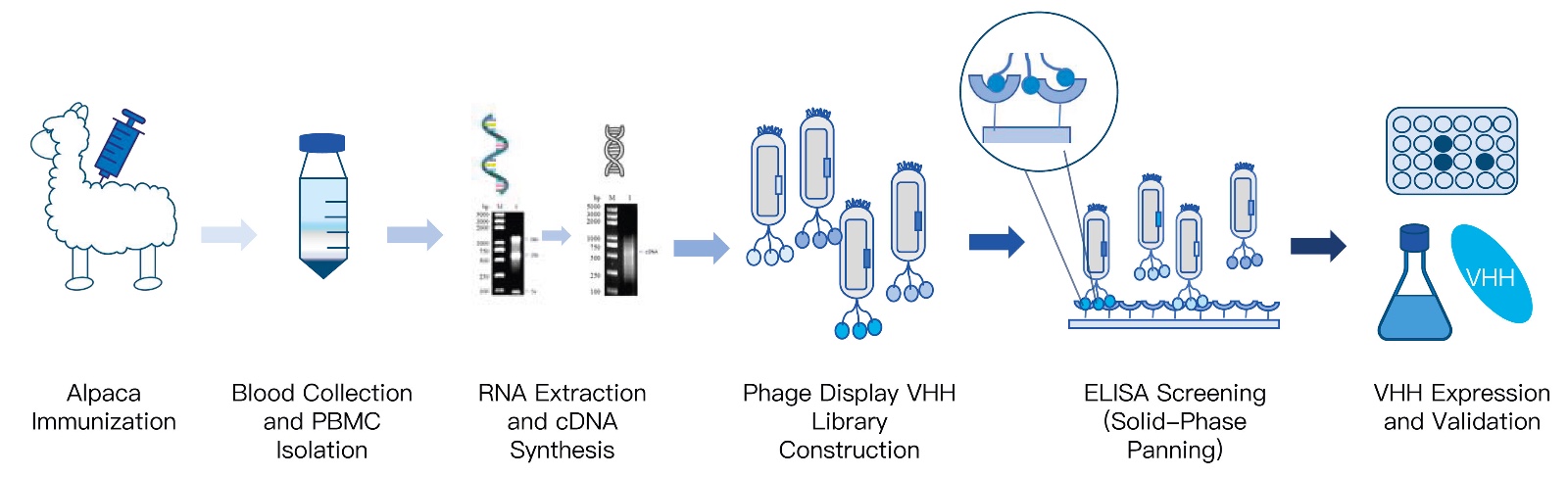
Alpaca VHH Antibody Library Construction
KMD Bioscience presents its alpaca VHH library construction service as part of an integrated phage-display discovery platform. The described scope includes antigen design, alpaca immunization, VHH library construction and screening, and functional validation, subject to project requirements and agreed deliverables.
This service may suit teams that want coordinated support across several discovery stages rather than managing each supplier independently. Before commissioning a project, confirm antigen requirements, project milestones, sequence and data deliverables, screening methods, validation depth, and the commercial terms that apply to your target.
Review the alpaca VHH library construction service and discuss project-specific feasibility with the provider.
Common Mistakes in VHH Antibody Discovery
1. Treating library size as the main quality metric
Library size is only one attribute. Diversity, sequence integrity, representation, and display performance also influence discovery. Request the supporting quality data and understand how the library size was measured.
2. Using an antigen that does not represent the final target
A recombinant fragment may expose an artificial epitope or omit a critical domain. If the final application depends on native conformation or cell-surface accessibility, include a suitable confirmation strategy before selecting the final lead.
3. Relying on one screening assay
A single assay can produce false positives through nonspecific interactions, tags, or presentation artifacts. Use an orthogonal test that addresses the main uncertainty in the primary result.
4. Confusing affinity with functional activity
A VHH can bind strongly and still fail to block a receptor, neutralize a ligand, or produce the desired biological effect. Select a functional assay that directly tests the intended mechanism when activity is part of the project brief.
5. Delaying developability checks
Poor expression, aggregation, or instability discovered late can undermine an otherwise promising candidate. Assess these properties early enough to inform candidate ranking, especially for therapeutic or complex-format development.
6. Leaving deliverables undefined
Before outsourcing, agree on what counts as a hit, how many unique sequences are expected to be reported, which validation assays are included, and what raw data will be supplied. Clear acceptance criteria reduce misunderstandings and make the final results more useful.
Expert Recommendation: Plan the End Point Before Starting Discovery
From our perspective, the most efficient VHH antibody discovery workflow is the one that removes uncertainty at the right time. The team should not spend heavily on a large screening campaign before confirming that the antigen is fit for purpose. It should not advance dozens of primary hits before checking specificity and sequence uniqueness. And it should not call a candidate validated until the evidence matches the intended application.
For beginners, start by defining the target format and the minimum evidence needed for a successful outcome. For established research groups, the greatest improvement often comes from tightening assay controls and establishing clear advancement criteria rather than simply increasing the number of clones screened.
For commercial or therapeutic discovery projects, include expression, stability, aggregation, specificity, and functional performance in the candidate profile early. If the target is difficult, discuss alternative antigen formats and library strategies before committing to a single approach. An integrated provider such as KMD Bioscience may be worth evaluating when the project needs coordinated antigen-related planning, alpaca library construction, phage-display screening, and functional validation.
Our recommended sequence is straightforward: define the use case, validate the antigen, choose a suitable library strategy, quality-check the library, enrich and screen binders, sequence and characterize the hits, then validate function and developability. The goal is not the largest hit list. It is a defensible shortlist of unique VHH candidates supported by evidence relevant to the work you actually intend to do.
Frequently Asked Questions About the VHH Antibody Discovery Workflow
1. What are the main steps in a VHH antibody discovery workflow?
The common stages are defining the objective, designing and validating the antigen, selecting a library strategy, constructing the VHH library, enriching binders, screening individual clones, sequencing and characterizing hits, and validating function and developability. The exact workflow varies with target biology and the intended application.
2. What is the difference between a VHH and a conventional antibody?
A VHH is a single variable domain derived from camelid heavy-chain-only antibodies. Conventional antibodies generally use paired heavy- and light-chain variable domains for antigen recognition. VHHs offer a compact single-domain format, but their performance still depends on sequence, target, assay, and construct design.
3. Why use alpacas for VHH antibody discovery?
Alpacas are camelids that naturally produce heavy-chain-only antibodies containing VHH domains. An immune VHH library can capture sequences generated during an antigen-specific immune response. The suitability of this strategy depends on the target, immunization feasibility, project requirements, and the available alternatives.
4. Is phage display required for VHH discovery?
No. Phage display is a widely used approach, but VHHs can also be discovered with other display technologies or through alternative screening strategies. The appropriate platform depends on target characteristics, library source, available infrastructure, and the type of candidate the project needs.
5. Does a positive ELISA result prove that a VHH is high affinity?
No. ELISA is useful for primary screening, but signal strength depends on several assay variables and does not directly establish binding kinetics. Quantitative methods such as SPR or BLI may be appropriate for measuring affinity and kinetics, with assay design and controls chosen for the specific target.
6. How long does VHH antibody discovery take?
Timelines vary with antigen readiness, immunization strategy, library construction, selection rounds, expression, and the depth of validation. Immune-library discovery includes time for immunization, while downstream characterization can extend the project further. Request a milestone-based schedule for the exact scope rather than relying on a generic timeline.
7. What should be validated after identifying a VHH binder?
At minimum, confirm sequence identity and binding in an appropriate assay with relevant controls. Depending on the use, additional work may include specificity testing, quantitative affinity measurement, recombinant expression and purity assessment, cell-based recognition, functional assays, and developability evaluation.
8. How do I choose a VHH antibody discovery service provider?
Compare antigen support, library quality controls, selection and screening methods, sequence reporting, validation depth, data traceability, project communication, and contract deliverables. Confirm which assays are included and define acceptance criteria before the project starts.
9. Are VHH antibodies automatically more stable than conventional antibodies?
No. VHHs can have useful stability properties, but stability varies by sequence and formulation. Solubility, aggregation, expression, and thermal stability should be measured for the actual candidate and intended format rather than inferred from the VHH label alone.
10. When should I consider VHH engineering or affinity maturation?
Consider engineering when a validated candidate has a clearly defined limitation that can reasonably be addressed, such as insufficient affinity, poor stability, or a need for multivalent or multispecific formatting. Test the resulting variants because improving one property can affect others.
References
The following peer-reviewed and specialist sources provide further background on VHH discovery, phage display, and antibody developability. They complement, but do not replace, target-specific experimental validation.
Isolation and Characterization of Single-Domain Antibodies from Immune Phage Display Libraries. A methods-focused resource covering camelid immunization, library construction, phage panning, ELISA screening, affinity measurements, and additional characterization.
Blueprint for Antibody Biologics Developability. A review of developability risks and assessment methods, including aggregation, self-interaction, stability, and characterization considerations.
Considerations for Using Phage Display Technology in Therapeutic Antibody Drug Discovery. A specialist methods resource discussing target characteristics, library selection, panning, screening, and the planning of antibody discovery campaigns.





 0
