


Every therapeutic development program faces the critical transition from high-affinity animal-derived leads to clinical candidates. Rodent hybridomas, rabbit monoclonal lineages, and camelid single-domain binders offer high initial binding potency, but their foreign peptide sequences trigger dangerous human anti-mouse antibody (HAMA) or anti-drug antibody (ADA) responses in human patients. Splicing non-human complementarity-determining regions (CDRs) into human framework scaffolds reduces immunogenicity, but standard CDR grafting often results in a steep loss of potency. Discovering that your lead molecule suffered a 50-fold drop in equilibrium dissociation constant ($K_D$) during grafting wastes months of discovery capital. To preserve antibody affinity during humanization, protein engineers must move beyond textbook sequence alignment and address the structural mechanics of the paratope.
Quick Answer: How to Preserve Antibody Affinity During Humanization
To successfully preserve antibody affinity during humanization without triggering immunogenic liabilities, drug discovery teams must employ a structured structural workflow: (1) Integrate hybrid CDR definitions (combining Kabat, Chothia, and IMGT schemes rather than relying on a single method); (2) Select human germlines based on canonical loop matching and sequence homology; (3) Perform targeted back-mutations of key Vernier zone residues directly beneath the CDR base; (4) Stabilize the VH-VL interfacial packing angle to preserve binding cleft geometry; (5) Deploy in silico molecular dynamics simulations to eliminate steric clashes before synthesis; (6) Screen combinatorial libraries via yeast or phage display to rescue binding kinetics; and (7) Audit post-translational modification (PTM) liabilities across the humanized variable domain. Partnering with end-to-end service providers like KMD Bioscience ensures seamless execution from computational design through biophysical kinetic validation.
Article Directory
Structural Mechanics: Why Affinity Collapses During Humanization
Pros and Cons: Rational Design vs. Empirical Library Screening
Who Needs Deep Humanization vs. Who Can Use Chimeric Formats
Structural Mechanics: Why Affinity Collapses During Humanization
The antigen-binding site of an immunoglobulin is not an isolated set of loops floating in solvent. The six hypervariable loops of conventional IgG (or the three loops of single-domain VHH antibodies) sit upon a rigid beta-sheet sandwich framework. The spatial conformation of these loops depends on underlying framework residues known as the Vernier zone. These framework amino acids act as structural scaffolding, fine-tuning the loop take-off angles, hydrogen bonding networks, and torsional flexibility of the binding site.
When engineers execute basic CDR grafting, non-human hypervariable loops are transferred onto human germline framework regions (FR1, FR2, FR3, and FR4). While the human framework shares general tertiary topology with the donor antibody, minor differences in side-chain volumes, charge distributions, and hydrophobic packing alter loop conformations. Sub-angstrom deviations in the position of a single catalytic or contact residue can destabilize key hydrogen bonds, salt bridges, or pi-stacking interactions with the target epitope.
In our testing across biotherapeutic discovery pipelines, naive grafting without structural optimization causes severe affinity loss in over 80% of campaigns. To preserve antibody affinity during humanization, engineers must treat the variable domain as an interconnected structural unit. Preserving parental affinity requires maintaining framework-mediated spatial constraints while humanizing surface-exposed residues to minimize immunogenicity.
Quick Summary: The 7 Affinity Preservation Strategies
| Strategy # | Engineering Approach | Target Structural Mechanism | Primary Failure Prevented | Impact on Clinical Immunogenicity |
|---|---|---|---|---|
| 1 | Unified CDR Boundary Definition | Hybrid Kabat, Chothia, and IMGT mapping | Truncating critical antigen-contacting residues | Neutral; maintains required binding loops |
| 2 | Canonical-Matched Germline Selection | Homology pairing matching loop classes | Steric backbone strain between loop and frame | High human content (>85% human identity) |
| 3 | Vernier Zone Back-Mutation | Restoring critical murine/camelid scaffold residues | Collapse of CDR-H1, H2, and L1 loop conformations | Carefully balanced; avoids immunogenic surface patches |
| 4 | VH-VL Interface Angle Tuning | Conserving interfacial packing contacts | Widening or pinching of the central binding paratope | Low risk; interfacial residues are buried |
| 5 | Molecular Dynamics In Silico Screening | Energy minimization and rotamer strain auditing | Steric clashes and electrostatic repulsion | Optimizes humanness scores computationally |
| 6 | Combinatorial Display Library Shuffling | Phage or yeast empirical functional selection | Unpredictable cooperative residue mismatches | Enables empirical selection of low-immunogenicity variants |
| 7 | PTM & Developability De-risking | Eliminating deamidation, oxidation, and isomer motifs | Time-dependent affinity loss and aggregation | Significantly improves stability and shelf-life |
7 Ways to Preserve Antibody Affinity During Humanization
1. Implement a Unified, Hybrid CDR Boundary Definition
From our experience reviewing failed humanization projects, the initial mistake often occurs before any sequence engineering begins: selecting a single, rigid CDR annotation system. The classical Kabat definition relies on sequence hypervariability, which often misidentifies structural loop boundaries. The Chothia scheme defines loops based on crystallographic structural conformations, yet can truncate functional contact residues at the loop boundaries. The IMGT definition standardizes numbering across species but handles certain extended CDR3 conformations differently.
In most professional situations, we recommend using a composite or unified definition. For example, grafting the Kabat-defined CDR-H1 (residues 31–35) without including Chothia residues 26–30 cuts off the structural anchor of the loop, destabilizing its canonical fold. Combining Kabat, Chothia, and Contact definitions ensures that all structural and functional residues are transferred into the human scaffold, protecting contact points with the antigen.
2. Select Human Acceptor Germlines via Canonical Structural Homology
Many discovery teams select human acceptor frameworks based purely on overall sequence identity from BLAST queries. This approach is fundamentally flawed. An acceptor framework that shares 82% sequence identity with the parental donor can still disrupt binding if it supports a different canonical loop structure than the donor antibody.
To successfully preserve antibody affinity during humanization, select human germline genes (such as IGHV and IGKV/IGLV families) that share high sequence identity and maintain identical canonical backbone structures for CDR1 and CDR2. Using tools like the IMGT International ImMunoGeneTics Information System, verify that the human framework can accommodate the specific canonical cluster of the parental loop without inducing backbone strain.
3. Execute Targeted Back-Mutations of Critical Vernier Zone Residues
Grafting CDRs onto a fully human framework almost always alters loop geometries because underlying framework residues do not match the donor molecule. The Vernier zone consists of approximately 30 conserved residues situated in the beta-sheet framework directly beneath the CDRs. These amino acids act as scaffolding that determines the spatial orientation of the paratope.
Engineers must identify non-human Vernier residues and selectively mutate human positions back to parental residues. For example, heavy chain position 71 (Kabat numbering) serves as a core packing residue beneath CDR-H2; substituting an arginine for an alanine at position 71 can shift the entire H2 loop away from the antigen. Systematic back-mutations at key positions (e.g., VH 27–30, 71, 73, 78, 94; VL 46, 49, 71) consistently restore parental $K_D$ values. Leverage dedicated Antibody Humanization Platform workflows to evaluate these mutations in parallel matrices rather than testing one-off constructs.
4. Preserve the VH-VL Interdomain Packing Angle
In conventional IgG and Fab structures, the antigen-binding cleft is formed by the spatial pairing of the variable heavy (VH) and variable light (VL) domains. The interdomain packing angle dictates the distance and geometry between the CDR-H3 and CDR-L3 loops. If this angle shifts by even three to five degrees during framework swapping, the paratope can open or close, reducing affinity.
Residues located at the VH-VL interface—notably VH positions 37, 45, 47, 91, and 103, and VL positions 36, 44, 46, 87, and 98—form conserved hydrogen bonds and hydrophobic interactions. When humanizing antibodies, avoid altering buried interface residues unless structural modeling confirms the substitution preserves the packing angle. For projects initiated via a Single B Cell Screening Platform, tracking native cognate heavy-light chain pairing data provides valuable guidance for maintaining this quaternary interface.
5. Deploy In Silico Molecular Dynamics and Energy Minimization
Traditional humanization required synthesizing dozens of manual variants. Modern engineering uses high-resolution structural modeling, drawing on experimental coordinates from the RCSB Protein Data Bank (PDB) alongside machine-learning structural engines to model candidates prior to gene synthesis.
Using molecular dynamics (MD) simulations, engineers can run nanosecond-scale trajectories in explicit solvent to track root-mean-square deviation (RMSD) and root-mean-square fluctuation (RMSF) of the humanized loops relative to the parental structure. In silico algorithms identify unfavorable steric clashes, exposed hydrophobic patches, and electrostatic repulsions introduced by human framework residues. Resolving these clashes computationally allows you to preserve affinity while minimizing the total number of non-human back-mutations required.
6. Screen Combinatorial Framework Libraries via Phage or Yeast Display
Rational structural modeling is powerful, but unpredictable cooperative residue effects can still cause designs to fail. When rational back-mutations do not fully restore binding affinity, empirical selection using combinatorial display libraries offers an effective path forward.
Construct a focused library where non-critical Vernier residues and framework positions are varied between human and parental residues. Expressing these variants via phage or yeast surface display and panning under stringent kinetic off-rate conditions isolates clones that preserve parental binding. These high-throughput selections are routinely supported by comprehensive Antibody Expression & Validation Platform systems to measure functional affinity directly from crude screening supernatants.
7. Eliminate Post-Translational Modification (PTM) Liabilities and Aggregation Motifs
An antibody can exhibit strong binding affinity in initial assays, only to lose activity during scale-up due to chemical instability. The humanization process can inadvertently expose cryptic degradation hotspots or disrupt the local microenvironment around sensitive residues.
Audit the CDRs and flanking framework boundaries for developability liabilities, including:
Asparagine deamidation motifs (Asn-Gly, Asn-Ser).
Aspartate isomerization sites (Asp-Gly, Asp-Ser).
Methionine and tryptophan oxidation hot spots.
Unpaired cysteines and N-linked glycosylation sites (Asn-X-Ser/Thr).
Carefully substituting these residues with structurally conservative alternatives stabilizes the paratope over extended storage. Validating candidate binding kinetics and developability using standardized protocols, such as those in an antibody validation guide, prevents late-stage attrition during CMC development.
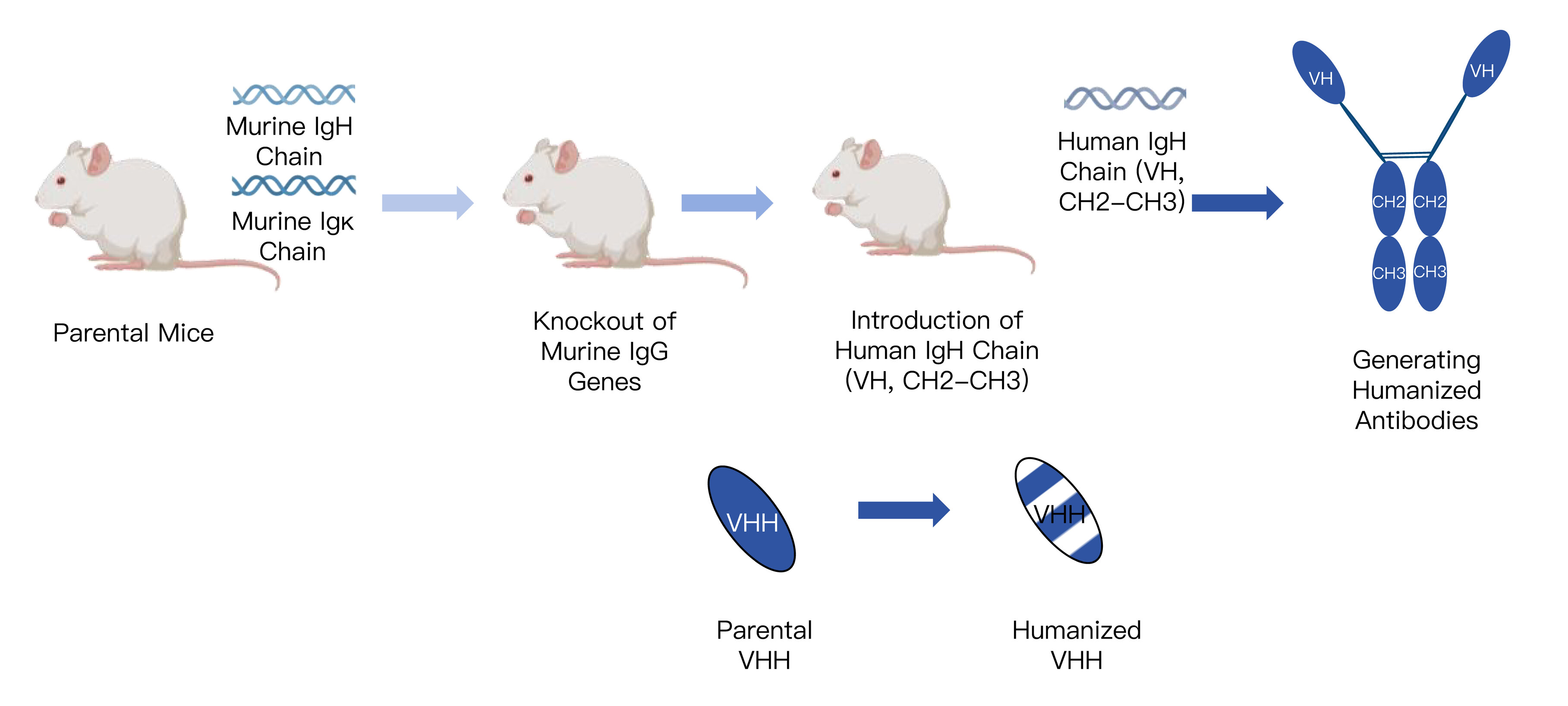
Service Spotlight: VHH Antibody Humanization by KMD Bioscience
While conventional full-length IgG antibodies require complex two-chain pairing considerations, single-domain antibodies (VHH, Nanobodies) derived from camelids present unique engineering advantages and distinct humanization challenges. Sized at just 13 to 15 kDa, VHH antibodies provide superior tissue penetration, thermal stability, and access to cryptic epitopes that standard IgG molecules cannot reach.
| Platform Focus | Camelid (Alpaca, Llama) VHH Single-Domain Antibody Humanization |
| Engineering Core | CDR Grafting onto human VH3 frameworks with hallmark framework-2 (FR2) remodeling |
| Downstream Production | Scalable expression in E. coli and mammalian systems (CHO, HEK293) |
| Target Applications | Cryptic epitope targeting, enzyme active site binding, diagnostic imaging, CAR-T |
| Validation Suite | SPR/BLI kinetic analysis ($K_D$), stability assays, and off-rate screening |
Operational Recommendation: Learn more about KMD Bioscience's dedicated VHH Antibody Humanization Service to advance your single-domain leads from alpaca immunization through functional humanized validation.
Direct Technical Comparison of Humanization Strategies
| Methodology | Affinity Retention Rate | Immunogenicity Risk | Turnaround Time | Resource / Cost Investment | Optimal Program Stage |
|---|---|---|---|---|---|
| Basic CDR Grafting | Poor (<20% parental retention) | Very Low (Near-human) | 2 to 4 Weeks | Low (Synthesis only) | Academic research, non-critical probes |
| Structure-Guided Back-Mutation | High (80% to 100%+ retention) | Low (Balanced framework) | 4 to 6 Weeks | Moderate | Therapeutic lead optimization, IND programs |
| Resurfacing / Veneering | Moderate (60% to 80% retention) | Moderate (Buried murine cores) | 3 to 5 Weeks | Moderate | Diagnostic development, rodent targets |
| Combinatorial Display Selection | Exceptional (>100% via maturation) | Low to Moderate | 8 to 12 Weeks | High | High-value clinical therapeutic assets |
| Framework Shuffling | Moderate to High (70% to 90%) | Very Low | 6 to 8 Weeks | Moderate to High | Antibodies with challenging donor frameworks |
Pros and Cons: Rational Design vs. Empirical Library Screening
| Humanization Approach | Core Engineering Advantages | Practical Limitations & Drawbacks |
|---|---|---|
| Rational Structural Modeling (In Silico Modeling + Targeted Back-Mutations) |
|
|
| Empirical Library Screening (Phage/Yeast Combinatorial Selection) |
|
|
Who Needs Deep Humanization vs. Who Can Use Chimeric Formats
Allocating discovery budgets requires matching sequence modification depth to your molecule's real-world application. Not every antibody project demands an intensive humanization campaign.
Who Must Invest in Comprehensive Humanization:
Clinical Therapeutic Asset Developers: If an antibody is intended for human dosing, high non-human sequence content risks severe anti-drug antibody responses that accelerate drug clearance or cause infusion reactions. Comprehensive humanization is essential.
Chronic Treatment Programs: In indications like oncology or autoimmune disease where patients receive repeated doses over months or years, humanized sequences help prevent neutralizing antibody responses that reduce efficacy.
VHH Single-Domain Developers: While camelid frameworks are well tolerated, camelid-specific hallmarks in framework-2 (FR2) can still provoke immune responses. Humanizing leads through a dedicated Custom Antibody Platform is necessary to ensure safety in human trials.
Who Can Avoid Humanization and Use Chimeric or Rodent Formats:
In Vitro Diagnostic Kit Manufacturers: ELISA, lateral flow, and immunohistochemistry applications do not interface with a patient's immune system. Chimeric or native rodent antibodies perform reliably in these formats without extra engineering.
Preclinical Target Validation Teams: When conducting preliminary in vivo proof-of-concept studies in mouse models, murine or chimeric antibodies avoid triggering mouse anti-human antibody responses, often making humanization counterproductive at this early stage.
Research Tool Reagents: Western blot, flow cytometry, and immunoprecipitation tools do not require humanization. Investing in framework remodeling for basic laboratory reagents offers little practical return.
Common Engineering Pitfalls That Destroy Affinity
Field Failure Warning: The most frequent mistake in antibody humanization is executing too many back-mutations at once to preserve affinity, inadvertently creating an immunogenic "humanized" antibody that carries a high percentage of non-human framework residues.
Relying Exclusively on Primary Sequence Alignment: Selecting human frameworks based only on linear sequence identity often pairs loops with frameworks that cannot support their native canonical conformations, causing paratope collapse.
Over-Mutating the Vernier Zone: Introducing 15 to 20 back-mutations to regain lost affinity simply recreates a chimeric antibody under another name. Maintain a disciplined threshold of 3 to 7 strategic back-mutations, focusing strictly on residues directly in contact with the CDR loops.
Failing to Validate Post-Humanization Expression Yields: An engineered candidate that maintains sub-nanomolar affinity is unusable if its expression in CHO or HEK293 systems drops below 50 mg/L due to poor folding stability. Always pair affinity testing with expression screening via Protein Expression Platform workflows.
Skipping Real-Time Kinetic Validation via SPR/BLI: Relying on semi-quantitative ELISA titers to assess affinity changes is dangerous. ELISA assays can mask accelerated dissociation rates ($k_{off}$) through avidity effects. Quantify binding kinetics using surface plasmon resonance (SPR) or bio-layer interferometry (BLI) through qualified Protein Interaction Services to measure true $K_D$ values.
Commercial Sourcing & CRO Evaluation Guide
When selecting a contract research organization (CRO) for antibody humanization, evaluating their proposal requires looking beyond the base price quote. Use these four criteria to vet potential service partners:
1. Guaranteed Affinity Retention Commitments
Does the CRO offer performance-based milestones? Leading providers routinely guarantee that humanized variants will retain affinity within a 2- to 3-fold window of the parental clone (e.g., maintaining $K_D$ within the same order of magnitude). Avoid providers that deliver sequence designs without providing experimentally verified binding kinetics.
2. Structural and In Silico Modeling Expertise
Confirm that the vendor uses modern 3D structural modeling and molecular dynamics packages rather than basic sequence alignment algorithms. Ask whether their team evaluates VH-VL packing angles, canonical loop conformations, and CDR-Vernier hydrogen bonding networks during candidate selection.
3. Integrated Biophysical & Expression Characterization
A reliable service partner must deliver fully purified IgG or VHH protein, not just plasmid DNA or in silico sequences. Ensure their package includes transient mammalian expression, SEC-HPLC purity profiling, thermal stability ($T_m$) determination via differential scanning fluorimetry (DSF), and SPR/BLI binding measurements.
4. Full Downstream Intellectual Property Ownership
Ensure that all humanized sequences, structural models, and generated expression clones remain 100% your organization's intellectual property without licensing encumbrances or milestone royalties. For biopharma teams advancing assets through an Innovative Drug Discovery Platform, clean IP ownership is critical for future partnering and IND filings.
Frequently Asked Questions
Why do antibodies routinely lose binding affinity during CDR grafting?
When non-human CDR loops are transferred onto human acceptor frameworks, differences in framework secondary structure, Vernier zone packing, and VH-VL interdomain orientation distort the spatial topology of the paratope. Even sub-angstrom shifts in CDR loop conformations alter contact surface geometry with the target antigen, causing affinity reductions of 10-fold to over 100-fold.
How many Vernier zone back-mutations are typically required to preserve antibody affinity during humanization?
In most professional situations, successful candidates require between 2 to 7 strategic back-mutations across both heavy and light chains. Introducing too few back-mutations fails to restore CDR canonical loop conformations, while introducing excessive non-human residues creates immunogenicity risks in clinical development.
Can computational in silico modeling replace experimental library screening?
Computational modeling and molecular dynamics narrow hundreds of theoretical variants down to 5 to 10 rationally engineered constructs, saving weeks of bench work. However, empirical binding kinetics, thermal stability (Tm), and developability assays remain mandatory to validate true affinity retention.
Is it possible to improve antibody affinity beyond the parental clone during humanization?
Yes. Combining structure-guided humanization with CDR-directed affinity maturation or combinatorial phage display libraries frequently yields humanized variants with single-digit nanomolar or sub-nanomolar affinity that surpasses the parental rodent or camelid clone.





 0
0
