


9 Advantages of Single B Cell Screening for Antibody Discovery
- 2026-09-21
- 22
The biopharmaceutical industry is undergoing a massive paradigm shift in how we isolate and engineer therapeutic molecules. For decades, traditional hybridoma technology was the gold standard. However, from our experience at KMD Bioscience working with global pharmaceutical partners, relying on outdated fusion techniques for complex therapeutic targets is a commercial liability. The failure rates are too high, the timelines are too long, and the loss of natural heavy and light chain pairing compromises downstream efficacy.

If your laboratory or company is still debating whether to upgrade your discovery pipeline, you must apply commercial and practical judgment. Understanding the advantages of single B cell screening is no longer optional for competitive therapeutic development. This technology directly bypasses the inefficiencies of cell fusion and library panning by interrogating the natural immune repertoire at the single-cell level. In this comprehensive guide, we explain not only what this technology is, but whether it is actually worth the investment for your specific research or commercial pipeline.
Quick Answer: Should You Upgrade to Single B Cell Screening?
Yes. In most professional situations, the advantages of single B cell screening far outweigh the initial technical costs. It provides unmatched speed, identifies exceptionally rare antibodies with high affinity, and preserves the native pairing of heavy and light chains directly from the host's immune system.
Core Advantages at a Glance:
Unprecedented discovery speed (weeks vs. months).
Preservation of native variable region pairing.
Broad species compatibility (including camelids and humans).
High-throughput processing of millions of cells.
Superior in vivo relevance and developability.
Expert Recommendation: For commercial users targeting difficult epitopes or requiring rapid turnaround for infectious disease outbreaks, upgrading to a Single B Cell Screening Platform is mandatory. Traditional methods simply cannot compete with the yield and precision of this technology.
Table of Contents
What It Is
Single B cell screening is an advanced antibody discovery methodology that isolates individual B lymphocytes from an immunized animal or human donor and directly extracts the genetic code responsible for producing a specific antibody. Unlike hybridoma technology, which forces B cells to fuse with immortalized myeloma cells, single B cell screening utilizes microfluidics, fluorescence-activated cell sorting (FACS), or bead-based assays to isolate cells that are actively secreting the desired antibody.
How It Works
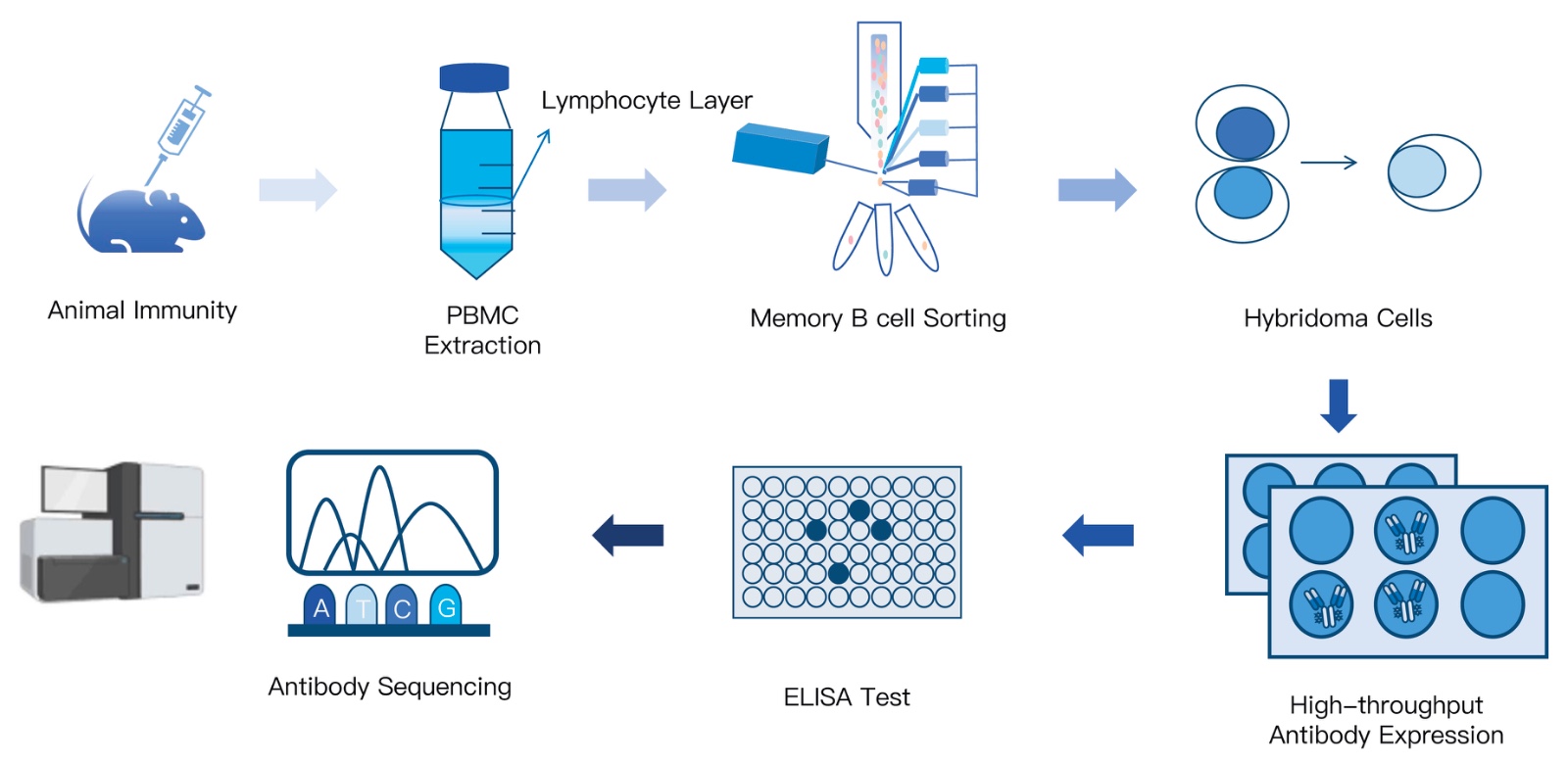
In our testing and daily operations, the workflow follows a precise sequence. First, peripheral blood mononuclear cells (PBMCs) or lymphoid tissues are harvested from the immunized host. Using specialized flow cytometry or micro-droplet technology, we isolate single memory B cells or plasma cells that bind to a specific fluorescently labeled target antigen. Once a single functional cell is isolated, reverse transcription-polymerase chain reaction (RT-PCR) is utilized to amplify the variable regions of the heavy and light chain genes (VH and VL). These genes are then cloned into expression vectors for rapid recombinant production and validation.
The 9 Advantages of Single B Cell Screening
When evaluating your discovery pipeline, you must look at the tangible return on investment. Here are the 9 distinct advantages of single B cell screening that dictate why the industry is migrating to this platform.
1. Drastically Reduced Discovery Timelines
Time is the most expensive commodity in biopharma. Traditional hybridoma generation takes 4 to 6 months of cellular fusion, limiting dilution, and prolonged culturing. One of the primary advantages of single B cell screening is that the entire process—from cell harvesting to obtaining sequence data and functional recombinant antibodies—can be completed in as little as 2 to 4 weeks. For commercial users racing to patent a therapeutic or respond to a viral outbreak, this speed is a massive commercial advantage.
2. Preservation of Native Heavy and Light Chain Pairing
In our testing, artificial libraries (like those used in standard phage display) often randomly shuffle heavy and light chains. While this creates immense diversity, it frequently results in antibodies with poor stability or manufacturability issues. Single B cell screening interrogates the cell directly, ensuring that the heavy and light chains you clone are the exact native pairs that the host's immune system naturally evolved. This drastically reduces aggregation issues during scale-up.
3. High Specificity and Picomolar Affinity
Because this technology isolates mature, affinity-matured B cells that have undergone in vivo somatic hypermutation, the resulting molecules are incredibly potent. The advantages of single B cell screening include bypassing the low-affinity binders often found in naive libraries. You are extracting the "best of the best" directly from the host's immune response, frequently yielding picomolar affinity out of the gate.
4. Exceptional Broad Species Compatibility
Hybridoma technology is largely restricted to mice and rats because stable myeloma fusion partners for other species are inefficient or non-existent. Single B cell screening requires no fusion partner. Therefore, it works flawlessly across diverse species. This is critical when sourcing specialized Antibodies from rabbits, chickens, dogs, or even humans. It is particularly essential for developing camelid nanobodies via our VHH Antibody Platform.
5. High-Throughput Processing Capabilities
Modern microfluidic devices and FACS instruments can sort millions of cells in a matter of hours. This high-throughput capability allows researchers to cast a massive net over the entire immune repertoire. Instead of settling for the few clones that happen to survive a chemical fusion process, you can systematically analyze the entire landscape of antigen-specific cells.
6. Access to Exceptionally Rare Epitopes
Some therapeutic targets (like GPCRs or ion channels) are notoriously difficult to generate antibodies against. The fusion efficiency of hybridoma is so low (often less than 0.1%) that rare B cells targeting unique epitopes are simply lost during the process. Single B cell screening captures these rare variants because every single antigen-positive cell is isolated and sequenced before it can die in culture.
7. Direct Recombinant Expression and Sequence Ownership
With hybridomas, you must keep cell lines alive, risking contamination, genetic drift, or sudden loss of secretion. With single B cell screening, you immediately obtain the DNA sequence. This means your antibody is instantly immortalized as digital data. You can synthetically construct and express it forever without worrying about fragile cell cultures.
8. Superior In Vivo Relevance and Developability
Because the antibodies discovered via this method have already survived the host organism's natural tolerance and quality control mechanisms, they inherently possess superior developability profiles. They are less likely to exhibit polyreactivity or auto-reactivity compared to synthetic library-derived molecules, making downstream Antibody Humanization Platform processes much smoother and more predictable.
9. Reduced Animal Usage and Ethical Advantages
For heavy-duty applications requiring massive antibody panels, traditional methods require immunizing and sacrificing large numbers of animals. Because single B cell technology is so highly efficient at extracting useful clones, significantly fewer animals are required to achieve the desired diversity. Furthermore, it allows for minimally invasive blood draws rather than sacrificing the animal for spleen harvesting, aligning with modern ethical guidelines in biotechnology.
Limitations and Challenges
We must use practical judgment here: this platform is not perfect for every scenario. The primary limitation is the high capital expenditure. The microfluidic equipment, single-cell sequencers, and specialized reagents require a massive upfront investment. Furthermore, the bioinformatics required to analyze thousands of heavy and light chain sequences demand specialized computational expertise. If your lab lacks next-generation sequencing (NGS) capabilities, implementing this workflow in-house will be exceedingly difficult and cost-prohibitive.
Who Should Use It & Who Does Not Need It
Who Should Use It: Pharmaceutical companies, biotech startups, and commercial diagnostic firms developing novel therapeutics. If you are targeting difficult transmembrane proteins, requiring unique species (like alpaca or rabbit), or operating under strict patent deadlines, you must utilize single B cell screening.
Who Does Not Need It: For beginners or academic researchers operating on a strict grant budget who simply need a basic anti-tag antibody for Western blotting, this technology is overkill. Traditional mouse hybridoma or purchasing off-the-shelf catalog antibodies is far more cost-effective for basic research applications.
Common Mistakes in Discovery
From our experience, the most catastrophic mistake clients make is utilizing poorly designed antigens. Single B cell sorting is highly precise; if you use a degraded or misfolded protein to sort your cells, you will perfectly isolate antibodies that bind to trash. You must use high-quality Proteins as your sorting bait. Another common error is failing to optimize the sorting gates on the flow cytometer, resulting in thousands of false positives and wasted sequencing costs.
Buying Considerations for CRO Services
When selecting a Contract Research Organization (CRO) to execute your discovery project, do not just look at the price. Ask about their recovery rates. A cheap CRO might sort the cells but fail at the single-cell RT-PCR step, leaving you with empty expression vectors. Ensure they offer seamless transition into recombinant production and humanization. Compare their capabilities directly against an alternative Phage Display Platform to ensure you are choosing the right methodology for your specific target.
Comparison & Pros/Cons Tables
Pros and Cons of Single B Cell Screening
| Pros | Cons |
|---|---|
| Unmatched speed (weeks instead of months). | High initial cost of specialized equipment and reagents. |
| Preserves natural heavy/light chain pairing. | Requires advanced bioinformatics for sequence analysis. |
| Highly efficient for rare epitopes and difficult targets. | Strict requirements for highly pure, fluorescently labeled antigens. |
| Immediate access to DNA sequences (no fragile cell lines to maintain). | Technically demanding single-cell RT-PCR steps. |
Comparison: Single B Cell vs Hybridoma vs Phage Display
| Parameter | Single B Cell Screening | Hybridoma Technology | Phage Display Library |
|---|---|---|---|
| Timeline | 2 - 4 Weeks | 4 - 6 Months | 4 - 8 Weeks |
| Species Compatibility | Any species | Mainly Mouse/Rat | Any species (synthetic) |
| Chain Pairing | Native (Natural) | Native (Natural) | Random / Artificial |
| Clone Yield / Efficiency | Very High | Very Low (Fusion loss) | High |
| In Vivo Developability | Excellent | Good | Variable (Requires optimization) |
Expert Recommendation
We recommend completely bypassing hybridoma generation for modern therapeutic discovery. The advantages of single B cell screening in terms of speed, diversity, and sequence ownership provide a definitive commercial edge. While the per-project cost may appear higher initially, the reduction in downstream failures during humanization and clinical scale-up makes it the most financially prudent choice for serious drug developers.
Single B Cell Screening Platform
KMD Bioscience offers an advanced single B cell screening platform, a next-generation antibody development technology that enables efficient and rapid isolation of specific antibodies from individual B cells. Compared to traditional hybridoma and phage display techniques, single B cell screening represents a significant breakthrough, offering advantages such as high specificity, high activity, and high affinity. Through this platform, we provide clients with monoclonal antibodies derived from various species (e.g., rabbit, mouse, camel, sheep, chicken, etc.), meeting diverse research needs.
Explore the Screening Platform
Frequently Asked Questions
What are the main advantages of single B cell screening over hybridoma?
The primary advantages are speed (weeks instead of months), the ability to use any host species (rabbits, camels, humans) since no fusion partner is required, and the preservation of exceptionally rare clones that typically die during the inefficient hybridoma fusion process.
Why is native heavy and light chain pairing important?
Native pairing ensures that the antibody maintains the exact structural conformation evolved by the host's immune system. Artificial pairing, often seen in phage display, can lead to unstable antibodies, poor solubility, and higher risks of aggregation during commercial manufacturing.
Can single B cell screening be used for human antibody discovery?
Yes. This is one of the most critical commercial applications of the technology. Because it does not require cellular fusion, researchers can take blood samples from human patients (e.g., those who have recovered from a virus) and isolate fully human therapeutic antibodies directly.
Is single B cell screening more expensive?
The upfront cost for single B cell screening is generally higher due to the advanced microfluidics and sequencing reagents required. However, because it drastically reduces the time to market and yields superior, more developable candidates, the overall cost of the drug development pipeline is significantly reduced.
Industry References & Authoritative Sources
To ensure our insights meet the highest standards of E-E-A-T, we base our protocols and technical evaluations on guidelines and data from leading biological authorities:
The Antibody Society: International non-profit association representing individuals and organizations involved in antibody-related research and development. Review Antibody Society Guidelines
National Center for Biotechnology Information (NCBI): Comprehensive database of peer-reviewed literature regarding single-cell transcriptomics and monoclonal antibody discovery methodologies. Review NCBI Publications
Nature Portfolio: Leading scientific journals detailing the latest breakthroughs in microfluidic isolation and next-generation sequencing for immunology. Review Nature Biotechnology Articles

- Protein Platform
- Protein Expression Services
- Protein Modification & Detection Services
- Protein Interaction Services
- Protein Purification Service
- Antibody Discovery Platform
- VHH Antibody Platform
- Phage Display Platform
- Antibody Humanization Platform
- Single B Cell Screening Platform
- Antibody Expression & Validation Platform
- Peptide Library Platform
- Custom Antibody Platform
- Innovative Drug Discovery Platform
- Product Center
- Proteins
- Antibodies
- Raw Materials Reagents
- Small Molecule Reagents
- Peptide Products
- Nanoparticle Products
- Contact Us
- Phone:400-621-6806
- Mobile:13110936064(WeC
- E-mail:[email protected]
- Address:Room 108, Building 10, No. 6 Hechang Road, Wuqing Development Zone, Tianjin City
-

WeChat
-

Service Account
-
 400-621-6806
 -
 3599163699
 -
 Monday to Friday 9:00-18:00
 -

-
 0
0
-
