


BioLayer Interferometry (BLI)
- 2026-07-10
- 327
The Octet platform is based on Bio-Layer Interferometry (BLI) technology for detecting and analyzing biomolecular interactions, and can be used to measure interactions between proteins and other biomolecules. This system requires only minimal sample volumes, eliminates the need for labeling, and provides real-time analysis of biomolecular interactions, thereby accelerating and streamlining research and production processes.
Experimental Principle:
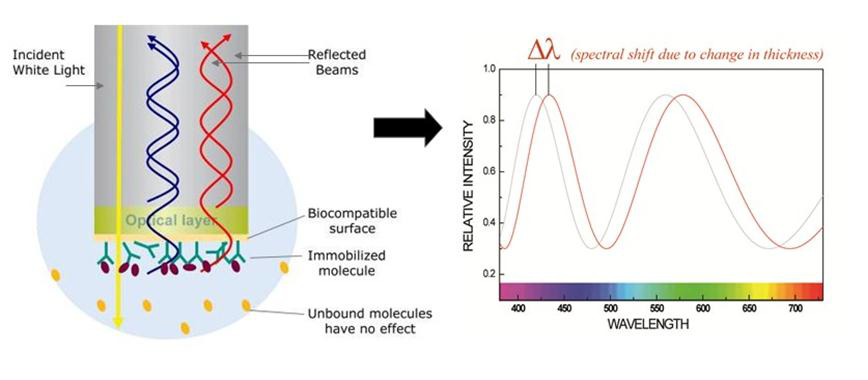
Bio-Layer Interferometry (BLI) is a technology that detects reactions on the sensor surface by measuring shifts in interference spectra. When a beam of visible light is emitted from the spectrometer, two reflected beams are generated at the interfaces of the optical coating on the sensor tip, forming an interference spectrum. Any changes in coating thickness or density caused by molecular binding or dissociation are reflected as shifts in the interference spectrum. These shifts are used to generate real-time interaction monitoring graphs (as shown in the figure below).
Operating Procedure:
The Octet platform enables qualitative and quantitative analysis of molecular interactions or concentration determination of target proteins in mixed samples.
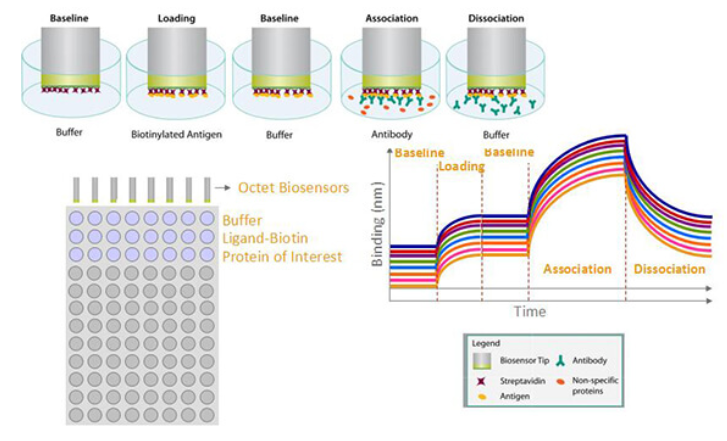
● Qualitative and quantitative analysis of protein interactions: Each operational step generates corresponding binding curves, including:
● Quantitative determination of the sample concentration in a protein mixture is performed by first measuring the standards to generate a standard curve, followed by measuring the test samples. The obtained data is then interpolated into the standard curve, allowing the sample concentration to be accurately determined based on the standard curve.
Detection range:
| Testing content | |
| Testable samples | *Protein-Protein *Protein-Small Molecule |
| Measurable data | *Affinity Assay |
Advantages and Features:
Comparison between the BLI method and traditional co-immunoprecipitation:
● Real-time kinetic data measurement: Enables real-time detection of interaction kinetics between molecules, allowing the observation of transient molecular interactions.
● Higher throughput and faster experimental workflow.
● Broader application scope: Direct detection of crude samples, even those containing insoluble components. Tolerates various solution conditions, as only molecules bound to the sensor surface are detected. Kinetic results can also be obtained for large molecular samples, such as viral particles.
● Accurate results: Precise quantitative analysis with kinetic parameters to extract more biological insights.
Kamede Biotech provides clients with accurate and rapid affinity determination services based on the ForteBio Octet platform. Combined with the company's extensive in-house product pipeline, we are capable of conducting qualitative and quantitative analyses of interactions involving proteins, antibodies, and Fab fragments.Utilizing Bio-Layer Interferometry (BLI) technology, our label-free approach enables real-time quantitative testing. With the highly sensitive and precise ForteBio biosensors, we ensure that the detection results are accurate, objective, and reliable.
- Molecular interaction studies
- BioLayer Interferometry (BLI)
- Affinity measurement services
- ForteBio Octet platform

- Protein Platform
- Protein Expression Services
- Protein Modification & Detection Services
- Protein Interaction Services
- Protein Purification Service
- Antibody Discovery Platform
- VHH Antibody Platform
- Phage Display Platform
- Antibody Humanization Platform
- Single B Cell Screening Platform
- Antibody Expression & Validation Platform
- Peptide Library Platform
- Custom Antibody Platform
- Innovative Drug Discovery Platform
- Product Center
- Proteins
- Antibodies
- Raw Materials Reagents
- Small Molecule Reagents
- Peptide Products
- Nanoparticle Products
- Contact Us
- Phone:400-621-6806
- Mobile:13110936064(WeC
- E-mail:[email protected]
- Address:Room 108, Building 10, No. 6 Hechang Road, Wuqing Development Zone, Tianjin City
-

WeChat
-

Service Account
-
 400-621-6806
 -
 3599163699
 -
 Monday to Friday 9:00-18:00
 -

-
 0
0
-
