


Principles and Methods of ELISA Detection
- 2026-07-10
- 317
Enzyme-Linked Immunosorbent Assay (ELISA) refers to an immunochemical qualitative and quantitative detection method that involves binding soluble antigens or antibodies to a solid-phase carrier (such as polystyrene) and utilizing the specificity of antigen-antibody binding for immune reactions. It is one of the most widely used immunoenzyme techniques. ELISA kits (ELISA Kits) have become a common diagnostic tool in pharmaceutical and plant pathology research, serving as an ideal means for detecting target antibodies/antigens in tissue extracts, serum, and cell culture supernatants, as well as an important quality control measure.
1. Main Experimental Principles:
Coating: Antigens or antibodies can physically adsorb onto the surface of a solid-phase carrier due to hydrophobic interactions between proteins and the polystyrene surface. After adsorption, they retain their immunoreactivity, such as antigen-antibody binding capability.
Labeling: Antigens or antibodies can be covalently linked to enzymes, forming enzyme conjugates. These conjugates retain both their immunoreactivity and the catalytic properties of the enzyme.
Color Development: Once the enzyme conjugate binds to the corresponding antigen or antibody coated on the solid-phase carrier, it becomes immobilized on the carrier. Upon adding the enzyme’s substrate, a colorimetric reaction occurs. The relative concentration of the antigen or antibody can be quantified based on the intensity of the color reaction.
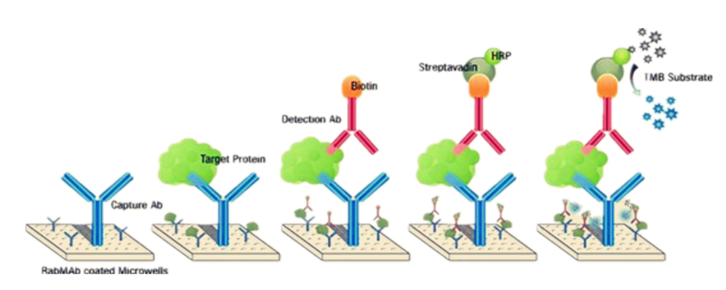
Fig.1 Principle of ELISA assay method
2. ELISA Detection Methods:
Double Antibody Sandwich Assay
The double antibody sandwich assay is commonly used for the detection of antigens, proteins, and other targets. It is named as such because the target is "sandwiched" between a capture antibody coated on the plate and a detection antibody. Generally, it can be divided into two types: the double antibody sandwich method and the double antigen sandwich method. The former is used to detect antigens, while the latter is used to detect antibodies. Compared to indirect methods, this assay offers superior sensitivity and specificity. It is primarily designed for multivalent antigens with at least two antigenic determinants.
In clinical practice, there are many multivalent antigens with two antigenic determinants. Common examples include large-molecular-weight antigens such as HBsAg, AFP, and HCG.The detection procedure is as follows: First, the purified corresponding antibody is coated onto a solid-phase carrier. Then, the test sample is added—if it contains the target antigen, the antigen will bind to the solid-phase antibody. After washing away impurities, an enzyme-labeled detection antibody is added for reaction. Following another wash to remove any unbound enzyme-labeled antibody, a substrate is added for color development. The presence or absence of color, as well as its intensity, indicates the presence and relative concentration of the target antigen.
Competitive ELISA
The competitive ELISA is generally used to detect small-molecule antigens. Small-molecule antigens or haptens lack two or more binding sites required for a sandwich assay, making it impossible for them to simultaneously bind to two antibodies. Therefore, the sandwich method cannot be used, and the competitive format is adopted instead. This technique is commonly applied for detecting small molecules, IgA, IgG, IgM, and similar targets.The principle of antigen detection in this method is based on competition: the antigen in the sample competes with a fixed amount of enzyme-labeled antigen for binding to the solid-phase antibody. The higher the concentration of antigen in the sample, the less enzyme-labeled antigen binds to the solid phase, resulting in weaker final color development.
Indirect Method
The indirect method is the most commonly used and simplest technique for detecting antibodies. Its principle involves using enzyme-labeled anti-antibodies to detect the target antibodies that have already bound to solid-phase antigens, hence the name "indirect method." This method has several characteristics:
1. Enzyme-labeled anti-antibodies can selectively detect specific antibody subtypes, which helps distinguish different stages of infection.
2. However, the detection of antibodies using enzyme-labeled anti-antibodies lacks high specificity and may lead to false-positive results.
In clinical practice, this method is widely used to detect antibodies such as anti-HCV, anti-HEV, anti-CMV, anti-HSV, and anti-Chlamydia trachomatis antibodies.
3. Scope of Application:
| ELISA Test Content |
| Macromolecules (peptides, etc.),Small molecules (pesticides, antibiotics, metabolites, etc.) |
Detection of animal and plant disease |
| Serum protein concentration |
| Medical diagnostics |
| Food safety testing |
KMD Bioscience has been dedicated to the research of immunoassay products and technologies for many years. Our team of scientific experts possesses extensive research experience and utilizes mature technologies to efficiently complete ELISA experiments, ensuring the acquisition of highly sensitive and accurate data within a short timeframe. This not only saves you time and costs but also prevents reagent and sample wastage caused by a lack of assay experience and technical expertise.Additionally, KMD Bioscience offers tailored service solutions based on clients' ELISA detection requirements, providing comprehensive, high-quality one-stop technical services, including ELISA development, outsourced testing, and result analysis.
- ELISA Testing Services
- Competitive Method Detection
- Double Antibody Sandwich Method Detection Principle
- ELISA Indirect Method Detection

- Protein Platform
- Protein Expression Services
- Protein Modification & Detection Services
- Protein Interaction Services
- Protein Purification Service
- Antibody Discovery Platform
- VHH Antibody Platform
- Phage Display Platform
- Antibody Humanization Platform
- Single B Cell Screening Platform
- Antibody Expression & Validation Platform
- Peptide Library Platform
- Custom Antibody Platform
- Innovative Drug Discovery Platform
- Product Center
- Proteins
- Antibodies
- Raw Materials Reagents
- Small Molecule Reagents
- Peptide Products
- Nanoparticle Products
- Contact Us
- Phone:400-621-6806
- Mobile:13110936064(WeC
- E-mail:[email protected]
- Address:Room 108, Building 10, No. 6 Hechang Road, Wuqing Development Zone, Tianjin City
-

WeChat
-

Service Account
-
 400-621-6806
-
 3599163699
-
 Monday to Friday 9:00-18:00
-

-
 0
-
