


Introduction to the Preparation of Single B Cell Antibodies from Alpacas
- 2026-07-08
- 423
1.Principle of Alpaca Single B Cell Technology
Alpacas produce two types of antibodies: (i) conventional antibodies composed of heavy and light chain dimers, and (ii) a class of antibodies that consist solely of heavy chains without light chains, known as heavy-chain antibodies (hcAbs). As shown in Figure 1-D, alpaca heavy-chain antibodies lack light chains and are composed of four heavy constant domains (HC) and two variable heavy domains (VH). The VH region is also referred to as a nanobody or single-domain antibody (sdAb).Compared to traditional antibodies, alpaca antibodies offer numerous advantages, including high stability, ease of genetic engineering, low immunogenicity, strong specificity, high affinity, and high expression yields in both eukaryotic and prokaryotic systems. Additionally, due to their high sequence similarity to human antibody heavy chains, alpaca antibodies are more amenable to humanization, making them widely applicable in current antibody drug research.
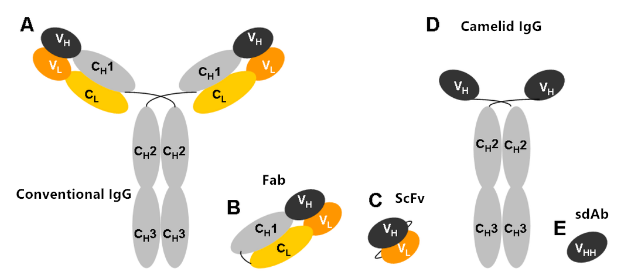
Figure 1 A. Conventional IgG;B. Fab fragment of a conventional antibody;C. Single-chain Fv (scFv) fragment of a conventional antibody;D. Heavy-chain antibody (hcAb) or camelid antibody;E. VH region of a camelid antibody, also known as a single-domain antibody (sdAb).
Single B Cell Antibody Production Technology is a novel antibody development approach that has emerged in recent years. KMD Bioscience utilizes this technology to isolate lymphocytes from alpaca peripheral blood or immune organs, then identifies and sorts specific B cells through cell sorting techniques. These selected B cells are cultured at the single-cell level, and the specificity of the antibodies they secrete is determined using reverse transcription polymerase chain reaction (RT-PCR) and antibody-specific primers.The target antibody genes are amplified via PCR, cloned into expression vectors, and expressed in designated systems. The purified antibodies are then validated for expression using methods such as ELISA. Thanks to this advanced single B cell antibody production platform, KMD Bioscience delivers high-quality antibodies with exceptional success rates.
2. Antibody Production Process Using Alpaca Single B Cell Technology
① Antigen Preparation. Hapten modification or complete antigen preparation.
② Animal Immunization. Antigen emulsification, immunizing alpaca 4-5 times; ELISA titer determination; antiserum collection.
③ B Cell Enrichment and Screening. PBMC isolation; FACS Assay, ELISA Assay.
④ B Cell Antibody Sequencing. Select at least 20 positive cell clones for RT-PCR to amplify their antibody variable region genes, followed by high-throughput sequencing.
⑤ Vector Construction and Antibody Expression/Purification. Small-scale or large-scale antibody transfection.
3. Advantages of Single B Cell Monoclonal Antibody Preparation
| Categories | Single B Cell Technology | Hybridoma Technology | Phage Display Technology |
| Antibodies | Natural | Natural | Not natural |
| Antibody Affinity | High | High | Medium |
| Drugability | High | High | Low |
| Timeline | 16~20 weeks, with optional rapid immunization | 20~26 weeks, with optional rapid immunization | 16~20 weeks, with optional rapid immunization |
| Antibody Gene Sequences | Get it directly | Requires further sequencing | Get it directly |
| Antibody Diversity | High | Medium | Medium |
| Supported Species for Screening | No restrictions on species | Rat, Rabbit | No restrictions on species |
The single B cell technology enables rapid monoclonal antibody production by leveraging the characteristics of B cells, directly yielding complete antibodies from a single source. This method is species-independent, highly efficient, and offers superior specificity, affinity, and developability. It provides excellent genetic diversity, fully natural origin, and allows direct acquisition of antibody gene sequences.
4. Applications of Alpaca Single B-Cell Antibodies
Alpaca single B-cell-derived monoclonal antibodies (mAbs) are widely utilized in the following four key areas:
① Drug Development – These antibodies can be applied in novel drug discovery, particularly showing great potential in the field of cancer therapeutics.
② Vaccine Development – Alpaca single B-cell mAbs can enhance vaccine efficacy and specificity.
③ Immunotherapy – They are applicable in immunotherapies, offering more personalized treatment options for patients.
④ Basic Medical Research – Due to their high specificity and diversity, these antibodies are valuable tools for elucidating biological processes and disease mechanisms.
KMD Bioscience, with its professional technical team and state-of-the-art laboratory facilities, is committed to providing high-quality alpaca single B-cell monoclonal antibody (mAb) production services. Leveraging cutting-edge technologies and precise experimental procedures, we tailor experimental designs to meet specific client requirements, ensuring the generation of high-affinity and highly specific monoclonal antibodies.Alpaca single B-cell-derived mAbs exhibit miniaturized size, superior binding affinity, and enhanced stability, making them ideal for diverse applications in biopharmaceuticals and life sciences, including immunohistochemistry (IHC), Western blotting (WB), and immunoprecipitation (IP).As your trusted partner, we offer customized solutions to support your research projects and industrial applications, helping you achieve breakthrough scientific outcomes and commercial success.
- Alpaca Single B Cell Antibody Preparation Service
- Alpaca Antibody
- Camelid Monoclonal Antibody Customization
- Single B Cell

- Protein Platform
- Protein Expression Services
- Protein Modification & Detection Services
- Protein Interaction Services
- Protein Purification Service
- Antibody Discovery Platform
- VHH Antibody Platform
- Phage Display Platform
- Antibody Humanization Platform
- Single B Cell Screening Platform
- Antibody Expression & Validation Platform
- Peptide Library Platform
- Custom Antibody Platform
- Innovative Drug Discovery Platform
- Product Center
- Proteins
- Antibodies
- Raw Materials Reagents
- Small Molecule Reagents
- Peptide Products
- Nanoparticle Products
- Contact Us
- Phone:400-621-6806
- Mobile:13110936064(WeC
- E-mail:[email protected]
- Address:Room 108, Building 10, No. 6 Hechang Road, Wuqing Development Zone, Tianjin City
-

WeChat
-

Service Account
-
 400-621-6806
 -
 3599163699
 -
 Monday to Friday 9:00-18:00
 -

-
 0
0
-
