


Verification of Protein Expression and Purification in Prokaryotes
- 2026-07-09
- 209
I. Principles of Inducible Expression in Prokaryotes
Once the repressor protein produced by lacI-expressing cells binds to the lac operon, it can no longer affect the transcription and expression of external genes, thereby ensuring the healthy growth of the host cell. IPTG is also an intermediate substance that can bind to hydrolyzed lactose. Although it cannot be assimilated by the cell, it can bind to the repressor protein, thereby allowing the cell to control the high-level transcription and efficient expression of the exogenous gene.
II. Optimization Strategies for Induced Expression
1. Enhancing Protein Solubility and Folding: High temperatures can cause proteins to aggregate and form inclusions; therefore, low-temperature induction can be selected.
2. Enhancing Translation Levels: Adjust the distance between the start codon (SD) sequence and AUG; introduce point mutations to alter nucleotides; and increase mRNA stability.
3. Reducing the Metabolic Burden on Cells and Increasing Expression Levels: Separate bacterial growth from the induced expression of exogenous genes; use chemical or temperature-based induction methods.
4. Optimize rare codons: Most amino acids have more than one codon. When mRNA from a heterologous target gene is abnormally expressed, the abundance of tRNAs directly reflects codon preference; the rarity or absence of one or more tRNAs can lead to translation arrest.
III. Experimental Protocol for Induced Expression of Recombinant Proteins
1. Digest the vector DNA and the target gene with appropriate restriction enzymes.
2. Ligate the target gene to the vector according to the ligation protocol, and transform the resulting construct into DH5α competent cells.
3. Pick positive colonies and inoculate them into 5 mL of LB medium (0.1 g/L ampicillin), then incubate overnight at 37°C.
4. Transfer 2% (v/v) of the culture to 2 mL of LB (0.1 g/L ampicillin) and continue culturing at 37°C for 2.5 hours until the bacteria reach the logarithmic growth phase. Add 2 µL of 0.1 mmol/L IPTG to induce expression for 3–4 hours; simultaneously, set up a control culture without IPTG induction.
5. Take 1 mL of the bacterial culture, centrifuge at 12,000 rpm for 10 minutes, and collect the bacterial pellet.
6. Resuspend the pellet in 100 µL of ice-cold PBS and add PMSF to a final concentration of 10 mmol/L. Mix thoroughly on a shaker, add 2× sample buffer, boil for 10 minutes to denature the proteins, and centrifuge at 12,000 rpm for 10 minutes.
7. Perform SDS-PAGE electrophoresis analysis on 10 µL samples taken before and after induction.
IV. Verification of Protein Expression and Purification Results via SDS-PAGE
1. Principle of SDS-PAGE:
The speed at which charged particles migrate in an electric field is directly proportional to the electric field strength and the net charge of the particles, and inversely proportional to the particle radius (molecular weight and structure) and the viscosity of the medium. If the sample is a mixture of proteins, the number of atoms at the isoelectric point varies among the different proteins, resulting in distinct electrophoretic bands during electrophoresis.
2. Experimental Procedure:
(1) Gel Preparation: Prepare the separating gel by mixing 4.0 mL of ddH₂O, 3.3 mL of 30% gel stock, 2.5 mL of 1.5 M Tris-HCl, 0.1 mL of 10% SDS, and 0.1 mL of 10% APS. After measuring 1 mL of the above mixture, seal the bottom with 10 μL of TEMED (N,N,N',N'-tetramethylenediamine). Mix the remaining volume thoroughly, then cover the top with a glass plate filled with a 20% ethanol solution. Ensure the liquid level is level. Prepare the concentration gel using 1.4 mL of ddH₂O, 0.33 mL of 30% gel stock, 0.25 mL of 1 M Tris-HCl, 0.02 mL of 10% SDS, 0.02 mL of 10% APS, and 2 μL of TEMED. After removing or separating the water from the gel, pour the mixture back in, then quickly place the comb into the glass to allow for thorough polymerization, which takes approximately 15–30 minutes.
(2) Sample Loading and Electrophoresis: Add a specified amount of 2× SDS buffer to the sample, heat for 3–5 minutes, centrifuge at 12,000 g for 1 minute, and then collect the supernatant for SDS-polyacrylamide gel electrophoresis. Load 10 μL of induced and uninduced samples into the sample wells, and add protein markers to adjacent lanes. Pour the electrophoresis buffer into the gel chamber and turn on the power. The voltage for the concentrating gel is approximately 80 V, while the voltage for the separating gel is 120 V. The electrophoresis is complete when the bromophenol blue reaches the bottom of the gel.
(3) Protein Staining and Decolorization: Remove the gel from the glass plate and stain it with Coomassie Brilliant Blue solution at room temperature for 4–6 hours. After staining, remove the gel from the staining solution and place it in the destaining solution. Destain the gel repeatedly until the protein bands are clearly visible.
(4) Image Capture and Gel Preservation: In image processing mode, capture an image of the destained gel and save the result on a computer. The gel can be preserved in double-distilled water.
3. Common Problems and Solutions for SDS-PAGE:
Frequently Asked Questions | Causes | Solution |
Striped Trail | Excessive gel concentration / Poor sample dissolution | Centrifuge and shake the samples; prepare the electrophoresis buffer immediately before use; reduce the gel concentration |
Concave in the middle, curved upward on both sides | The gel has set unevenly in the middle | Handle only after it has fully set |
Convex in the middle, concave on both sides | There are air bubbles on the underside of the panels | Add an appropriate amount of buffer to remove air bubbles |
Thick stripes | Not concentrated properly | Increase the length of the concentration column as appropriate; ensure the voltage remains stable; ensure the pH of the storage solution is correct. |
There is a precipitate at the bottom of the sample well. | The inactivation of the reducing agent causes protein molecules to aggregate into large molecules. | Add an appropriate amount of DTT or β-mercaptoethanol; add EDTA to prevent oxidation of the reducing agent. |
Textures appear | The sample contains insoluble particles. | Add solvent/Centrifuge before adding the sample |
4. Results:
SDS-PAGE results for a 43 kDa fusion protein before and after prokaryotic-induced expression:
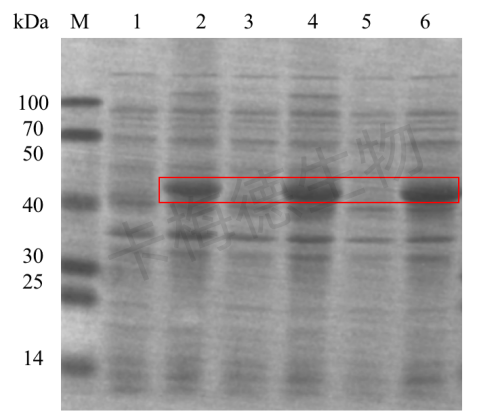
M: Protein marker; Lanes 1, 3, 5: Three monoclonal strains before induction; Lanes 2, 4, 6: Three monoclonal strains after induction
V. Applications of Electrophoresis Technology:
1. Clinical Medicine: Electrophoresis technology plays a vital role in clinical diagnosis, providing new methods for detecting isoenzymes, various proteins, and other substances.
2. Biopharmaceuticals, Drug Screening, and Analysis: Analysis of drugs and their metabolites in biological samples, analysis of drug impurities, and analysis of key components.
3. Food Safety and Microbial Identification: Sample bands can reflect community similarities among different samples; when used in conjunction with time-of-flight mass spectrometry and electrochemical detectors, they enhance the reliability of trace detection.
4. Agricultural and Livestock Production: It can be used in various aspects, including the identification of hybrid offspring, kinship analysis, and genetic mapping.
KMD Bioscience possesses a rich library of prokaryotic expression vectors and a variety of expression strains. Drawing on technical expertise gained from over 400 prokaryotic protein production projects annually, we can design a complete protein expression and purification protocol in a short period of time—requiring only a protein sequence, CDS, or protein name from the client—to provide high-quality protein products that help advance your experimental progress.
- Induced Expression Analysis
- Purification and Characterization
- SDS-PAGE

- Protein Platform
- Protein Expression Services
- Protein Modification & Detection Services
- Protein Interaction Services
- Protein Purification Service
- Antibody Discovery Platform
- VHH Antibody Platform
- Phage Display Platform
- Antibody Humanization Platform
- Single B Cell Screening Platform
- Antibody Expression & Validation Platform
- Peptide Library Platform
- Custom Antibody Platform
- Innovative Drug Discovery Platform
- Product Center
- Proteins
- Antibodies
- Raw Materials Reagents
- Small Molecule Reagents
- Peptide Products
- Nanoparticle Products
- Contact Us
- Phone:400-621-6806
- Mobile:13110936064(WeC
- E-mail:[email protected]
- Address:Room 108, Building 10, No. 6 Hechang Road, Wuqing Development Zone, Tianjin City
-

WeChat
-

Service Account
-
 400-621-6806
 -
 3599163699
 -
 Monday to Friday 9:00-18:00
 -

-
 0
0
-
